


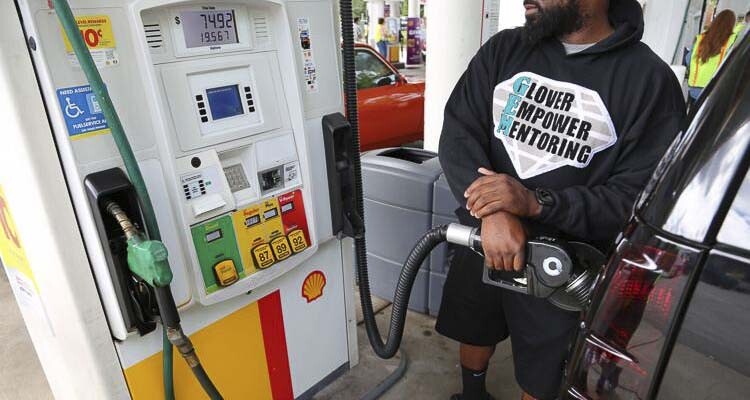
Rep. Jim Walsh wants to get rid of, or at least modify, the carbon tax to provide relief to drivers impacted by high fuel prices.
Brett Davis
The Center Square Washington
State Rep. Jim Walsh, R-Aberdeen, is urging legislative action to lower the price at the pump for Washington motorists paying the second-highest gas prices in the nation, including scrapping or modifying the state’s carbon tax.
On Jan. 1, the state’s cap-and-trade program went into effect. The program, part of the Climate Commitment Act passed by the Legislature in 2021, sets a cap on greenhouse gas emissions and implements a trading market similar to the stock market for allowing polluters to purchase “emissions allowances” equal to their covered greenhouse gas emissions.
The carbon tax is partially responsible for high gas prices, according to Walsh.
“In my district, and all around the state, rising fuel costs are forcing working people and families to make tough financial decisions, like whether to buy groceries or a tank of gas,” he said in a Thursday news release. “Food banks report that more people need their help because the cap-and-trade scheme has increased fuel costs, leaving individuals and families unable to buy food.”
Walsh wants to get rid of, or at least modify, the carbon tax to provide relief to drivers impacted by high fuel prices.
“In my opinion, the cap-and-trade scheme needs to be repealed entirely,” Walsh said. “It’s inflicting too much suffering on working families and people living on fixed incomes. But several other proposals are also worth considering. Sen. Mark Mullet has proposed a system of caps on the prices of pollution allowances the state sells as part of the cap-and-trade program. Rep. April Connors has proposed a series of rebates for people affected by rising fuel costs.”
He continued, “I know Sen. Mullet recently called for legislative action on rising fuel costs, making this request bipartisan. Once again, I ask legislative leaders to discuss and implement some version of these proposals and get relief to Washingtonians as quickly as possible.”
Walsh took a shot at Gov. Jay Inslee, whose signature issue is climate change, in the news release.
“While the governor visits New York to meet with ‘international leaders for climate and economic discussions,’ working families here in Washington state are paying $5.04 a gallon or more for gas,” he said. “Diesel prices are even higher. This directly results from the wretched cap-and-trade tax scheme that financially burdens working people and families.”
On Friday morning, Inslee and New York Gov. Kathy Hochul, Main Gov. Janet Mills and White House National Climate Advisor Ali Zaidi hosted a press conference in New York City regarding new commitments to install a total of 20 million heat pumps in their states by the end of the decade.
The press conference was part of Climate Week, an annual summit put on by the U.S. Climate Alliance that takes place alongside the U.N. General Assembly and brings together international leaders from business, government and civil society on the issue of climate change.
The Center Square reached out to the governor’s office for comment on what Walsh had to say in his news release.
“It’s just another example of politicians doing the bidding of fossil fuel interests, which are enjoying record profits on the backs of consumers while burdening their communities with pollution and climate change,” Mike Faulk, Inslee’s spokesperson, said in an email to The Center Square.
He defended the governor’s appearance at Climate Week.
“Earlier today the governor announced a joint effort with dozens of other states and the Biden administration to quadruple heat pump installations in the coming years,” Faulk said. “That means helping families get efficient heating/cooling systems while also slashing the carbon emissions polluting their communities.”
Faulk also defended the utility of the Climate Commitment Act.
“It’s one of many ways Climate Commitment Act dollars are being used to help working families and communities,” he said. “CCA funding goes right back into communities – it has already helped transit agencies provide free transit for youth under 18, and is speeding up all our efforts to help more people access fossil-fuel-free options like heat pumps, solar panels and electric cars; attracting clean energy jobs; slashing air pollution in overburdened communities; and more of the necessary work to transition away from the dirtiest products on the planet.”
This report was first published by The Center Square Washington.
Also read:
- Opinion: Portland’s War on Cars Part 4 – A smarter automobile strategy to end gridlock
 O’Toole argues fuel wasted in Portland-area congestion has sextupled since 1982, generating 250,000 tons of extra greenhouse gases annually.
 - Opinion: Transit ridership trends are dismal but regional plans are oblivious
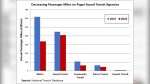 Puget Sound transit passenger-miles fell 31% from 2015 to 2024 despite a half-million-resident population increase.
 - Interstate Bridge Replacement Program seeks qualified firms for bridge replacement contract
 The CRBR project is backed by $5.7 billion from state funds, federal grants, and future tolling.
 - Opinion: Bankrupt – A $3.5 billion Rose Quarter Freeway widening project
 Joe Cortright argues ODOT’s Rose Quarter project has grown from a $450M approval to a $3.5B estimate, with a $2B funding gap.
 - Opinion: Portland’s War on Cars 3 – Ending the war on automobiles
 O’Toole argues Portland should add toll lanes, fix safety hazards, and redesign TriMet routes to end its anti-auto policies.