



As of July 25, the monthly rolling average for streamflow in vast portions of Washington is below the 10th percentile when compared to those historical averages
Timothy Schumann
The Center Square Washington
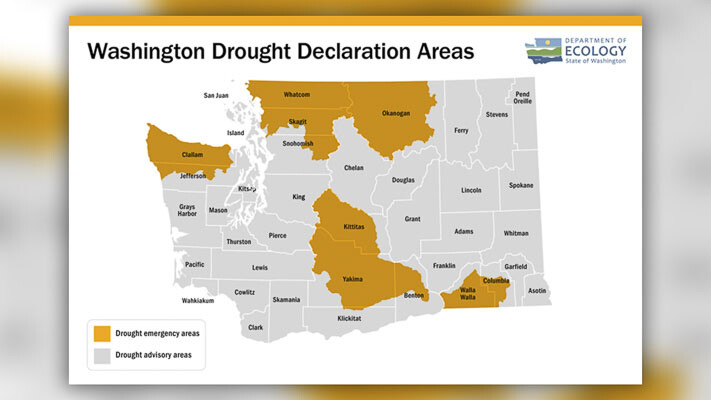
In a presentation to the Joint Legislative Committee on Water Supply During Drought, representatives from the Department of Ecology went over what led to the recent drought declaration and what the corresponding $3 million in grant funding means for communities.
“A main one is that we look at water supply seasonal forecasts. What is the volume of runoff expected, especially for that April through September period, which in our state is when water supply challenges are likely to arise?” asked Jeff Marti, Drought Coordinator for the Department of Ecology’s Water Resources Division, during Monday’s committee meeting.
Marti went on to explain that there are 62 watersheds defined within the state, also known as Water Resource Inventory Area or WRIA’s.
The watersheds themselves are not bound by borders, either regional or international. They follow the flow of water and snowmelt, with some passing through state lines and even up into large portions of Canada.
“We declared [a drought] in 12 out of the 62 WRIA’s throughout the state, and they happened to be located in 12 counties,” explained Marti.
He went on to describe the conditions that lead to the drought declaration, noting that as of the beginning of May statewide snowpack was near the 100th percentile of historical norms.
By the end of May, those numbers were looking much worse, with many of the WRIA’s where the drought was declared being below the 50th percentile of historical norms.
“We had really rapid snowmelt this year because May was an extraordinarily warm May,” said Marti, noting the month tied 1958 for the warmest May, based on temperature records going back to 1895.
As of July 25, the monthly rolling average for streamflow in vast portions of Washington is below the 10th percentile when compared to those historical averages. Three watersheds even set historical records for lowest flows ever recorded.
“About 75 percent of our stream gauges are either below normal or worse as of today,” said Marti, signifying a flow rate of 25% or less than historical averages.
These numbers line up with projections from the Office of the Washington State Climatologist, showing stream flow in May well above historical averages, and the surrounding months significantly below average.
The presentation went on to highlight what new laws mean for this drought declaration.
“This year, we were really fortunate,” said Dave Christensen, Deputy Program Manager for the Department of Ecology Water Resources Division before going on to discuss House Bill 1138, signed into law by Gov. Jay Inslee on May 4.
“The bill provided, automatically, funding to Ecology upon the declaration of a drought even if that declaration occurred after the Legislature was out of session,” added Christensen, citing examples from prior years where this was not the case.
The new law went into effect on July 23.
“We have in this year’s biennial budget, $2 million for drought planning, preparedness, and climate resiliency,” he added, noting the Department of Ecology is getting that funding out later this year to prepare for next year’s drought season.
Along with this came an additional $3 million in grant funding available immediately upon declaration of a drought.
These funds are available to a variety of governmental organizations, but will require a 50% match from local sources. Projects must provide benefits and start during the declared drought period, but they do not have to be completed during the drought declaration.
The lone exception to the 50% match are public water systems in disadvantaged communities, which can request a waiver if eligible.
Drought conditions were declared by the Department of Ecology on July 24.
This report was first published by The Center Square Washington.
Also read:
- Fiscal fallout: $375 million bond debt indirectly funding operating budget
 Shifting $375 million from a loan fund impacts local infrastructure as Washington state covers operating costs with bond debt, prompting concern among officials and advocacy groups.
 - Lawsuit aims to block new eligibility requirements for WA sheriffs
 Four sheriffs are suing over a state law that sets new eligibility rules, arguing it undermines voter authority by allowing removal for certification issues.
 - Opinion: The growing gap between public voice and political power
 Todd Myers describes how large-scale protest and sign-ins often fail to sway state leaders, and argues authentic influence is most likely found through local action.
 - City of Battle Ground seeks applicants for Salary Commission vacancy
 Battle Ground seeks a resident to join its independent Salary Commission, which reviews compensation and health benefits for local elected officials through 2027.
 - Opinion: Who is winning the race for affordable power?
 Hydroelectric power keeps Washington competitive, but new laws and carbon pricing are driving up electricity costs for residents each year.
 - Vancouver Fire Department assists with Columbia River Marina fire response
 Vancouver Fire Department joined Clark-Cowlitz and Scappoose crews to help fight a vessel and dock fire at Goble Marina, assisting in river operations where one boat sank and another was partially submerged.
 - White House govt. Funding request for 2027 cuts $73 billion
 President Trump’s budget seeks to boost defense funding while cutting $73 billion from agencies like the EPA, NASA, and Agriculture, prompting sharp criticism from Democratic leaders.
