



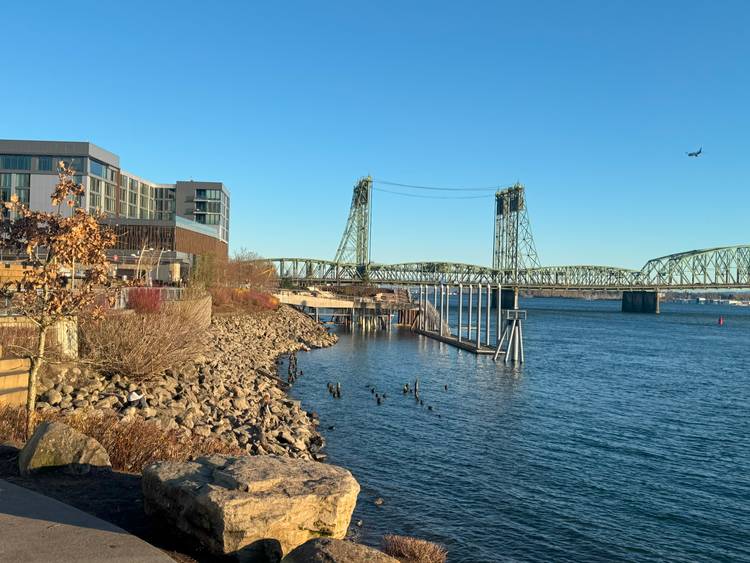
While most understood that Vancouver was going to get two stops on the proposed extension of light rail into Clark County, the Interstate Bridge Replacement Program announced that there will only be one light rail stop in Vancouver, at the waterfront, in the first phase of the project
Paul Valencia
Clark County Today
A 48-second statement that the mayor of Vancouver made to the Regional Transportation Council (RTC) on Tuesday regarding light rail stunned at least one member of that commission and surprised at least one member of the C-TRAN Board of Directors.
Late in Tuesday’s RTC meeting, Vancouver Mayor Anne McEnerny-Ogle said that she expects to return in May to this council with a formal request.
“The Vancouver City Council is going to recommend that the core elements extend LRT (light rail transit) beyond the waterfront 70-foot elevator and connect it to C-TRAN’s current and planned bus system at Library Square,” McEnerny-Ogle said, emphasizing the word planned.
“We would like to bring that conversation back to this body. We feel that it is absolutely essential that instead of light rail coming to a stop that it comes to a station where C-TRAN buses can help individuals transition from a bus to the light rail and not an elevator. So we would like to bring that back in May.”
Her statement raised eyebrows from some who have always believed that if light rail is to become part of the new Interstate Bridge, there would be two stops in Vancouver — one at the waterfront, high up on the bridge, and the other stop near Evergreen Boulevard, at Library Square.
The mayor’s comment seemed to indicate that there was a new plan.
It turns out, the mayor, in a way, was giving a counter proposal to the Interstate Bridge Replacement Program (IBR).
While it did not receive much publicity last month, the IBR is now saying that light rail will, at least temporarily, only extend to the waterfront.
If you recall, a couple weeks back, the governor, the mayor, IBR officials, and others associated with the project were claiming victory. Gov. Bob Ferguson even gave a timeline for when construction on the new bridge would begin.
Interestingly, at the same time the IBR team released the latest cost estimates that could exceed $14 billion for the entire project, the governor’s press conference highlighted a smaller number: $7.65 billion. That is because the smaller number only targeted the new bridge and a few other parts of the project around the bridge — not the entire 5-mile corridor that the IBR has been working on for years. In the new plan, with the $7.65 billion tag, light rail would end at the waterfront — or high above the waterfront, a stop that would require at least a 70-foot tall elevator and a long spiral walkway for commuters to go from the ground to the trains.
Next week, members the Vancouver City Council will be voting on a resolution that concludes:
“The Vancouver City Council strongly recommends that LRT extend beyond the planned
Waterfront Station and connect with C-TRAN’s existing and planned bus system at a multimodal hub by Evergreen Boulevard near Library Square to achieve the stated purpose and needs of the IBR Program.”
The IBR did confirm with Clark County Today that a phasing plan is in the works now, with the hopes of completing the five-mile program in the future.
“These core projects must be completed first before we can build other elements in the corridor,” according to a statement from the IBR team. “As we shared in the cost estimate update presentation and on our cost estimate page, the core set of projects includes:
- Replacement Columbia River Bridge
- Bridge connections to I-5
- Extension of light rail to Waterfront Station in Vancouver
- Removal of existing bridge
“The long-term vision is still to complete the extension to Evergreen Station,” the statement continued, noting the IBR will continue to work with Vancouver and other partners to complete the full five-mile corridor of improvements.
“While the timeframe of delivery has changed, our commitment to bringing those investments forward has not,” the IBR statement concluded.
State Representative John Ley, who also sits on the RTC, said he was “stunned” by the mayor’s comments and wanted to know more details.
On Thursday morning, he found out that yes, the IBR did release this information at a meeting just after the governor and mayor were celebrating in the IBR office on March 17.
“It was not pointed out in any of their press releases,” Ley said. “It was intentional that we not notice all that stuff when the governor was here.”
There were questions for the governor about light rail at the press conference. It is believed that no one at the press conference, including the mayor, said anything about light rail having only one stop in Vancouver under the new phasing plan.
Tim Hein, who represents Camas on the C-TRAN Board of Directors, was surprised by the changes the mayor is proposing.
A C-TRAN representative told Clark County Today that any proposed changes would likely be discussed at a future board meeting, possibly as soon as April 21.
Hein said the current understanding is that all increases of operations and maintenance costs associated with light rail would have to be paid for by Vancouver and the Vancouver Urban Growth Area, and not the smaller cities, such as Camas, associated with C-TRAN.
“Funding is a challenge now. Where is it going to come from for any changes?” Hein asked.
Last month, the C-TRAN Board agreed to a new composition plan, allowing for more seats on the board for the city of Vancouver and Clark County in exchange for the smaller cities not being required to pay for O&M costs associated with light rail.
Would a new planned bus system to serve a light rail station be part of light rail O&M or part of regular C-TRAN service? That is something the C-TRAN board would have to consider.
In the meantime, Ley is wondering why the change from two stops to one stop was not a point of emphasis last month with the governor and mayor.
“I was stunned, but in the end, not surprised,” Ley said. “This entire IBR effort has kept legislators and the taxpayers in the dark far too long.”
He noted that IBR “kept us” in the dark about “exploding” cost estimates for more than a year. The IBR, he said, misled the public on ridership numbers for a number of years.
“Now there’s a potential change to the transit component,” Ley said. “How long has this been discussed behind the scenes? … There are an infinite number of details and questions. But the taxpayers are not being well served by the process.”
With that said, even those against light rail would likely concede that if light rail has to come to Vancouver, having the lone stop in Vancouver on the bridge at the waterfront does not seem beneficial for Clark County commuters.
Then again, Ley pointed out, if the new phasing plan is focused on essential parts of the project, there is no need for any extension of light rail that just barely comes into Vancouver.
“The essential components in this first phase are the bridge and light rail?” Ley wondered. “Why is light rail considered essential?”
Also read:
- Court battle set to begin over WA’s new income tax
 Former AG Rob McKenna leads constitutional challenge against 9.9% tax on earnings above $1 million starting Thursday.
 - Vancouver mayor counters IBR’s proposal for the only light rail stop to be at the waterfront
 Vancouver’s mayor wants light rail extended beyond the waterfront to connect with C-TRAN buses at Library Square.
 - ‘Our new normal’: WA confronts another year of drought
 Casey Sixkiller says every watershed in Washington has dropped below 75% of normal water supply.
 - Schools expect minimal impact with Title IX pacts rescinded
 Federal officials rescinded agreements with six school districts, saying previous administrations misapplied Title IX protections.
 - Area Agency on Aging & Disabilities in Southwest Washington announces the Senior Farmers Market Nutrition Program
 AAADSW opens applications for $80 benefit cards to help eligible seniors buy fresh produce at farmers markets.
