
Oregon’s light rail making its way into Vancouver via the Interstate Bridge Replacement Program is not the only fixed-rail idea being floated by city leaders.
Vancouver Councilor Erik Paulsen, acting as member of the C-TRAN Board of Directors, made a passionate plea earlier this month for the Southwest Washington transportation provider to look into fixed rail projects throughout the city and the Vancouver Urban Growth Area (VUGA).
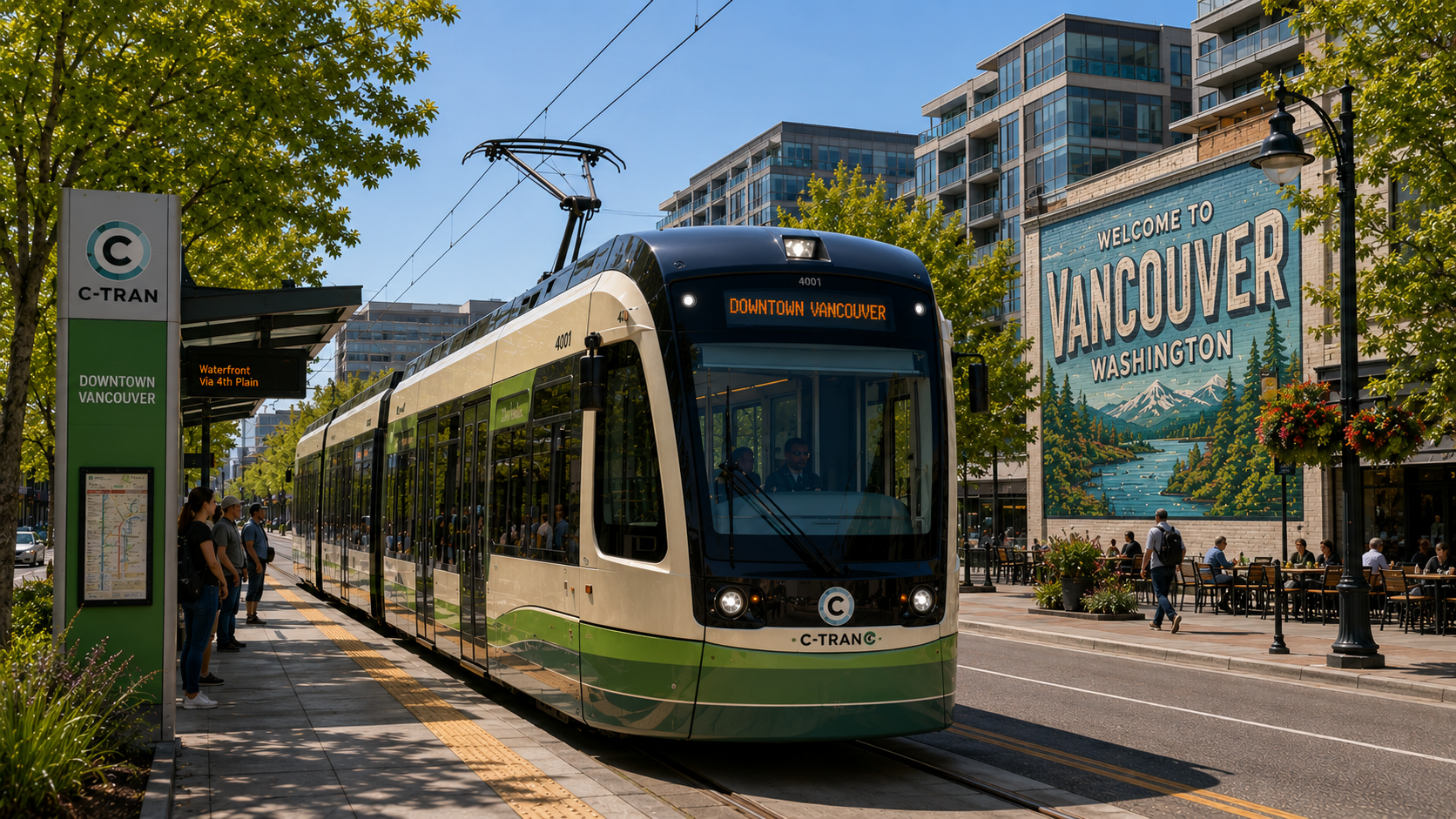
The two new Vine projects — bus rapid transit systems — that just opened in 2017 and 2023? It was suggested that they be turned into trams — also known as trolleys — instead.
“When do we stop thinking about ourselves as just a bus transit provider and begin thinking about other modes of transportation that are available to us?” Paulsen asked during a C-TRAN workshop on June 9.
Vancouver Mayor Anne McEnerny-Ogle backed Paulsen’s move, asking the C-TRAN board to give the city time to put forward a new plan that included rail within the city limits and the VUGA, to be included in the C-TRAN 2045 plan.
The Board of Directors had just listened to C-TRAN staff discuss the current financial state of the organization as well as the 20-year plan. Staff wanted guidance for the C-TRAN 2045 plan, asking the board whether it wanted to reduce services, maintain services, or grow services — with the three options having different costs.
None of those options had fixed rail as a possibility, other than the planned light rail extension from Oregon to Vancouver over the new bridge.
Paulsen took exception.
“It’s really disheartening for me to see a 20-year plan and a funding mechanism that really just puts us in a place where we continue doing what we’ve always done, charge ourselves more to do it, and get the same results. That’s the literal definition of insanity,” Paulsen said.
Paulsen’s suggestions came toward the end of a long process. C-TRAN released a statement regarding Paulsen’s proposals.
“As it stands now, the draft C-TRAN 2045 long-range plan is the result of two years of engagement with all of the communities served by C-TRAN. That includes residents, city staff members in all jurisdictions, other community stakeholders, and the C-TRAN Board of Directors,” C-TRAN noted. “It represents a diverse cross-section of needs and ideas C-TRAN heard through that process.”
Paulsen wants the process to include fixed rail in the city, in hopes of inspiring an economic boom.
Transit, Paulsen reminded the board, is more than transportation. Transit oriented development, he said, is a huge opportunity. Paulsen said that traditional bus lines do not move the needle in that development. BRT is better, but not ideal. Fixed rail, he said, is what really kickstarts development because developers know that a fixed line cannot be moved.
“Transit is a catalyst for development. Rail oriented transit catalyzes much more development,” he said.
Paulsen noted the forecasted growth for not only Clark County, but the city of Vancouver. By 2050, some estimates say the city’s population could be close to 300,000 people.
“There is no other city in the state of Washington with 300,000 people in it that does not have fixed-rail service,” Paulsen said.
He said having this discussion now is appropriate because there have been talks about creating a subdistrict tax base within C-TRAN’s Public Transportation Benefit Area (PBTA) simply to pay for operations and maintenance costs associated with Oregon’s light rail system coming to Vancouver. Paulsen pointed out that such a subdistrict could only be asked one time for funds. He said it would be prudent to ask that subdistrict for more than just to fund TriMet’s O&M costs.
Paulsen would prefer asking the subdistrict, for example, to look into a long-term vision that funds fixed-rail investment throughout the VUGA to complement C-TRAN’s 20-year plan.
Paulsen suggested board members take a look at Redmond, Wash., and that city’s development around light rail.
Vancouver could do that, he said.
“You could replace the Green and Red Vines with a tram (or trolley) that just circulated in a circle. All the (Vine) stops that have been built have the floor height to be able to support the tram. All you would have to do is lay the rail,” he said.
Paulsen is looking for studies on ridership, transit oriented development, rights of way, and more.
“We’re not even having those conversations. That’s my whole point. At some point, we need to have those conversations,” he said. “Why not now? If not now, when?”
It appears those conversations have started.
Kim Harless, also representing Vancouver on the C-TRAN board, said: “I want to explore options for rail.”
Sue Marshall, Clark County Council Chair and C-TRAN board member, acknowledged that she is unsure that people would have an appetite for more taxes. However, it is worth it to give the public an idea of what the plan would look like in the future.
“It can surprise you what people are willing to pay for if it’s truly needed,” Marshall said. “It’s our obligation to give them a choice.”
McEnerny-Ogle agreed.
“I would recommend that you allow the city of Vancouver to put forward a secondary plan for LRT (light rail transit) within the Vancouver city limits and the Vancouver Urban Growth Area and it become a part of the draft plan that is considered by the board,” she said. “It would be something different. It doesn’t mean that it is funded. But the concept, the discussion, needs to happen, and it needs to happen in this 20-year plan.”
The board members hoped to schedule another workshop for next month. C-TRAN staff have said previously the goal is to adopt the 2045 plan by the end of this year.
“As the plan is finalized, the C-TRAN board will continue to be involved. A long-range plan is intended to capture a collective vision for public transportation in our region. It serves as a guiding document that will inform C-TRAN's future projects and priorities. Any future decisions on high-capacity transit would still go through a separate review and approval process, as required by RCW 81.104,” C-TRAN said in its statement.
Comments
Loading comments…