



The Washington State Department of Ecology reported in November that $472 million of CCA funds were spent during the fiscal year 2024
TJ Martinell
The Center Square Washington
Although the 2021 Climate Commitment Act’s primary goal is to reduce carbon emissions, supporters defending it against a failed initiative last year argued the revenue generated by it was vital to support air quality projects.
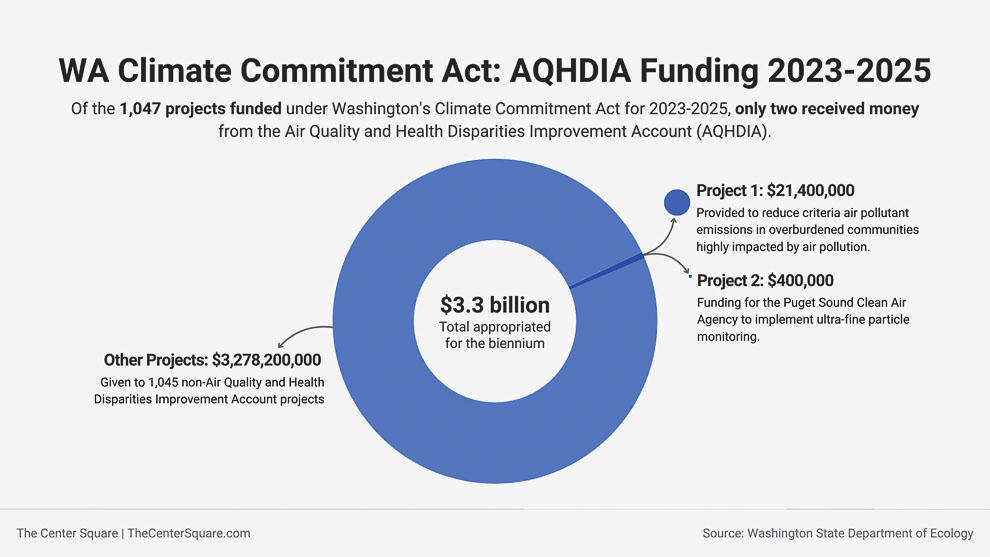
However, an analysis of CCA money spent from an account specifically meant for those projects found it made up roughly .1% of the total spending for the 2024 fiscal year.
CCA revenue is deposited into three main accounts, with two of those accounts having two sub accounts each. Among them is the Air Quality & Health Disparities Improvement Account, the funds of which are “to be used for projects that result in long-term environmental benefits and increased resilience to the impacts of climate change such as improving air quality through the reduction of criteria pollutants, and reducing health disparities in overburdened communities by improving health outcomes through the reduction or elimination of environmental harms and the promotion of environmental benefits.”
The Washington State Department of Ecology reported in November that $472 million of CCA funds were spent during the fiscal year 2024. Of that, .1%, or $596,000, came from the air quality account for two projects.
Those two projects were to “reduce criteria air pollutant emissions in overburdened communities highly impacted by air pollution” and for the monitoring of ultra-fine particles by the Puget Sound Clean Air Agency.
In total $21.8 million, or .64%, of the $3.3 billion in CCA revenue appropriated for the 2023-25 biennium came from the air quality account, all of which is directed at the two projects, while there were more than 1,000 projects allocated CCA money for the same time period. Meanwhile, roughly 89% of project spending in fiscal year 2024 did not have any impact to carbon emissions, while 45% of the spending was on transit related projects.
According to Ecology, the agency is working on improving air quality in 16 Washington communities that are “historically overburdened with health, social, and environmental inequities and are highly impacted by criteria air pollution, such as ozone and fine particles.” The state agency reports that those communities are a combination of urban, suburban, and rural and range from populations of 1,500 to more than 200,000 residents. Altogether, the 16 communities have 1.2 million people, 15.5% of the state’s total population.
The CCA will also be funding a $10 million grant program to support local projects aimed at reducing air quality, with qualified applicants including tribes and local governments.
According to Ecology, all of Washington, except a small area in Whatcom County, currently meets air quality standards.
However, Washington Policy Center’s Vice President of Research Todd Myers told The Center Square he’s skeptical more CCA spending would have an effect; he noted in 2019 that an Ecology study cited by the Puget Sound Clean Air Agency found a proposed low carbon fuel standard wouldn’t have an effect on air quality, as it is projected to improve regardless.
“Air quality is getting much better,” he said. “Transportation has a relatively low impact on air quality. When we miss air quality targets, it’s never because of traffic and smog. It’s because of wood burning stoves.”
Ecology oversees the Wood Smoke Reduction Grant Program, which provides funding for the transition of homes reliant on wood burning stoves to either natural gas or electricity. In place for 17 years, the state Legislature typically allocates $3 to $4 million for the program, which has replaced more than 7,000 wood stoves. The revenue for the grant program comes from the Model Toxics Control Act Capital Account.
This report was first published by The Center Square Washington.
Also read:
- Opinion: ‘Both states know they have seriously flawed voter registration’
 Lars Larson argues Oregon and Washington are suing DOJ to avoid cleaning up fraudulent voter rolls before elections.
 - Letter: Compassion without accountability is failing Clark County
 Sarah Mittelman calls for clear standards and measurable results in homelessness spending.
 - ‘Our new normal’: WA confronts another year of drought
 Casey Sixkiller says every watershed in Washington has dropped below 75% of normal water supply.
 - Schools expect minimal impact with Title IX pacts rescinded
 Federal officials rescinded agreements with six school districts, saying previous administrations misapplied Title IX protections.
 - Area Agency on Aging & Disabilities in Southwest Washington announces the Senior Farmers Market Nutrition Program
 AAADSW opens applications for $80 benefit cards to help eligible seniors buy fresh produce at farmers markets.
 - Free in-person workshops promote composting and sustainable living
 Clark County’s free workshops teach residents worm composting, green cleaning, and smart recycling through April and May.
 - Keeping afloat: A bittersweet chronicle of two women who endured the sinking of the Titanic
 Local historian Peri Muchich shares the story of Pacific Northwest Titanic survivor Anna Warren at Sunday’s museum event.
 wpDiscuz
