



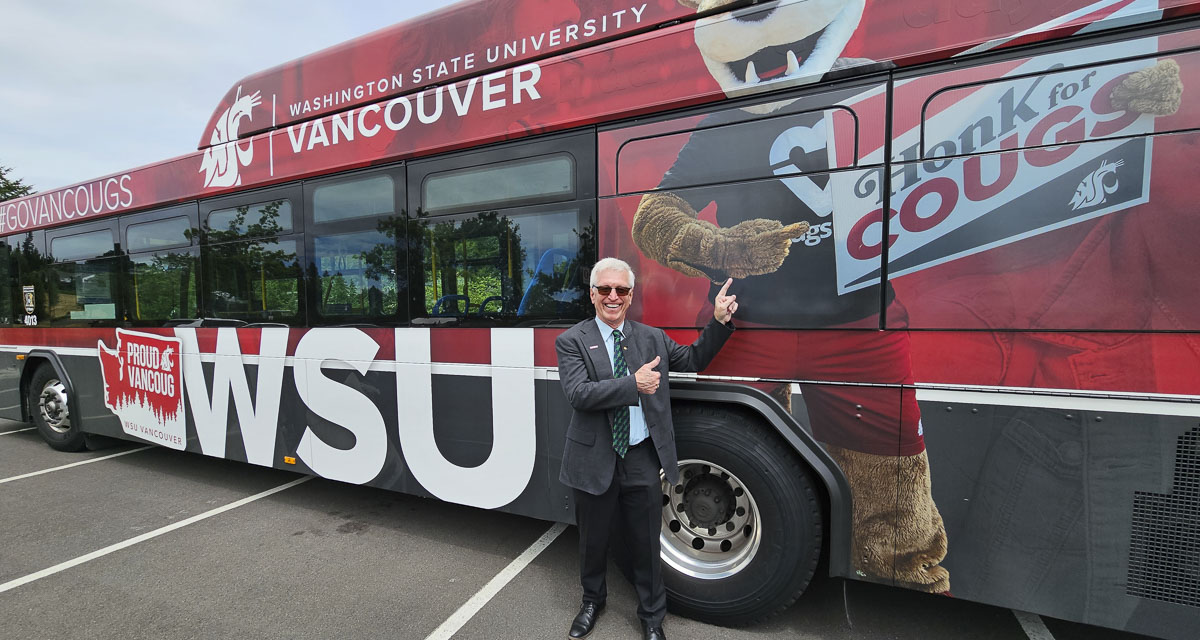
State representative is interested in supporting affordable and flexible transit solutions that deliver value to citizens and taxpayers
Rep. John Ley
for Clark County Today
Rep. John Ley attended the C-TRAN ribbon cutting for their new Bus Rapid Transit (BRT) line in Vancouver on Wednesday. The new line will run from WSU Vancouver down Highway 99 to downtown Vancouver, offering more frequent and higher-capacity bus service for transit riders. The total cost for the proposed construction is not expected to exceed $42.5 million, according to C-TRAN figures. This is the third line in C-TRAN’s BRT system.
“The $42 million project highlights a much more affordable, flexible, and efficient mass transit system for Vancouver and Clark County residents,” said Ley, R-Vancouver. “This contrasts with the $2 billion light rail extension proposed for the Interstate Bridge Replacement (IBR) Program that extends Portland’s MAX light rail into Vancouver. The Yellow Line only travels 14 mph, whereas if we extend this BRT line into Portland, it will travel well over twice that speed.”
Ley is interested in supporting affordable and flexible transit solutions that deliver value to citizens and taxpayers. “The C-TRAN bus service offers better quality service and costs roughly 40% less per boarding rider to operate than TriMet’s MAX light rail. Clark County citizens do not want to pay more taxes for Portland’s troubled MAX light rail.”
The IBR is currently proposing to replace an over-congested 3-lane bridge with another 3-lane bridge that allocates 54 percent of the bridge surface to bikes, pedestrians and transit.
Adding the BRT line to the replacement bridge would save $2 billion and allow BRT buses to mingle with other vehicles on the bridge if the light rail tracks were replaced with two additional vehicle lanes. “Everyone wins under this scenario,” Ley concluded.
Information provided by Washington State House Republicans, houserepublicans.wa.gov
Also read:
- VIDEO: WA diesel hits record $6.53, crushing truckers and school budgets
 With diesel nearing $6.53 per gallon in Washington, trucking businesses and school districts now confront sharply higher fuel expenses affecting budgets and workers.
 - Opinion: In plain sight – yielding to pedestrians
 Drivers often fail to see pedestrians due to inattentional blindness, which highlights the need for more focused awareness at intersections and stronger safety practices.
 - Expect delays on SR 14 in Vancouver for guardrail repairs Wednesday
 State Route 14 travelers in Vancouver should plan for morning delays as WSDOT will close two eastbound lanes for guardrail repairs, affecting mileposts 6.0 to 7.0.
 - Overnight closure planned on westbound SR 14 Camas Slough Bridge Tuesday
 WSDOT crews will close westbound SR 14 at Exit 14 in Camas to collect bridge deck samples and plan future repairs; detours will be in effect.
 - Opinion: Stay in your lane – seriously, it’s the law
 Drivers must choose the nearest lane when turning in Washington, and left turns bring added risk. Even with signals, every driver must help prevent crashes by following law.
 wpDiscuz
