



New pedestrian signal brings better connectivity for people crossing SR 503
VANCOUVER – People who walk or roll will soon have a safer way to cross State Route 503 with the help of a new signal and crossing location.
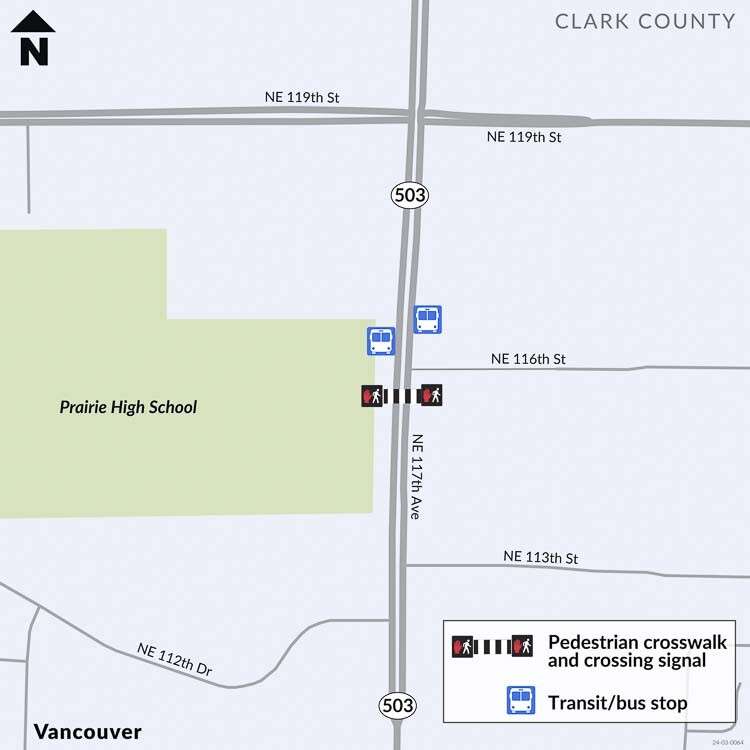
The Washington State Department of Transportation plans to build a HAWK (High intensity Activated crossWalK) pedestrian signal, creating safer access for pedestrians crossing SR 503 to and from Prairie High School and the nearby transit stop.
On Jan. 6, 2023, a 14-year-old student was struck by a vehicle while crossing SR 503, not in a marked crossing, near Prairie High School. Following this incident, WSDOT worked with Prairie High School to conduct pedestrian surveys to identify the best location for another controlled crossing. The new HAWK crossing will be located just south of Northeast 116th Street, immediately east of the high school. It will also include a refuge island to give pedestrians a safe place to wait at the half-way point before completing their crossing.
“We’re excited to bring this safety improvement project so students can get to school more safely,” said WSDOT Transportation Engineer Jacob Whitfield. “We’re looking forward to adding another crossing option across SR 503 to better serve the area, while also keeping drivers moving.”
This $1.1 million project is scheduled to begin and complete construction in early 2025.
What is a HAWK signal?
The HAWK signal is a traffic control device used to provide a safer crossing for pedestrians, without holding up traffic. Different from a traditional traffic signal, a HAWK signal is only activated when a pedestrian pushes the crossing button. When there are no pedestrians, vehicles can move without interruption.
An activated HAWK signal will operate in a sequence of flashing lights. When drivers encounter the lights, they should treat them like any other traffic signal, slowing on yellow and stopping on solid red. During the flashing red interval, drivers should stop and then proceed through the crossing area only if it is safe to do so without posing any risk to pedestrians.
Pedestrians can switch on the HAWK signal by pushing the button at either end of the crossing. The lights on the pedestrian signal will show when it is safe to cross. A visual traffic signal benefits both drivers and pedestrians in helping determine who has the right of way and when it’s safe to proceed.
Stay updated on this project by signing up for email updates and alerts.
Also read:
- He Is Risen: An Easter Message from Clark County Today
 Families and congregations throughout Clark County observe Easter in unique ways, highlighting moments of renewal and togetherness for the community.
 - White House govt. Funding request for 2027 cuts $73 billion
 President Trump’s budget seeks to boost defense funding while cutting $73 billion from agencies like the EPA, NASA, and Agriculture, prompting sharp criticism from Democratic leaders.
 - Heywood asks WA Supreme Court to allow referendum effort on income tax
 Brian Heywood is petitioning the state Supreme Court after the Secretary of State rejected a referendum to repeal Washington’s new 9.9% tax on income over $1 million.
 - Opinion: Half the road, full stop – Understanding pedestrian right-of-way
 Doug Dahl explains how Washington’s law requires drivers to stop when a pedestrian is within one lane of their half of the road, not just when directly in front.
 - Clark County seeks volunteer for Law and Justice Council
 Applicants with experience in mental health services are encouraged to help guide Clark County’s coordination of local criminal justice and corrections planning.
 - VIDEO: Families at center of WA transgender sports debate face-to-face with OSPI
 Two Washington high school students and their parents met with Superintendent Chris Reykdal to discuss concerns about sports policies after one student faced an investigation for harassment.
 - As Washington lawmakers punt on school cellphone ban, some want more action
 At Robert Eagle Staff Middle School, all-day phone removal led to fewer conflicts and more student engagement, but some parents and lawmakers argue a ban should not be imposed statewide.
 wpDiscuz
