


Elizabeth Hovde states that House Bill 1893 would have completely changed a fund paid for by taxes on employers and meant for employees who lose work through no fault of their own
Elizabeth Hovde
Washington Policy Center
One of the worst bills with the longest legs kept me on watch until sine die in the now adjourned Washington state legislative session.
House Bill 1893, allowing striking workers to receive unemployment insurance benefits, nearly succeeded this legislative session. It would have completely changed a fund paid for by taxes on employers and meant for employees who lose work through no fault of their own.
Creating a taxpayer-financed strike fund was a priority for big labor, and HB 1893 had 51 Democrat co-sponsors. (A companion bill in the Senate had 21 co-sponsors.) The back-scratching bill cleared the House and luckily stalled in the Senate. Labor mourned the proposal’s loss, and labor leaders promised it would be back, with April Sims, President of the Washington State Labor Council, AFL-CIO, saying, “This is not over.” Count on it. At least two other states on the East Coast already allow striking workers such benefits. Similar efforts are underway in many states.
Labor unions donate heavily to Democrats and seemed surprised that when they told state lawmakers to jump, this time not enough of them said “how high?” forcibly enough.
The Washington State Standard quoted Joe Kendo, a lobbyist for the Washington State Labor Council, saying he was “sorely disappointed” and that “Senate Democrats couldn’t pull it together.” Sen. Karen Keiser, D-Des Moines, sponsored the legislation in the Senate and chairs the Labor and Commerce Committee, which voted to advance both bills. She told the Standard, “We were really close. We were so close I could taste it.” She added, ”I think there was a caution and a reluctance. A lot of people were just not comfortable taking on a big, new idea in a short session.”
It wasn’t just a big, new idea and a short session, it was and is a horrible policy idea that no lawmaker should ever be comfortable with. Ask taxpayers to pay workers who choose not to work and encourage more strike activity, costing other workers, employers and society at large? Think better, supporters.
Some amendments were made to make House Bill 1893 more palatable, but even wait periods, time limits on the unemployment benefits given to striking workers and taxing employers with striking workers more were not enough to make this proposal make sense.
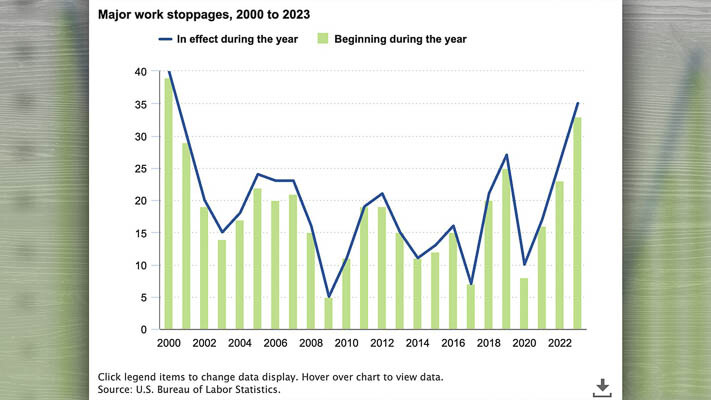
Strikes have grown significantly the last two decades (see chart). The U.S. Bureau of Labor Statistics reports that during the last 20 years, the average number of “major work stoppages” at the beginning of the year was 16.7. That compares to 33 at the beginning of 2023. (Major work stoppages include strikes and are defined as involving 1,000 or more workers. Smaller worker strikes — think strikes at Starbucks stores — are not included in this compilation.)
Four strikes among the 33 major work stoppages at the beginning of the year were based in Washington state. Legislation such as HB 1893 and SB 5777 would help that number increase if workers know they will be paid to not work. Read more about this harmful proposal in my policy paper, “SB 5777, to pay state-funded unemployment benefits to workers who choose to go on strike.”
Elizabeth Hovde is a policy analyst and the director of the Centers for Health Care and Worker Rights at the Washington Policy Center. She is a Clark County resident.
Also read:
- Opinion: Were Republican voters just sleeping during the August primary election?
 CCRP Chairman Matt Bumala says 60% of primary no-shows in the 17th and 18th districts were Republicans.
 - High school football: New coach prepares for long-term success at Prairie High School
 James Young-Lewis, a Clark County native who graduated from Evergreen in 2009, became Prairie’s head coach in May after working as an assistant coach across various programs since 2015, joining Prairie’s staff in 2024.
 - Cost to battle 20 wildfires in WA has topped $200M
 Twenty wildfires have cost Washington $207M in one month, more than two-thirds of what DNR spent all last fiscal year.
 - Opinion: WA Cares’ launch showcased care WA Cares did not provide
 Gov. Ferguson showcased a caregiving arrangement at the WA Cares launch that the program had not paid for a single day of.
 - Former State Rep. Liz Pike provides update on husband Neil Cahoon
 Neil Cahoon, a Camas resident, has undergone multiple surgeries including five on Aug. 15 after the Aug. 10 crash near La Center’s Daybreak Airport.
 - Opinion: Portland’s War on Cars Part 4 – A smarter automobile strategy to end gridlock
 O’Toole argues fuel wasted in Portland-area congestion has sextupled since 1982, generating 250,000 tons of extra greenhouse gases annually.
 - $1,000 first prize for Camas Plein Air Art Event honoring Marquita Call on Sept. 26
 Plein air artists compete Sept. 26 in Camas for $1,000 first prize honoring gallery founder Marquita Call.