


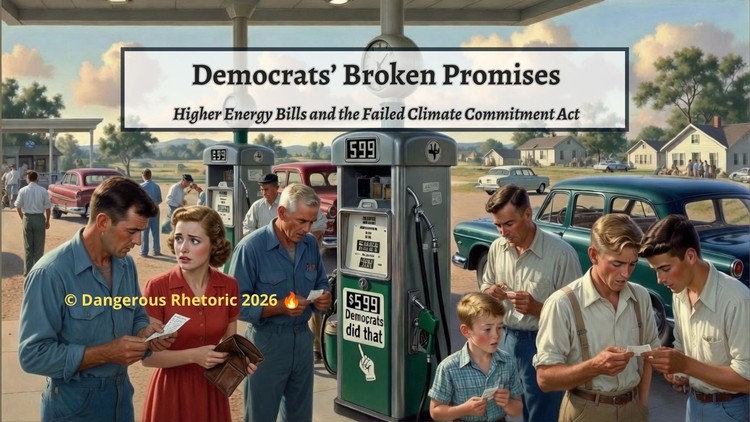
Nancy Churchill discusses higher energy bills and the failed Climate Commitment Act
Nancy Churchill
Dangerous Rhetoric
In 2021, then-Governor Jay Inslee assured Washingtonians that the new Climate Commitment Act (CCA) — the state’s aggressive cap-and-invest carbon tax — would have minimal impact on everyday costs. He stated plainly: “The impact on gas prices is going to be very, very small. It’s pennies per gallon.”

Nancy Churchill
That was the promise. The reality, delivered by Democrat leadership, has been far different.
The CCA has added 47 cents per gallon to the price of gas in Washington state. And the costs keep climbing. As of April 2026, thousands of Cascade Natural Gas customers are being hit with new rate increases directly tied to the CCA and the Clean Energy Transformation Act (CETA). Puget Sound Energy is seeking approval for nearly 30% higher electric bills and 20% higher gas bills by 2029 for residential customers.
This is not the failure of one politician. It reflects a consistent pattern from Washington Democrats: bold promises of affordability, transparency, and climate progress, followed by policies that deliver higher costs, reduced accountability, and negligible environmental gains.
Broken promise on protecting farmers
Democrat leaders repeatedly promised to shield agriculture from the worst effects of the CCA. In a Seattle Times editorial board meeting, Rep. Joe Fitzgibbon (D-West Seattle), one of the CCA's architects, assured skeptics: “We intend to exempt that class of fuel from the CCA. That doesn’t fully solve the problem. We’re going to have to do more heavy-duty work… It is at the top of the list of things that we know are not working… it will absolutely be prioritizing making it better.”
Instead of delivering relief, Democrats attempted to eliminate the agricultural fuel exemption entirely through legislation authored by Fitzgibbon. Only bipartisan opposition prevented the change. Farmers, already operating on thin margins, continue paying higher fuel costs under a policy sold to them as protective.
Broken promise on controlling costs
Democrats also claimed they would step in if the CCA drove prices too high. Fitzgibbon told the Seattle Times editorial board:“If prices are where they were last December when they were $52 per metric ton, I think that calls for a stronger set of remedies.”
Today, the price sits at $65 per metric ton. That’s nearly 30% higher than the threshold that was supposed to trigger action. Rather than provide relief, Democratic lawmakers passed measures closing loopholes that had previously kept some costs down. The result has been even higher prices passed directly to consumers.
Cascade Natural Gas is now filing for rate increases to cover “compliance charges” under the CCA. Puget Sound Energy faces the same pressure.
As Todd Myers of the Washington Policy Center noted, utilities aren’t the villains here—state law forces them to comply and pass costs onto ratepayers. The Utilities and Transportation Commission has little choice but to approve increases so the utilities stay solvent.
Broken promise on transparency and results
Supporters of the CCA promised rigorous oversight. Fitzgibbon said, “Do I think that it would be useful for us to have a really sophisticated tracking mechanism by which we can look at every instrument made through the CCA and what the CO2 benefit of that is both in the short term and the long term. Yeah, I think that would be great.”
He added that resources would be “allocated… in [a] way that [is] prescribed by law and are all geared toward reducing emissions.” But the state’s own report showed that’s not true at all! Turns out that was another Democrat “pie-crust promise.”
Democrats did the opposite. They reduced reporting requirements from annually to every other year, making oversight weaker and data less timely. As a result, billions of dollars have flowed into a system with minimal transparency.
Much of the money funds bureaucracy, government programs, and projects that deliver little or no measurable carbon reduction. State reports have shown government climate spending is up to 140 times more expensive than comparable private sector efforts.
Myers put it bluntly: “Electricity costs are going up. Home heating costs are going up. Gas prices are going up… most of the money is going to bureaucracy, government programs, or things that don’t actually yield environmental benefits… we’re still not getting what we paid for.”
The regressive reality for working families
Washington’s Democrats will talk all day about how terribly regressive our tax code is. However, the Climate Commitment Act they created is absolutely regressive. It hits low-income and working-class Washingtonians hardest because they spend a larger share of their income on energy and transportation.
While Democrats celebrate symbolic climate targets — such as reducing emissions 95% from 1990 levels by 2050 — the state’s total emissions are a tiny fraction of global output. Even total elimination would have virtually no impact on worldwide temperatures.
Washington families are paying more for gas, electricity, and home heating with almost nothing to show for it. The policy has become a classic example of all pain, no gain.
Time to demand accountability
The chasm between what Washington Democrats promised and what they have delivered is now impossible to ignore. They promised pennies on the gallon. They delivered nearly 50 cents, plus surging utility bills. They promised protection for farmers and transparency for taxpayers. They delivered attempts to raise costs on agriculture and reduced oversight of billions in spending.
Even those who support aggressive climate action should be outraged. As Myers observed, supporters of the CCA and CETA should be “most bothered by not seeing results despite all the money spent.”
Washingtonians deserve honesty from their leaders. It’s time to hold Democrat policymakers accountable for this pattern of broken promises. The CCA was passed in 2021 as Senate Bill 5126. Look at the roll call votes. Any senator or representative who voted “Yea” needs to be asked some hard questions during this year’s re-election campaign.
The Climate Commitment Act needs dramatic reform — or outright repeal — before more damage is done to families, farmers, and the state’s economy.
Nancy Churchill is a writer, educator, and conservative activist in rural eastern Washington state. She chairs the Ferry County Republican Party and advocates for effective citizen influence through Influencing Olympia Effectively. She may be reached at DangerousRhetoric@pm.me. The opinions expressed in Dangerous Rhetoric are her own. Dangerous Rhetoric is available on Substack and X.

Also read:
- Opinion: Were Republican voters just sleeping during the August primary election?
 CCRP Chairman Matt Bumala says 60% of primary no-shows in the 17th and 18th districts were Republicans.
 - Opinion: WA Cares’ launch showcased care WA Cares did not provide
 Gov. Ferguson showcased a caregiving arrangement at the WA Cares launch that the program had not paid for a single day of.
 - Auditor, auditor candidate address scrutiny over job title
 Greg Kimsey says roughly 40 county employees hold the deputy county auditor designation Kelly used in his campaign.
 - Opinion: Is Mitchell Kelly misleading voters with his ‘deputy auditor’ claim?
 Clark County HR records show no position called “Deputy County Auditor” has ever existed, Anderson argues.
 - Opinion: Democrats rig the ballot to save their income tax
 Churchill argues the ballot disclosure warning voters of education cuts describes revenue never collected and not yet allocated.
 wpDiscuz