



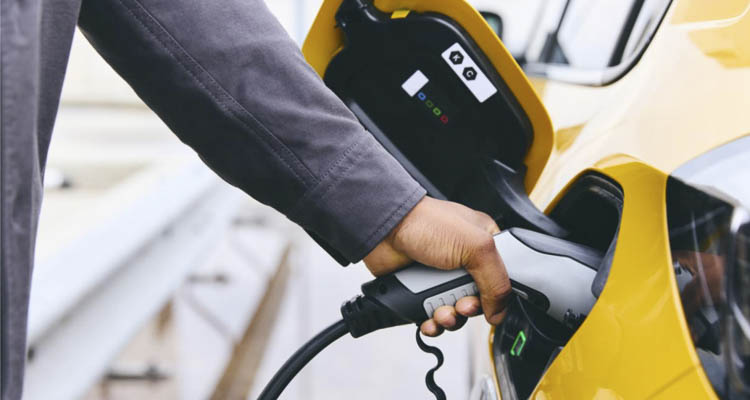
This week, Gov. Jay Inslee announced $45 million in subsidies through a Department of Commerce grant program for families deemed “low-income” to purchase an EV
TJ Martinell
The Center Square Washington
One strategy for state officials looking to transition Washington’s transportation sector to electric vehicles is by subsidizing them with taxpayer dollars.
This week, Gov. Jay Inslee announced $45 million in subsidies through a Department of Commerce grant program for families deemed “low-income” to purchase an EV.
“Washingtonians really get it when it comes to electric vehicles,” Inslee said at a Wednesday news conference in Tukwila.
The program provides up to $9,000 for families to lease an EV, or $5,000 to purchase one. The grant program allows them to purchase either new or used EVs. The funding would be available to those who make 300% of the federal poverty level or less.
Inslee described it as a way to “democratize EVs. We’re not stopping here. We want to help the entire ecosystem, if you will, of electrifying our transportation fleet. We expect there are going to be a lot of folks that are going to be enjoying this benefit.”
Subsidies has been one recommendation made in the Electric Vehicle Coordinating Council’s transportation electrification strategy, in which residents would receive public dollars in exchange for giving up a fossil fuel vehicle to purchase an EV.
The council has recently noted that EV sales, while increasing, aren’t as a high as they could be due to a lack of charging ports around the state. The state is looking to double the number of public charging ports through revenue from the Climate Commitment Act, which makes up 84% of all funding for the state’s EV investments.
Speaking at Wednesday’s press conference, Department of Commerce Director Mike Fong described the grant program as a “first in the nation” by allowing people to lease, rather than buy, an EV.
“We are always excited in Washington to be the first in the nation at innovating, particularly in equity and on climate change, and we are going to be able to do that with this program,” he said.
The program has drawn criticism, including from Washington Policy Center Environmental Director Todd Myers. In a blog post, he argued that the subsidies won’t help reduce carbon emissions and is a waste of taxpayer money better spent on other environmental priorities, such as salmon recovery.
“This is one more example of how wasteful and ineffective Washington’s climate policy is,” he wrote. “It also reveals the disingenuousness of claiming that climate change is an ‘existential crisis’ while wasting tens of millions of dollars on projects that do nothing to address that crisis.”
The grant funds will be available to qualifying residents in August.
This report was first published by The Center Square Washington.
Also read:
- VIDEO: WA diesel hits record $6.53, crushing truckers and school budgets
 With diesel nearing $6.53 per gallon in Washington, trucking businesses and school districts now confront sharply higher fuel expenses affecting budgets and workers.
 - Opinion: In plain sight – yielding to pedestrians
 Drivers often fail to see pedestrians due to inattentional blindness, which highlights the need for more focused awareness at intersections and stronger safety practices.
 - Expect delays on SR 14 in Vancouver for guardrail repairs Wednesday
 State Route 14 travelers in Vancouver should plan for morning delays as WSDOT will close two eastbound lanes for guardrail repairs, affecting mileposts 6.0 to 7.0.
 - Overnight closure planned on westbound SR 14 Camas Slough Bridge Tuesday
 WSDOT crews will close westbound SR 14 at Exit 14 in Camas to collect bridge deck samples and plan future repairs; detours will be in effect.
 - Opinion: Stay in your lane – seriously, it’s the law
 Drivers must choose the nearest lane when turning in Washington, and left turns bring added risk. Even with signals, every driver must help prevent crashes by following law.
 wpDiscuz
