



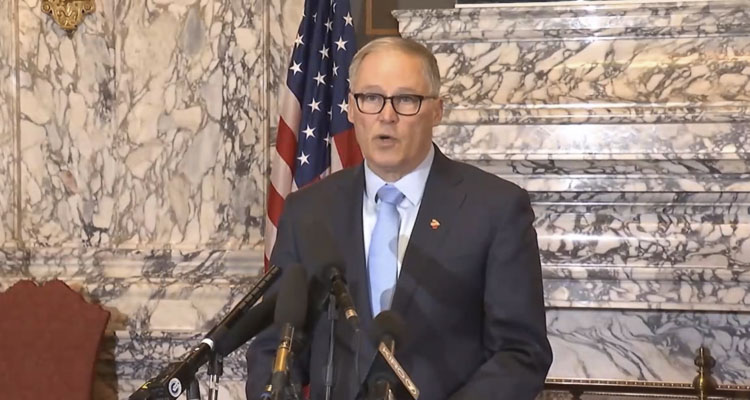
Governor emphasized that it addresses housing and homelessness, as well as the issues of behavioral health and climate change
Brett Davis
The Center Square
Washington State Gov. Jay Inslee unveiled his proposed $70.4 billion 2023-25 operating budget on Wednesday afternoon. He emphasized that it addresses housing and homelessness, as well as the issues of behavioral health and climate change.
According to a budget and policy highlights document on the Office of Financial Management’s website, the 2023-25 omnibus operating budget breaks down as follows: $30.8 billion for K-12 schools; $10.2 billion for social and health services; $7.5 billion for the state Health Care Authority; $5.9 billion for higher education; $3.8 billion for the Department of Children, Youth, and Families; $3.3 billion for general government; $3.1 billion for the Department of Corrections; $3 billion for bond retirement and interest; $1.7 billion for other; and $977 million for natural resources.
“We’ve always risen to the moment,” Inslee said during a press conference from the state capital. “And we need to rise to this challenge of homelessness and mental health care needs and climate change. And we have a budget to do all those things, so I look forward to working with the Legislature.”
The governor described homelessness as a housing deficit. He added that the current state of the economy means the private market won’t produce the number of housing units needed in the state.
“Rents have gone up, and people have fallen off the ladder of the ability to pay rent,” Inslee said. “Our population is still growing, we need to build about 50,000 housing units a year just to keep up. And we’re about 5,000 to 7,000 of that short, every single year.”
There are more than 25,000 homeless persons in Washington, according to Inslee, an increase from 22,000 in 2020. Other estimates have the number much higher.
“I’m proposing that we invest an additional $4 billion over the next six years to tackle this homelessness crisis in the state of Washington,” Inslee stated. “The reason for that number is that what it is required to get the job done. And this is a reality-based budget. It is not based on wishes or hopes or dreams. It is not based on the theory that somehow you can dream away homelessness, or you can vaporize people that you feel inconvenient living on the corner.”
He went to explain where that money would come from.
“Now to finance that $4 billion,” Inslee continued, “I am proposing we increase the bonding capacity of the state of Washington by classifying the bonds in a certain manner that’s consistent with our constitution.”
That would require a referendum of the people, Inslee said.
“And I’m asking the Legislature to send this proposal to Washingtonians,” he said, “and I believe Washingtonians want to see this problem solved.”
On behavioral health, Inslee said the state would continue and expand upon existing efforts in terms of providing community support for where people live, improving intensive care for young people, and working to meet the demand for the restoration of competency for people to stand trial.
“We also have a challenge with behavioral health,” Inslee said. “We have a significant shortage of mental health supports for Washingtonians.”
The governor touted the University of Washington Medical Center Northwest in Seattle as the future site of a new first-in-the-nation behavioral health teaching facility, as well as well as the therapeutically designed hospital being constructed on the Western State Hospital campus in Lakewood to care for forensic patients.
“Look, lawyers and lawsuits are not a solution to mental health challenges for people,” Inslee stressed. “Mental health treatment is, and we need to get folks into the mental health care system where they belong.”
On climate change, Inslee’s signature issue, the governor said the focus would be policies to fight planetary warming via green energy.
“So we want to make sure Washingtonians can power their cars and ultimately their homes with 100% clean electricity,” Inslee said. “And this budget provides resources for our agencies to improve siting and permitting for clean energy sites around the state of Washington so that we can get that job done.”
At least one member of the Legislature was not impressed with the governor’s budget.
“As if the cost of living wasn’t high enough already, it’s going to get worse for Washington families in 2023 because of policies the governor has supported in past years that are coming due,” Sen. Lynda Wilson, R-Vancouver, said in a statement. “There will be higher prices for gas and diesel, perhaps as much as 46 cents a gallon, and the unpopular payroll tax that was deferred until after the November election.”
She brought up the controversial capital gains income tax ruled unconstitutional earlier this year. The Washington Supreme Court is expected to rule on the tax’s constitutionality next year, but in the meantime has given the okay for the Department of Revenue to administer and collect the tax.
“Some also must begin paying the capital-gains income tax, even though it was declared unconstitutional – they can thank the state attorney general for that,” she said. “It seems irresponsible at best for the governor to ‘book’ 1.4 billion dollars of revenue from the income tax in his proposal, and pretend the state Supreme Court has already overturned the lower-court decision.”
The House and Senate will each present their own budget plans during next year’s 105-day legislative session that begins Jan. 9.
This report was first published by The Center Square Washington.
Also read:
- Fiscal fallout: $375 million bond debt indirectly funding operating budget
 Shifting $375 million from a loan fund impacts local infrastructure as Washington state covers operating costs with bond debt, prompting concern among officials and advocacy groups.
 - Lawsuit aims to block new eligibility requirements for WA sheriffs
 Four sheriffs are suing over a state law that sets new eligibility rules, arguing it undermines voter authority by allowing removal for certification issues.
 - Opinion: The growing gap between public voice and political power
 Todd Myers describes how large-scale protest and sign-ins often fail to sway state leaders, and argues authentic influence is most likely found through local action.
 - City of Battle Ground seeks applicants for Salary Commission vacancy
 Battle Ground seeks a resident to join its independent Salary Commission, which reviews compensation and health benefits for local elected officials through 2027.
 - Opinion: Who is winning the race for affordable power?
 Hydroelectric power keeps Washington competitive, but new laws and carbon pricing are driving up electricity costs for residents each year.
 - Vancouver Fire Department assists with Columbia River Marina fire response
 Vancouver Fire Department joined Clark-Cowlitz and Scappoose crews to help fight a vessel and dock fire at Goble Marina, assisting in river operations where one boat sank and another was partially submerged.
 - White House govt. Funding request for 2027 cuts $73 billion
 President Trump’s budget seeks to boost defense funding while cutting $73 billion from agencies like the EPA, NASA, and Agriculture, prompting sharp criticism from Democratic leaders.
 wpDiscuz
