



WSDOT maintenance crews will remove brush and clear danger trees alongside SR 503 near Amboy
CLARK COUNTY – Travelers in both directions of State Route 503 in Clark County should expect delays.
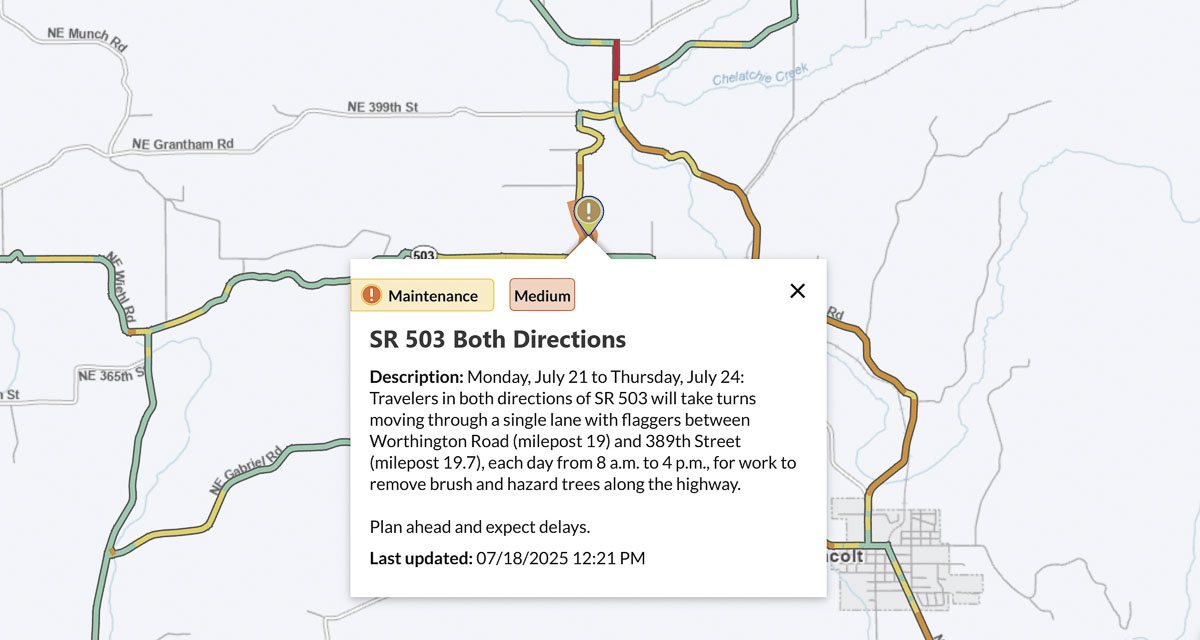
Beginning Monday, July 21, the Washington State Department of Transportation maintenance crews will remove brush and clear danger trees alongside SR 503 near Amboy. This work improves visibility, lowers the risk of fires, and keeps plants from growing onto the road.
What to expect
Monday, July 21 to Thursday, July 24:
- Travelers in both directions of SR 503 between Worthington Road (milepost 19) and Northeast 389th Street (milepost 19.7) will take turns moving through a single lane with flaggers each day from 8 a.m. to 4 p.m.
- During brush and tree removal, the speed limit will be reduced to 25 mph through the work zone.
For everyone’s safety, please slow down, stay focused and expect delays.
Know before you go
People can receive real-time travel information via the WSDOT mobile app, or by visiting our real-time travel map.
Also read:
- VIDEO: WA diesel hits record $6.53, crushing truckers and school budgets
 With diesel nearing $6.53 per gallon in Washington, trucking businesses and school districts now confront sharply higher fuel expenses affecting budgets and workers.
 - Opinion: In plain sight – yielding to pedestrians
 Drivers often fail to see pedestrians due to inattentional blindness, which highlights the need for more focused awareness at intersections and stronger safety practices.
 - Expect delays on SR 14 in Vancouver for guardrail repairs Wednesday
 State Route 14 travelers in Vancouver should plan for morning delays as WSDOT will close two eastbound lanes for guardrail repairs, affecting mileposts 6.0 to 7.0.
 - Overnight closure planned on westbound SR 14 Camas Slough Bridge Tuesday
 WSDOT crews will close westbound SR 14 at Exit 14 in Camas to collect bridge deck samples and plan future repairs; detours will be in effect.
 - Opinion: Stay in your lane – seriously, it’s the law
 Drivers must choose the nearest lane when turning in Washington, and left turns bring added risk. Even with signals, every driver must help prevent crashes by following law.
