



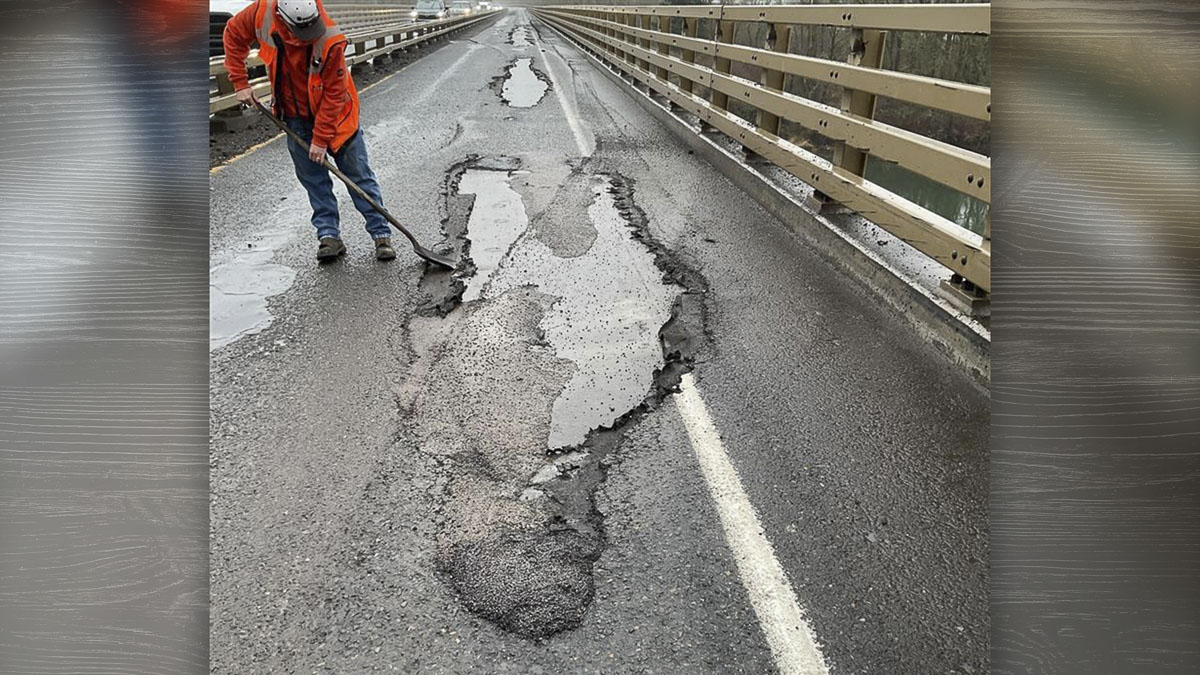
Heavy winter rain further damages failing pavement
CAMAS – On Tuesday, Jan. 7, Washington State Department of Transportation maintenance crews will begin emergency pavement repairs on the State Route 14 West Camas Slough Bridge. The repairs are needed to address the damaged pavement and provide a safer and smoother ride for travelers.
The failing pavement on the aging bridge deck was discovered the week of Dec. 23, following heavy rainfall. In response, WSDOT installed an advisory speed limit of 35 mph just west of the bridge, along with signs warning of a bumpy and uneven road surface. Travelers are advised to use caution in the area until repairs are completed. Motorcyclists will also see a sign warning of the bumpy pavement.
What to expect
- 9 a.m. to 2 p.m. Tuesday, Jan. 7 crews will close eastbound SR 14 near the West Camas Slough Bridge at milepost 12.6.
- Travelers will detour around the closure using Exit 12 to Northwest 6th Avenue.
- Work is weather-dependent and may be paused or rescheduled if poor weather such as rain occurs.
Maintenance crews will make temporary repairs, using “hot mix” asphalt. This material works well for quick, longer-lasting pothole repairs, but it’s still just a temporary fix until a permanent repair can be done.
The West Camas Slough Bridge, built in 1966, has seen its bridge deck worsen over time due to traffic and weather. While the bridge structure itself is sound and has a bridge rating of “fair,” the pavement on the bridge deck is far beyond its serviceable life. The surface of the bridge has long dealt with cracks and an uneven surface, and now large potholes have formed. Currently, WSDOT only has 40% of the funding needed to maintain and preserve the highway system.
Because of limited funding, WSDOT must spread its maintenance budget across all state-owned roads and bridges, including the West Camas Slough Bridge. All projects are prioritized based on the most urgent safety needs and available resources. This means that while emergency repairs are being done now, there is no funding for a full resurfacing project. WSDOT will continue to monitor and address safety concerns to help keep the bridge as safe as possible for travelers.
Also read:
- VIDEO: WA diesel hits record $6.53, crushing truckers and school budgets
 With diesel nearing $6.53 per gallon in Washington, trucking businesses and school districts now confront sharply higher fuel expenses affecting budgets and workers.
 - Opinion: In plain sight – yielding to pedestrians
 Drivers often fail to see pedestrians due to inattentional blindness, which highlights the need for more focused awareness at intersections and stronger safety practices.
 - Expect delays on SR 14 in Vancouver for guardrail repairs Wednesday
 State Route 14 travelers in Vancouver should plan for morning delays as WSDOT will close two eastbound lanes for guardrail repairs, affecting mileposts 6.0 to 7.0.
 - Overnight closure planned on westbound SR 14 Camas Slough Bridge Tuesday
 WSDOT crews will close westbound SR 14 at Exit 14 in Camas to collect bridge deck samples and plan future repairs; detours will be in effect.
 - Opinion: Stay in your lane – seriously, it’s the law
 Drivers must choose the nearest lane when turning in Washington, and left turns bring added risk. Even with signals, every driver must help prevent crashes by following law.
 wpDiscuz
