



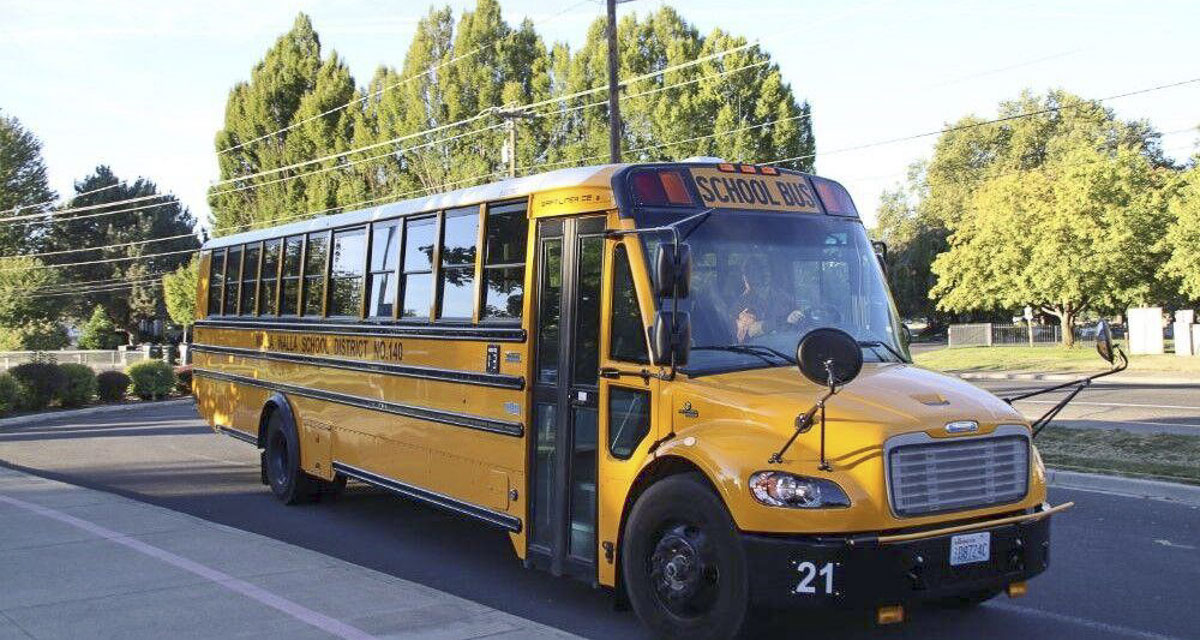
Woodland Public Schools is one of the districts to benefit from the EPA grant to replace diesel-powered vehicles with ‘clean vehicle infrastructure’
Carleen Johnson
The Center Square Washington
The number of electric school buses in Washington state is expected to more than double by 2026.
According to the Washington State Department of Ecology, there are currently 86 electric school buses in Washington spread across 40 school districts.
In early December, DOE awarded $31.5 million in state funding from the Climate Commitment Act and other sources. A week later, the U.S. Environmental Protection Agency awarded several multi-million dollar zero-emission school bus grants to Washington districts courtesy of the Inflation Reduction Act of 2022.
That translates into 124 zero-emission buses hitting the road by 2026, bringing the total to more than 200 electric school buses statewide.
Woodland Public Schools is one of the districts to benefit from the EPA grant to replace diesel-powered vehicles with “clean vehicle infrastructure.”
A Dec. 17 news release from U.S. Sen. Maria Cantwell, D-Wash., announced nearly $8.4 million in grants for zero-emission school buses in the Evergreen State. Woodland was awarded the largest share of the grant money: more than $4.2 million to replace 14 diesel school buses.
According to the news release, school districts serving neighborhoods with poor air quality were prioritized for the EPA grants.
Support for the transition from diesel school buses to more expensive electric buses is not universal.
During a Dec. 19 meeting of the Woodland School District Board of Directors, Trish Huddleston explained why she would be voting against accepting the grant.
“I never wanted to know so much about electric school buses,” she said. “I was kind of excited at first. It sounded great. It did. Too good to be true.”
Huddleston told fellow board members that conversations with people in the community convinced her to vote against accepting the grant.
“Our community is not excited, and they don’t want them, and there’s not a mandate yet, and I think we’ll survive if we don’t get electric school buses,” she explained. “OSPI [Office of Superintendent of Public Instruction] is required to fund transportation, so either way we’re still going to get funded for transportation if we don’t accept this grant.”
The board voted to accept the grant money.
The interest in switching out diesel buses for electric buses nationwide has been fueled in large part by federal funding.
According to Education Week, roughly 8,000 of the 12,000 electric school buses that districts are operating or will soon be operating were funded through the EPA’s Clean School Bus Program.
Education Week reports that 89 districts in more than 30 states, as well as the District of Columbia, Puerto Rico, and American Samoa, have received EPA grants for electric school buses.
Some districts that initially applied for grants ended up rejecting them.
One of the districts turning down the grant money was the East Side Union High School district in San Jose. Calif. According to the San Jose Spotlight, the district would have had to pay the difference between the rebate amount and the much larger total cost of the bus, which would have amounted to an additional $50,000 per bus. Each electric school bus costs upwards of $350,000.
The district was also concerned about the high cost of installing EV charging stations and other infrastructure to support the buses.
Another concern raised by districts that are already using electric school buses is the failure rate of the vehicles.
David Christopher, executive director of the New York Association for Pupil Transportation, told GovTech.com that traditional diesel buses have a failure rate of 1 or 2 percent, meaning that out of a fleet of 100 buses, one or two would be down for repairs on a given day.
“It’s typically an easy fix,” Christopher said.
The failure rate for electric buses, on the other hand, is often cited as around 20%. That translates into roughly 20 out of every 100 electric buses possibly experiencing a breakdown on any given day, primarily due to issues with the bus itself or its charging mechanisms. Exacerbating the problem is a lack of qualified mechanics to quickly effect repairs.
In addition to Woodland Public Schools receiving the latest grants for electric buses, DOE secured almost $3.9 million to replace 13 diesel school buses across four other school districts. The Olympia School District will receive five buses, the Central Kitsap School District four, the Bellevue School District one, and Durham School Services will receive three buses for the Everett School District.
This report was first published by The Center Square Washington.
Also read:
- Area Agency on Aging & Disabilities in Southwest Washington announces the Senior Farmers Market Nutrition Program
 AAADSW opens applications for $80 benefit cards to help eligible seniors buy fresh produce at farmers markets.
 - Free in-person workshops promote composting and sustainable living
 Clark County’s free workshops teach residents worm composting, green cleaning, and smart recycling through April and May.
 - Keeping afloat: A bittersweet chronicle of two women who endured the sinking of the Titanic
 Local historian Peri Muchich shares the story of Pacific Northwest Titanic survivor Anna Warren at Sunday’s museum event.
 - Letter: ‘This is the worst thing that ever happened to the region’
 A Hayden Island resident Sam Churchill is criticized in a letter calling the $14 billion Interstate Bridge Replacement project a “boondoggle” that destroys local businesses.
 - Washougal ramps up efforts to support small businesses
 Washougal launches Gateway to Success Series with free workshops starting April 15 at Best Western Plus Convention Center.
 - Vancouver woman displaced by apartment fire
 Fire crews responded to 1806 E Fourth Plain Blvd where one woman was displaced and received Red Cross aid.
 - Former WA Supreme Court justice joins legal effort against income tax
 Phil Talmadge and Rob McKenna have joined forces with the Citizens Action Defense Fund to oppose Washington’s new tax on high-income earners, raising legal and constitutional questions.
 wpDiscuz
