


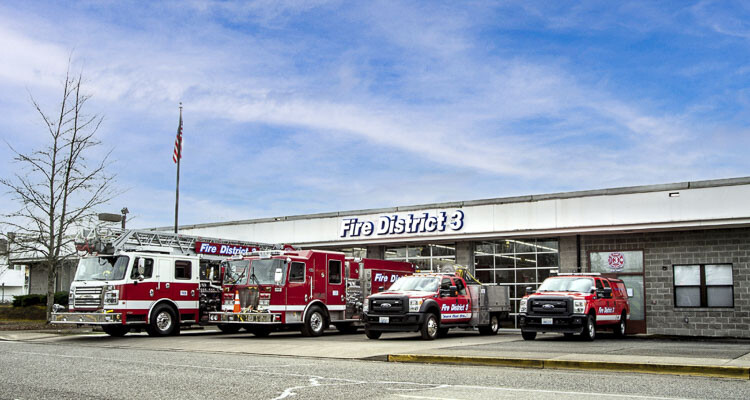
Board of Fire Commissioners considering fire levy lid lift
BRUSH PRAIRIE — Clark County Fire District 3 responded to 4,691 calls in 2022. The fire district’s population has grown 26 percent in the last 10 years and this growth is driving higher call volumes for emergency services. The fire district has petitioned the Clark County Council without success to pass impact fees to offset capital costs associated with growth.
“We don’t control growth, but we have to serve it,” Fire Chief Scott Sorenson said. “Our community has grown to the point where we require additional personnel to keep up with requirements to meet the emergency service needs of our community.”
Fire District 3 provides fire and emergency medical service (EMS) to 46,000 people in east Clark County, including the city of Battle Ground. To meet current and future needs, the fire district is discussing asking voters for a fire levy lid lift for daily operations sometime this year and a bond for a fire station further down the road.
“Impact fees would reduce the cost of the new fire station for taxpayers,” Chief Sorenson said. “We will continue to advocate for impact fees so our taxpayers know we are fighting for them.”
The priority now is to add additional emergency personnel to allow for three-person engine companies, which is the national standard for fire districts the size of Fire District 3. The district’s two-person engine companies prevent firefighters from entering buildings to perform search and rescue operations.
The fire district’s current staffing levels place the district out-of-compliance with state law for risk requirements for emergency personnel. This impacts safety for both the community and firefighters.
How the fire district is funded
The fire district funds daily operations, including its EMS program, with a fire levy capped at $1.50 per $1,000 of assessed property value. EMS calls account for 73 percent of all emergency calls. Voters approved a fire levy of $1.42 per $1,000 in 2017. Since that time, the rate has dropped to $1.21.
Why did the rate drop?
Each year the fire district is allowed to collect a set amount of revenue. State law limits the fire district to that amount plus one percent more each year (or any other voter-approved amount). Even if property values double, the fire district can only collect one percent more. This means that the levy rate falls as property values rise to limit the fire district to the same amount per year plus that one percent increase.
This is called “levy compression” and impacts the fire district’s ability to provide emergency services.
The fire district is considering asking voters to return the fire levy to $1.50 per $1,000 sometime this year, known as a fire levy lid lift. There will be a public process conducted before a final decision is made.
“We have always delivered on promised projects and improvements from past fire levy lid lifts,” Chief Sorenson said. “We are your fire district and we are accountable to you. We look forward to this important conversation.”
Clark County Fire District 3 provides fire and life safety services to 46,000 people in east Clark County, including the city of Battle Ground. Fifty-seven full-time and 10 volunteer emergency personnel responded to 4,691 calls in 2022. Fire District 3 operates under a balanced budget and has a long history of passing its financial and accountability audits by the state. More information on Fire District 3 can be found on its website www.fire3.org.
Information provided by Clark County Fire District 3.
Also read:
- Opinion: Were Republican voters just sleeping during the August primary election?
 CCRP Chairman Matt Bumala says 60% of primary no-shows in the 17th and 18th districts were Republicans.
 - High school football: New coach prepares for long-term success at Prairie High School
 James Young-Lewis, a Clark County native who graduated from Evergreen in 2009, became Prairie’s head coach in May after working as an assistant coach across various programs since 2015, joining Prairie’s staff in 2024.
 - Cost to battle 20 wildfires in WA has topped $200M
 Twenty wildfires have cost Washington $207M in one month, more than two-thirds of what DNR spent all last fiscal year.
 - Opinion: WA Cares’ launch showcased care WA Cares did not provide
 Gov. Ferguson showcased a caregiving arrangement at the WA Cares launch that the program had not paid for a single day of.
 - Former State Rep. Liz Pike provides update on husband Neil Cahoon
 Neil Cahoon, a Camas resident, has undergone multiple surgeries including five on Aug. 15 after the Aug. 10 crash near La Center’s Daybreak Airport.
 - Opinion: Portland’s War on Cars Part 4 – A smarter automobile strategy to end gridlock
 O’Toole argues fuel wasted in Portland-area congestion has sextupled since 1982, generating 250,000 tons of extra greenhouse gases annually.
 - $1,000 first prize for Camas Plein Air Art Event honoring Marquita Call on Sept. 26
 Plein air artists compete Sept. 26 in Camas for $1,000 first prize honoring gallery founder Marquita Call.
 wpDiscuz