



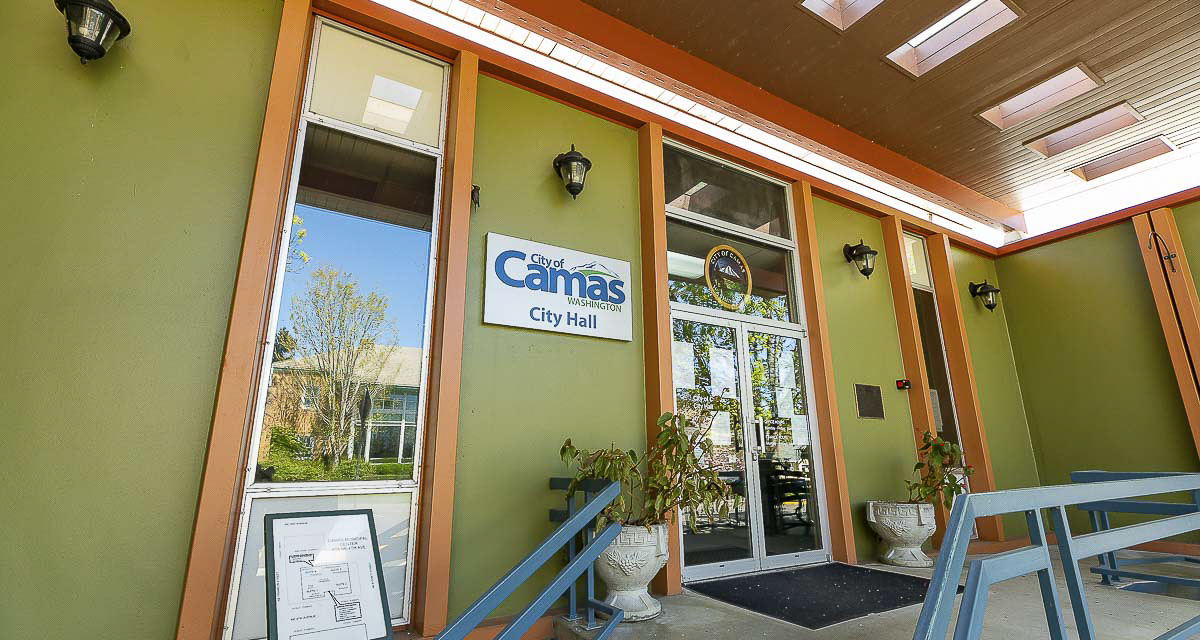
After a discussion by the Camas City Council workshop earlier this month, and after interviews this week with two members of the council, it is clear that the city will consider leaving C-TRAN if the transit authority teams up with Oregon’s light rail
Paul Valencia
Clark County Today
Is this the beginning of the end of C-TRAN as it is known?
Camas city leaders held a discussion in a workshop earlier this month that questioned whether the city should remain in a partnership with the transportation authority if C-TRAN is pushed into supporting Vancouver’s vision for light rail, and therefore, paying for part of Oregon’s TriMet system.
Smaller cities are likely to be asked to pay for operations and maintenance costs for light rail on a proposed new Interstate Bridge, and at the same time, those smaller cities are on the verge of losing one, and maybe two, seats on the C-TRAN Board of Directors.
So those cities will have to pay more and get less representation?
“Camas believes in C-TRAN. We believe in providing public transportation. We don’t believe in contributing $5 million in tax revenue, getting back $2 million in services — that’s a significant financial imbalance — and then not having a vote,” said Tim Hein, a City Council member as well as Camas’ representative on the C-TRAN board.
Those numbers came from C-TRAN’s own report, showing that Camas contributed $5 million from sales tax revenue to C-TRAN while receiving $1.9 million worth of service. Many other small cities also gave more than received in service.
That has never been a deal-breaker for Camas in the past because the mission of C-TRAN was to pool the resources for the betterment of the entire county. However, if C-TRAN is pushed into a partnership with the Oregon transportation system just to appease Vancouver, that could lead to a new mindset in Camas.
“How many times do you go into business with a partner that is failing? You don’t do it,” Hein said.
Hein and Camas Mayor Steve Hogan led a discussion in a work session on Aug. 18 detailing the events of the C-TRAN board since November of last year. That included the changing of the language of an agreement, allowing Clark County taxpayers to be on the hook for O&M costs for Oregon’s light rail expansion into downtown Vancouver. Later, C-TRAN board member Michelle Belkot tried to protect the taxpayers by reverting to older language. She was booted off the C-TRAN board by three members of the Clark County Council. That action led to ongoing lawsuits that have yet to be determined by the courts.
In the meantime, the Washington State Department of Transportation informed the C-TRAN board that it was out of compliance with state law in regard to representation based on population.
The C-TRAN Board Composition Review Committee voted earlier this month to give the county one more seat on the board and take away a seat from the smaller cities. If that proposal is not accepted by the state, it appears the city of Vancouver will get four seats, the county will get three, and all the smaller cities will share two seats.
In both of those proposals, Hein said it would be unlikely for the language to ever be changed back to protect the Clark County taxpayers from O&M costs associated with Oregon’s light rail. “They are going to stack the deck,” Hein said. “They’re going to ram it down everybody’s throats.”
Leslie Lewallen, a Camas council member, did not give her opinion during the workshop. More than a week later, she voiced her concerns with Clark County Today.
“I just feel the smaller cities are not being represented. Not only that, but we are being shut out,” Lewallen said. “If you don’t want to hear us, if you don’t want to listen to our voices … then maybe we should be looking at other alternatives.”
The goal of the discussion, Hein said, is to drive public awareness to the issue. Hein and Hogan are scheduled to meet this week in hopes of setting up a town hall to ask for public input.
“The public has to wake up and see what is happening,” Hein said. “To see how the public is being manipulated to support an agenda. There is a clear agenda on Mayor McEnerny-Ogle to get a new bridge and light rail.”
He was referring to Vancouver Mayor Anne McEnerny-Ogle.
“If they want to make it Vancouver exclusive, that’s fine. Then make the decision. But they want all the small cities to pay for it,” Hein said.
LeWallen agreed that Vancouver is driving C-TRAN toward a relationship with TriMet and light rail.
“Mayor Anne relies on the smaller cities to fund all of this,” she said. “If we pull out, what happens? That’s a very important question to ask. I think we’ve been taken for granted for many, many years.”
Hein also emphasized that if Camas leaves C-TRAN, the city will find a way to provide its citizens with public transportation.
In a perfect world from Camas’ perspective, C-TRAN would keep its focus on providing for the citizens of Clark County — all of Clark County, Hein said.
“I think it’s really unfortunate that all this time and energy is being spent on things that aren’t in the benefit of C-TRAN’s mission,” Hein said. “That’s disappointing. We’re not looking to be in this position, but we will not shy away from it.”
Could Camas be leading a monumental change?
“If others choose to follow, that’s fine. We’ll keep updating them on our actions,” Hein said, in reference to the smaller cities in the county. “We’re not going to tolerate, blindly, what we believe are the abuses of this agenda and us being held financially hostage.”
According to C-TRAN data, Camas was estimated to pay just more than $5 million in 2024 and received just less than $2 million in fixed route and C-VAN operating expenses.
All other small cities, as well as the Clark County Urban Growth Area, pays more into C-TRAN than it receives in operating expenses.
“We pay more, and we get less,” Lewallen said.
The city of Vancouver, however, pays $49.3 million and receives $53.5 million.
Hein noted that if C-TRAN taxpayers are forced to pay for TriMet O&M for light rail, the disproportional numbers will only be more expensive for the smaller cities.
“We do not want to pay for it because we are not going to benefit from it,” Hein said.
“If you look at Vancouver and then you go to every other city, every other city is being short-changed,” Hogan said during the workshop. “The only one getting extra money is Vancouver.”
Hogan said there would be some negative consequences from leaving C-TRAN. He also said that C-TRAN services Clark County well. He just is not sure about C-TRAN’s future if it is linked with light rail, combined with the fact that the smaller cities are losing representation.
He has had informal discussions with leaders of small cities, and he believes they also feel the same.
Lewallen said she is proud to be part of the Camas City Council, which has shown that non-partisan boards can work together. She noted that earlier this year the council unanimously voted against supporting light rail on the new bridge. She said she would not be surprised if the council voted unanimously to leave C-TRAN if C-TRAN opts to pay for light rail.
“I’m proud that Camas has become a leader in terms of the smaller cities,” Lewallen said. “I’m proud of the direction we’ve all taken. I would be inclined to take a good, hard look at the pros and cons of remaining in C-TRAN if we are not welcome at the table.
“I would hope other cities would follow suit.”
Also read:
- A sub-district vote could be a way to go to pay O&M costs associated with light rail
 Clark County Council members heard details on how a voter-approved C-TRAN sub-district could be created to fund long-term operations and maintenance costs for light rail tied to a new Interstate Bridge.
 - Letter: British Columbia’s new immersed tunnel can solve Interstate Bridge Replacement Program’s $17.7 billion problem
 Bob Ortblad argues that an immersed tunnel similar to a project underway in British Columbia could significantly reduce costs and impacts associated with the Interstate Bridge Replacement Program.
 - C-TRAN offering free service on Transit Equity Day, Feb. 4
 C-TRAN will offer free service across its entire system on February 4 in observance of Transit Equity Day, honoring the legacy of Rosa Parks.
 - Opinion: The many reminders not to speed
 Doug Dahl examines the many technological and policy-based reminders aimed at reducing speeding and explains why most drivers still choose not to use them voluntarily.
 - Rep. John Ley’s new bill calls for an independent audit of Interstate 5 Bridge Replacement Project
 Rep. John Ley introduced legislation requiring an independent audit of the Interstate 5 Bridge Replacement Project to review costs, management, and oversight.

Thank you, Camas City Council, for seeing the truth of what is going on and looking out for our city.
Bye, Felicia!
Question: How much do Camas’ (and other small towns in the County) taxpayers fork over to C-Tran to run the rolling roadblock, The Vine, exclusively in Vancouver??
Asking for a friend….
After the fiasco of the C-tran board freezing out an elected official from voting the will of the people she represented, the obvious grifting of the Vancouver elected leaders from Tri-met for pushing for light-rail boondoggle, the unending poor decisions that come down from state and local leaders on both sides of the bridge… I must say the foresight and reason from the Camas City Council is a refreshing change. Battle Ground, Ridgefield, and other small cities of Clark County should take notice. The answer is always monetary. Don’t fund what you don’t believe in. It is the only truth that enacts government to make meaningful change in the PNW.
We lived in Camas for 20 years and had confidence in the leadership. So it is now. We appauld the City of Camas for considering withdrawal from supporting Porland’s lite rail and Mayor Anne who is arm twisting and to get “her dream” to bring in lite rail to Vancouver. Never mind the voters who have voted against this more than once. There is another answer. There is a gentleman who has stepped up to challenge Mayor Anne. I listened to his presentation. He is bright, articulate, understands financial issues of Vancouver. Mayor Anne is popular with Democrats. But we need different thinking and a respect of our voters. When we say “no” that should be it. As I have noted before C-Tran is mismanaged, to much money spent on busses when ridership does not warrant it. It is time for a change.
I agree with the people who take notice of the C tran buses in Camas Washougal are without riders. Yesterday I saw 2 riders in an expensive vehicle and a driver earning a great wage with benefits, Stop wasting money on buses, or lightrail. By the time ridership may come, 40 yrs, C tran will have wasted billions. Stop this now.