



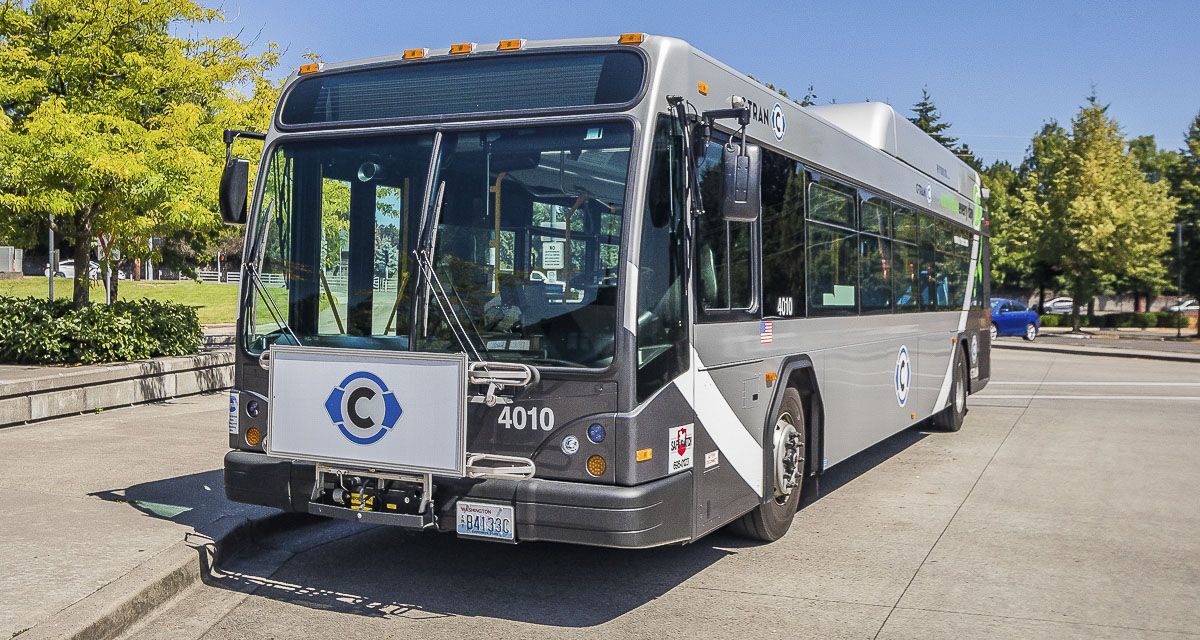
Small cities are likely to have less representation on the C-TRAN Board of Directors in the near future, but C-TRAN remains committed to serving all of its jurisdictions
Paul Valencia
Clark County Today
As reported earlier this month, it is likely that the C-TRAN Board of Directors will soon have a major change in its representation, with the smaller cities losing one or two seats.
C-TRAN wants to make it clear, though, that C-TRAN expects to maintain its current service levels throughout Clark County, and it is also open to expanding and improving service.
The C-TRAN Board Composition Review Committee has recommended that the state accept its proposal for 3-3-3 format, which would keep the city of Vancouver with three seats, add a third seat to Clark County, and take away a seat from the small cities, leaving them with three. The current format is 3-2-4, with small cities having four seats.
The change was deemed necessary after the Washington State Department of Transportation informed the C-TRAN board that it was out of compliance with state law in regard to representation based on population. In fact, some members of the review committee are not confident that the state will accept this 3-3-3 proposal, and that it is very possible the C-TRAN board will move to a 4-3-2 format, with Vancouver getting four seats and the smaller cities sharing two seats.
C-TRAN’s communications office reached out to Clark County Today this week, hoping to get the message out that regardless of the makeup of the new board, C-TRAN is committed to serving all communities in the county.
“In fact, C-TRAN has significantly expanded service levels in the smaller jurisdictions in recent years,” according to a release from C-TRAN.
That includes:
- The Current, which launched in 2022, provides on-demand transit service in the entire city limits of Camas, Washougal, La Center, and Ridgefield. The Camas/Washougal service zone is the busiest of all service zones on The Current.
- The Current will expand to Battle Ground next month.
- Fixed-route bus service was added to Ridgefield in 2022 and La Center in 2025 via Route 48. That route also provides service to ilani Casino.
- C-TRAN has invested additional trips or higher frequency on several existing routes serving small jurisdictions, including Route 7 (Battle Ground), Route 47 (Battle Ground/Yacolt), Route 92 (Camas/Washougal), and Route 48 (Ridgefield/La Center).
The C-TRAN 2045 long-range plan includes future route concepts throughout the county, as well.
“C-TRAN is currently conducting outreach across all jurisdictions to gather feedback on the plan and the collective vision for the future of public transportation in Clark County,” the release said.
“C-TRAN strives to provide service based on the unique needs of each part of our service area, and we constantly work with our board and community partners to make improvements where possible. That’s an ongoing process as our community grows and evolves.”
In the past couple of weeks, Camas city leaders have started asking if the city should continue its partnership with C-TRAN. That discussion was sparked by the possibility that C-TRAN (and its taxpayers) will be paying for annual operating and maintenance costs for Oregon’s light rail expansion into Vancouver.
City leaders noted that Camas pays $5 million into C-TRAN while receiving roughly $2 million worth of service. The costs for Camas would increase, leaders noted, if C-TRAN is involved with TriMet and light rail.
City leaders got those numbers from C-TRAN itself. C-TRAN also provided those numbers to Clark County Today.
The chart below estimates the 2024 sales tax collection, population, and operating expenses in each of the jurisdictions served by C-TRAN. The information was compiled as part of the board composition review process now underway.
| Jurisdiction | 2024 Sales Tax Collected | 2024 Service Area Population Estimates | 2024 Fixed Route and C-VAN Operating Expenses | |||
| City of Vancouver | $49,361,531 | 58% | 202,600 | 44% | $53,592,023 | 70% |
| Clark County UGA | $18,862,380 | 22% | 164,598 | 36% | $15,824,079 | 21% |
| Camas | $5,045,549 | 6% | 27,660 | 6% | $1,990,782 | 3% |
| Battle Ground | $4,651,651 | 5% | 22,470 | 5% | $2,504,543 | 3% |
| Ridgefield | $3,811,407 | 4% | 15,790 | 3% | $315,002 | 0% |
| Washougal | $2,835,296 | 3% | 18,150 | 4% | $1,891,038 | 2% |
| La Center | $616,678 | 1% | 4,045 | 1% | $69,120 | 0% |
| Yacolt | $213,926 | 0% | 1,670 | 0% | $11,954 | 0% |
| Totals | $85,398,419 | 100% | 456,983 | 100% | $76,198,541 | 100% |
Also read:
- Letter: Vancouver Mayor Anne McEnerny-Ogle makes several serious and incorrect engineering statements
 Bob Ortblad critiques engineering claims by Vancouver Mayor Anne McEnerny-Ogle, highlighting cost and safety advantages of an immersed tunnel for the I-5 crossing.
 - Washington’s studded tire deadline is March 31
 Drivers must remove studded tires by March 31 or face a $137 fine, with WSDOT urging early action due to busy service centers and no planned deadline extension.
 - VIDEO: WA diesel hits record $6.53, crushing truckers and school budgets
 With diesel nearing $6.53 per gallon in Washington, trucking businesses and school districts now confront sharply higher fuel expenses affecting budgets and workers.
 - Opinion: In plain sight – yielding to pedestrians
 Drivers often fail to see pedestrians due to inattentional blindness, which highlights the need for more focused awareness at intersections and stronger safety practices.
 - Expect delays on SR 14 in Vancouver for guardrail repairs Wednesday
 State Route 14 travelers in Vancouver should plan for morning delays as WSDOT will close two eastbound lanes for guardrail repairs, affecting mileposts 6.0 to 7.0.
 wpDiscuz
