



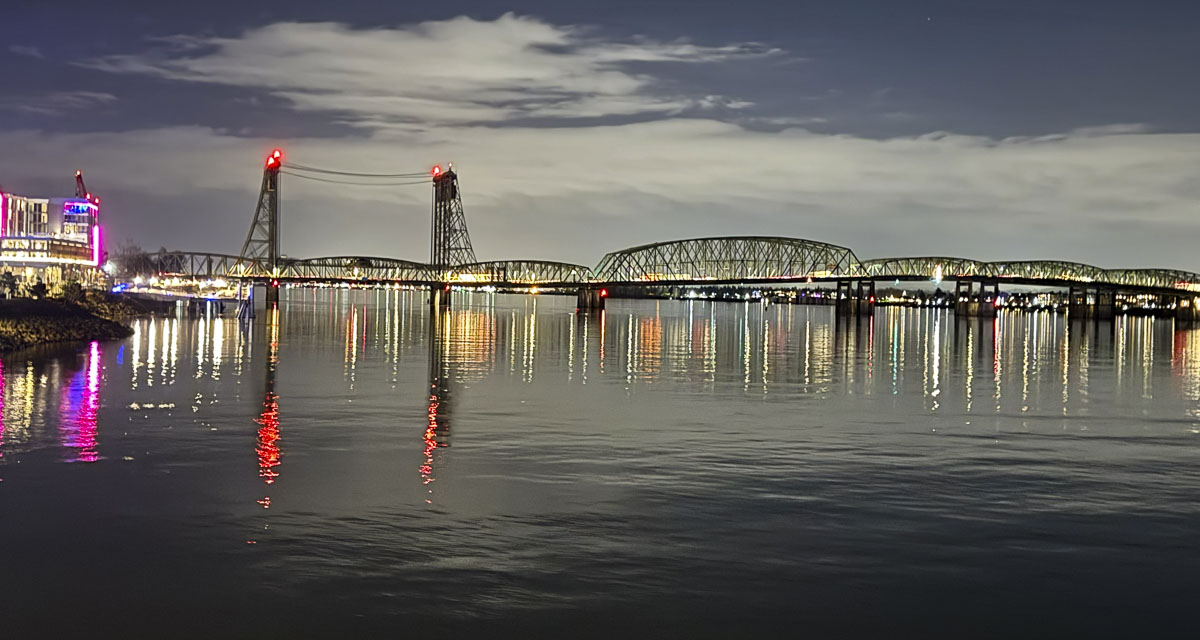
Vancouver Mayor Anne McEnerny-Ogle spoke in favor of the bill, saying that ‘we’re not special’ in regard to bond debt financing for projects like the bridge replacement
TJ Martinell
The Center Square Washington
A Washington bill would authorize the state to issue up to $1.6 billion in bonds to expedite the construction of a new bistate bridge to replace the existing one across the Columbia River between Vancouver, Wash., and Portland, Ore., which would be paid back with toll revenue.
However, some lawmakers raised concerns at House Bill 1958’s public hearing in the House Transportation Committee as to whether or not the bill would leave Washington on the hook for paying bonds on a multi-state project involving Oregon.
Sponsored by Transportation Chair Rep. Jake Fey, D-Tacoma, HB 1958 authorizes the $1.6 billion in bonds to be used to pay for various aspects of the new bistate bridge, including its design and construction. All funds would be deposited into the Interstate Bridge Replacement Account, and to be paid for with tolling authorized by the state Legislature in 2023.
For the bill’s supporters, the upfront money obtained through bonding means the existing bridge, which turned 108 years old earlier this month, can be replaced faster.
Fey told colleagues that the bill ensures “we have a safe, reliable bridge,” adding that “this project has a long history to it, and it is more than past the time” to have it built.
However, some committee members such as Rep. Ed Orcutt, R-Kamala, expressed reservations about how Washington would assume full financial responsibility for paying off the bonds. Rep. John Ley, R-Vancouver made the suggestion that the bill be implement on the contingency that Oregon accepted 50% of the financial risk.
According to Fey, there currently no is legal agreement between Washington and Oregon regarding fiscal responsibility, though future agreements are in the works as the project progresses.
Various other government officials testified in favor of the bill including Washington State Department of Transportation Principal Financial Officer Doug Vaughn, who told the committee that the bonding is a “necessary step forward for this important project,” adding that the bonding authorization represents a ceiling rather than the actual amount of bond debt that will be issued based on legislative appropriations.
Heather Kurtenbach with the Washington State Building and Construction Trades Council told the committee that bonding is more preferential than “pay as you go,” noting that the current bridge “imposes a safety risk to the traveling public,” in part because of its vulnerability to a seismic event.
Vancouver Mayor Anne McEnerny-Ogle also spoke in favor of the bill, saying that “we’re not special” in regard to bond debt financing for projects like the bridge replacement.
HB 1958 is currently not scheduled for any further committee action. Its companion legislation, Senate Bill 5734, was scheduled for a public hearing on Tuesday.
This report was first published by The Center Square Washington.
Also read:
- VIDEO: WA diesel hits record $6.53, crushing truckers and school budgets
 With diesel nearing $6.53 per gallon in Washington, trucking businesses and school districts now confront sharply higher fuel expenses affecting budgets and workers.
 - Opinion: In plain sight – yielding to pedestrians
 Drivers often fail to see pedestrians due to inattentional blindness, which highlights the need for more focused awareness at intersections and stronger safety practices.
 - Expect delays on SR 14 in Vancouver for guardrail repairs Wednesday
 State Route 14 travelers in Vancouver should plan for morning delays as WSDOT will close two eastbound lanes for guardrail repairs, affecting mileposts 6.0 to 7.0.
 - Overnight closure planned on westbound SR 14 Camas Slough Bridge Tuesday
 WSDOT crews will close westbound SR 14 at Exit 14 in Camas to collect bridge deck samples and plan future repairs; detours will be in effect.
 - Opinion: Stay in your lane – seriously, it’s the law
 Drivers must choose the nearest lane when turning in Washington, and left turns bring added risk. Even with signals, every driver must help prevent crashes by following law.
 wpDiscuz
