



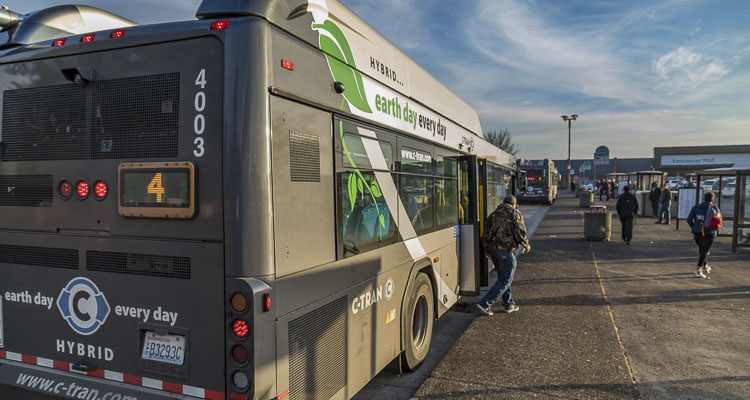
Once the pandemic hit, transit operational costs increased while passengers abandoned public transportation for various reasons
Elyse Apel, Tom Gantert and Brett Rowland
The Center Square
In 2019, transit agencies across the U.S. for all modes of transportation took in 32.3 cents in fares for every dollar they spent on operating costs.
Those transit agencies recovered 18.4 cents in fares on the dollar in 2020 and just 12.8 cents in 2021.
Once the pandemic hit, transit operational costs increased while passengers abandoned public transportation for various reasons – including fear of COVID-19, working from home and having some transportation shut down.
That loss in farebox revenue was made up by an injection of federal taxpayer dollars. The federal government gave transit agencies $71.7 billion in four relief packages in response to the COVID-19 pandemic, according to a report from rating agency S&P.
The National Transit Authority stated 852 transit agencies across the U.S. spent $13.1 billion in federal pandemic relief funds mostly on operational expenses in 2021, a 95 percent increase from the previous year.
All forms of transit saw the percentage of farebox revenue compared to operating expenses drop in 2021. For example, farebox revenue was 49.1 percent of operating expenses in 2019, the year before the pandemic hit. In 2021, the farebox revenue dropped to 19 percent.
Recently released data from the Federal Transit Administration sheds light on how the COVID-19 pandemic continued to cripple public transportation throughout 2021 and how federal taxpayer funding kept it running.
Federal funding was the predominant source of funding for transit, something the report says was due to the “COVID-19 public health emergency.”
From 2021 to 2020, federal funding for transit operating expenses rose dramatically. In 2020, federal funding made up 25.8 percent of the funding, while in 2021 that percentage rose to 36.2 percent.
In 2019, federal funding made up only 7.1 percent of funding for operating expenses.
In Southwest Washington, C-TRAN’s percent of operating revenue to operating costs were as follows:
2021
- Fixed Route: 5.9 percent
- Demand Response: 1.7 percent
- Vanpool: 37.7 percent
2020
- Fixed Route: 7.3 percent
- Demand Response: 2.2 percent
- Vanpool: 28.3 percent
2019
- Fixed Route: 14.2 percent
- Demand Response: 3.5 percent
- Vanpool: 35.3 percent
This story was first published by The Center Square.
Also read:
- Fort Vancouver athletics improving under partnership with Trico League
 Fort Vancouver High School athletics are showing measurable gains in competition and participation during the second year of a partnership competing in the Class 1A Trico League.
 - Opinion: Inviting courts into health care policy discussion
 Elizabeth New (Hovde) warns that Senate Joint Resolution 8206 could invite lawsuits by placing vague health care mandates into Washington’s Constitution.
 - Opinion: 24 States In. Washington Out? $732 Million Lost?
 Vicki Murray argues Washington risks forfeiting $732 million in federal education funding if state leaders do not opt into the federal tax-credit scholarship program.
 - C-TRAN offering free service on Transit Equity Day, Feb. 4
 C-TRAN will offer free service across its entire system on February 4 in observance of Transit Equity Day, honoring the legacy of Rosa Parks.
 - City of Battle Ground prepares for 75th Anniversary Celebration
 The City of Battle Ground is marking the 75th anniversary of its incorporation with a year-long series of community activities and celebrations planned throughout 2026.
 - Opinion: Nationwide strike in support of illegals and opposing the rule of law?
 Lars Larson argues that a reported nationwide strike reflects opposition to immigration enforcement and the rule of law, criticizing political leaders and media coverage.
 - POLL: Should councilors serving on boards be required to vote the way the full council decides?
 A new poll asks whether Clark County councilors serving on boards should be required to vote in line with the full council’s position or retain independent judgment.

For the past several years, even before the pandemic, I noticed that the 40′ buses rarely have more than a handful of riders, and often none at all. Even so, CTRAN is adding more 60′ articulated buses, on Mill Plain and the east side. The one I saw today was empty.
Now we just need people to go use them. Less cars on the road means less traffic for me!