



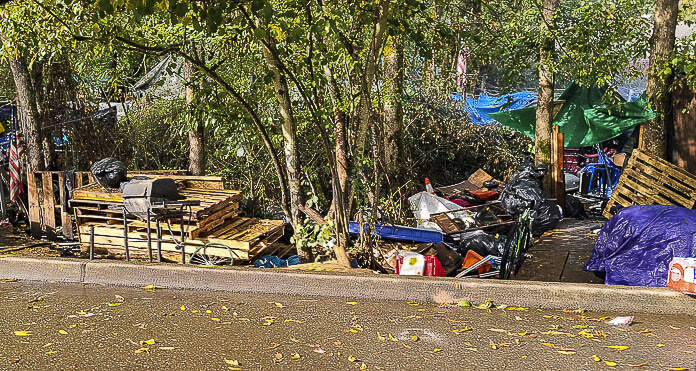
The report found that despite important local improvements in delivery of services, homelessness continues to rise among residents
VANCOUVER — Council for the Homeless has released its 2022 Homeless Crisis Response System Report for Clark County. The report found that despite important local improvements in delivery of services, homelessness continues to rise among residents.
According to the report, 9,032 people from 5,352 households experienced homelessness in 2022, with two-thirds of them identifying as “newly homeless.” Forty-four percent identified as “Black, Indigenous and people of color” (BIPOC). For comparison, in 2021, 6,285 people from 4,036 households were homeless, with 61% identifying as newly homeless and 40% as BIPOC.
The report says the inflow of newly homeless people appears to be heavily driven by the lack of affordable housing; increasingly higher costs of rent and move-in expenses; stagnant wages; and higher cost of living.
“We are all doing this great work to help people, and the lack of affordable housing continues to pose the most significant challenge to getting people permanently housed,” said Sunny Wonder, deputy director of Council for the Homeless.
Some of the recent service expansions and improvements were:
- More rental assistance than ever distributed in Clark County.
- A significant increase in emergency shelter, bringing the total year-round count to 393 shelter beds.
- Creation of a Youth By-Name List to focus efforts on youth ages 18-24 experiencing homelessness without a parent or guardian.
- A tenfold increase in outreach workers.
The report is available at www.councilforthehomeless.org/wp-content/uploads/2023/06/2022-CFTH-System-Numbers-Report-PROOF3.pdf.
A public dashboard displaying program data, updated monthly, is available at www.councilforthehomeless.org/system-dashboard.
On June 27 from 5:30 to 6:30 p.m., Council for the Homeless will present a free webinar on the “State of Homelessness in Clark County: 2022 System Numbers.” Discussed will be the numbers of people experiencing homelessness, services they needed and accessed, and individual and group demographics. Anyone can attend by registering at https://us06web.zoom.us/webinar/register/WN_640aCkWPRSSfIAYGD7yKfA#/registration.
Council for the Homeless is a nonprofit organization whose mission is to provide community leadership, compelling advocacy, and practical solutions to prevent and end homelessness in Clark County. www.councilforthehomeless.org
Also read:
- Vancouver Fire Department responds to emergency aircraft landing on SR-14
 A Cessna aircraft made an emergency landing on State Route 14 near milepost 2 after experiencing mechanical issues.
 - Vancouver Police investigate shooting
 Vancouver Police seek suspect after 20-year-old shot in SE Mill Plain parking lot early Saturday morning.
 - Dollars flowing into a pair of hotly contested WA congressional races
 Amanda McKinney leads 4th District GOP field with $523,892 raised, while Braun trails significantly behind incumbent.
 - Final Supplemental Environmental Impact Statement published for Interstate Bridge Replacement Program
 Federal agencies published the final environmental impact statement for the Interstate Bridge replacement project.
 - Belkot appeals judge’s decision to dismiss her case against Clark County
 Belkot’s attorney says the federal appeals court will hear the case in several months after judge dismissed all five claims.
 - Union baseball, softball teams honor military, veterans, and first responders
 Baseball and softball teams combined efforts to recognize military heroes and first responders with ceremonial pitches.
 - Union baseball, softball teams honor military, veterans, and first responders
 Baseball and softball teams combined efforts to recognize military heroes and first responders with ceremonial pitches.
