



🎧 IBR’s $3.5B Light Rail Bet vs. TriMet’s Track Record
Camas resident Douglas Tweet offers data supporting his claim
Editor’s note: Opinions expressed in this letter to the editor are those of the author alone and may not reflect the editorial position of ClarkCountyToday.com
TriMet’s MAX light rail system has a long history of dramatically over-predicting ridership. Low and declining MAX usage has helped to fuel TriMet’s massive budget deficits leading to ongoing cuts in service. The Interstate Bridge Replacement Program (IBR) uses similar models to predict enormous (~20x) increases in future transit ridership to justify spending an estimated $3.5 billion for bringing Oregon light rail across the I-5 Bridge into Vancouver. Here are some details about MAX light rail’s history of poor predictions.

Douglas Tweet
At the October 14, 2025 C-TRAN board meeting, IBR executives were asked about forecasted vs. actual ridership results for the MAX light rail system. The IBR program administrator replied in a letter dated December 10, 2025. He discussed only the MAX Green Line and Orange Line, and just gave information about the opening year ridership, saying nothing about ridership since then. It has been very low. For 2024-2026 these two lines are at about one third of forecasts.
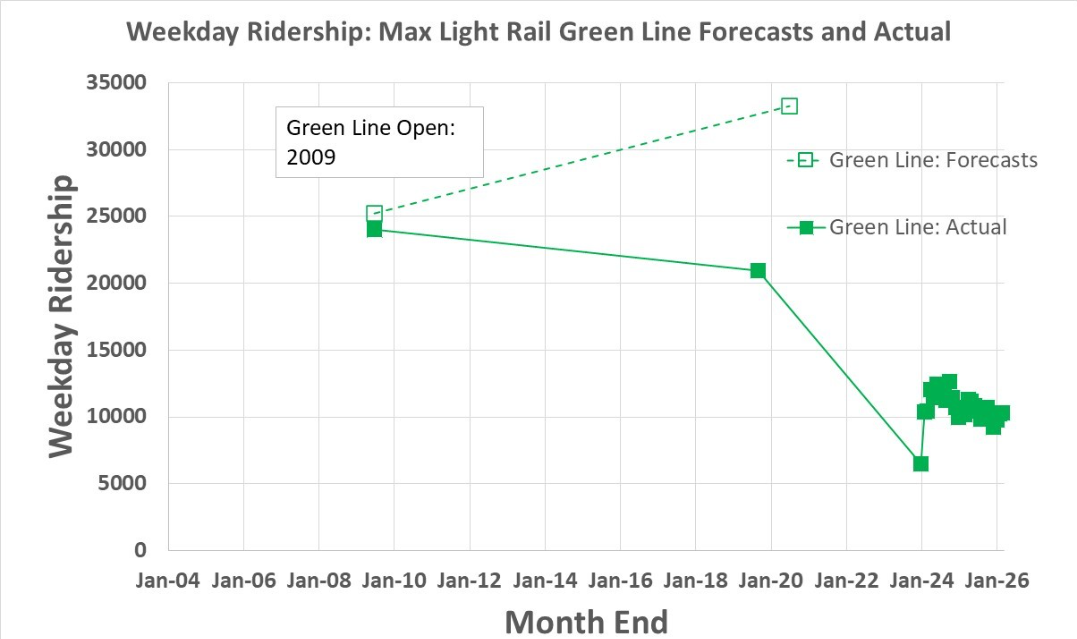
- MAX Green Line: Ridership forecasts for the 2009 opening year were made with the Oregon Metro Regional Travel Demand Model (RTDM). (The letter cites a FY 2014 Report to Congress.)
- 2009 TriMet Forecast: 25,250 average weekday riders
- 2009 Actual: 24,000
That’s good for the first year (2009), but what about since then? Since the IBR letter gave no information, I found other sources. (Data for all the graphs below: Cascade Policy Institute 2020 Letter to FTA, TriMet Light Rail Monthly Performance Reports)
- 2020 Forecast: ~33,270 average weekday riders
- 2019 Actual (pre-COVID): ~20,940 (~63% of 2020 forecast)
- 2024-2026 Actual: ~10,000 – 11,000 (less than 33% of 2020 forecast)
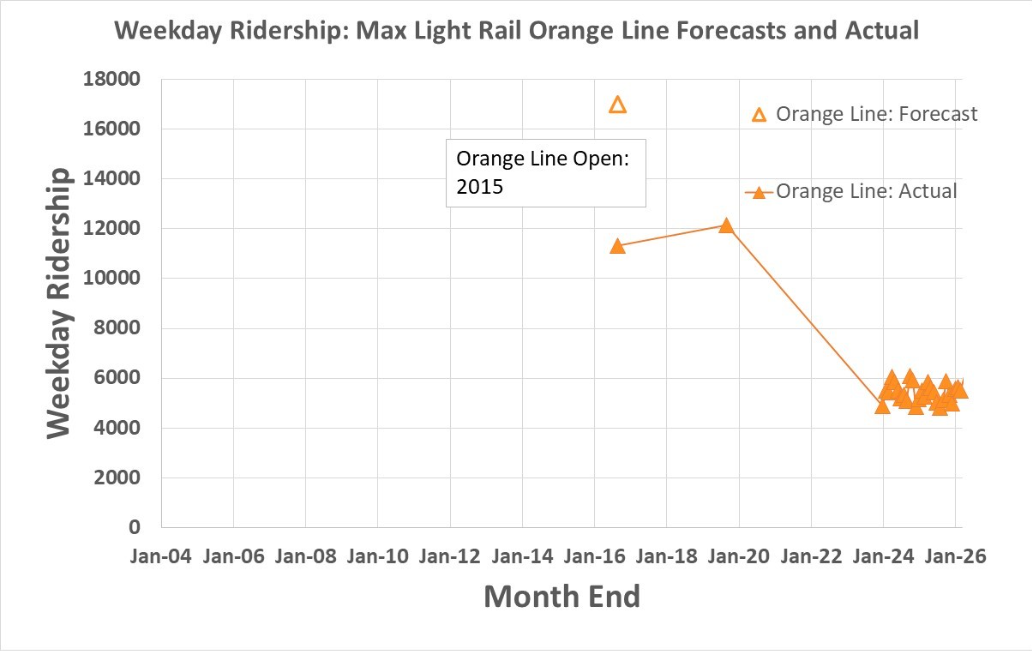
In the same Dec 10, 2025 letter, IBR admitted that the MAX Orange Line ridership forecast for the 2015 opening year was quite a bit higher than actual:
- 2015 Predicted: 17,000
- 2016 Actual: 11,300 (~67% of 2015 forecast)
IBR claimed that, after adjusting the model, they got it closer to the actual numbers. However, since funding depends on predictions made some years in advance, that is a poor excuse.
What about more recent ridership?
- 2019 Actual (pre-COVID): 12,160 (still far below the 2015 forecast of 17,000)
- 2024-2026 Actual: ~5400 (less than half of 2016 and 2019, and ~32% of 2015 forecast)
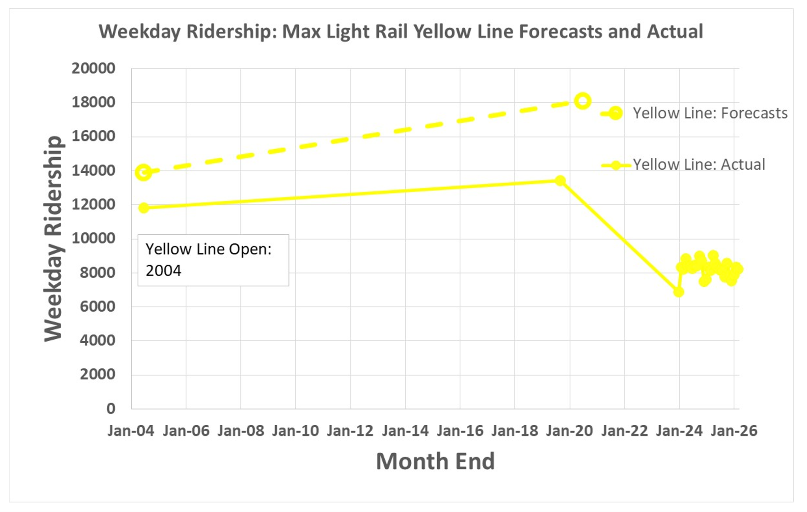
What about the MAX Yellow Line, which IBR wants to connect to Vancouver at a cost of ~$3.5 Billion? Note that this highly relevant MAX line was NOT mentioned at all in the IBR letter.
- 2004 Forecast for Opening Year: 13,900
- 2004 Actual: 11,800 (~85% of forecast)
- 2020 Forecast: 18,100
- 2019 Actual (pre-Covid): 13,430 (~74% of 2020 forecast)
- 2024-2026 Actual: ~8200 (~45% of 2020 forecast)
Conclusion: TriMet models consistently over-predict ridership, even for opening year, but especially for the future. Current ridership (2024-2026) is half to one third of forecasts.
TriMet is drowning in debt due to their own poor management and planning, and they want to make Clark County pay for it, by pushing MAX light rail across the I-5 bridge into Vancouver. This will open up access to Clark County funding through tolls across the Interstate Bridge(s), increased sales taxes, and other potential fees and taxes.
IBR is using similar flawed models to predict that transit ridership across the I-5 bridge in 2045 will be about 20x what it is now. That is in spite of the fact that bridge ridership today is half of what it was 20 years ago. These bloated forecasts are in the Final Supplementary Environmental Impact Statement (FSEIS) which has been submitted to the Federal Government for funding. These exaggerated forecasts are the basis for the light rail portion of the project, estimated at ~$3.5 billion, or about 23% of the total project cost of $15.2 billion.
Douglas Tweet
Camas

Also read:
- Letter: ‘Eileen Quiring O’Brien has earned my trust and confidence’
 Clark County Charter Commissioner Liz Cline endorses Eileen Quiring O’Brien for Clark County auditor.
 - These new WA laws take effect Thursday
 Over 200 new Washington state laws take effect Thursday, covering abortion taxes, gambling, housing, and student restraints.
 - Letter: A bad dream of tomorrow
 Peter Bracchi asks Vancouver why old homelessness programs stay funded when each new one is called the answer.
 - Rep. John Ley asks transportation secretary to deny Record of Decision for I-5 Bridge replacement project
 Ley cited scope creep and fiscal irresponsibility in urging Duffy to block the $15 billion bridge ROD.
 - Letter: Trump Derangement Syndrome endangers America’s 250th Birthday celebrations
 Jonathan Hines argues injunctions targeting White House events are poisoning America’s 250th anniversary.
 wpDiscuz
