



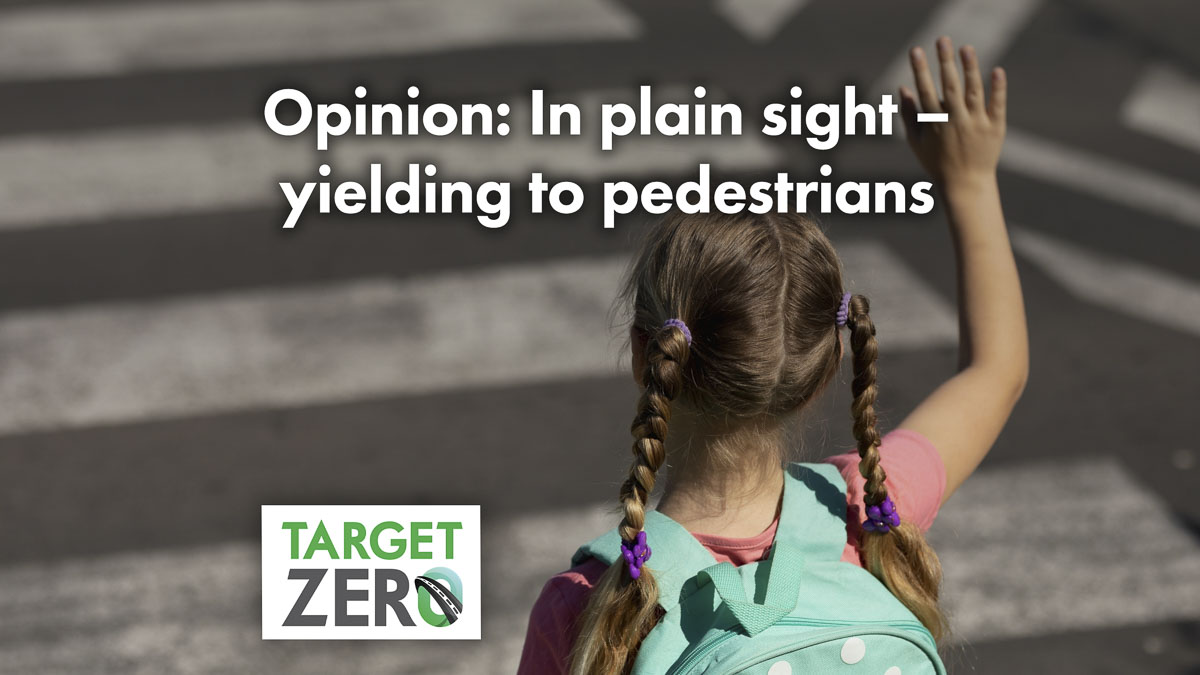
Target Zero Manager Doug Dahl addresses the need of drivers yielding to pedestrians
Doug Dahl
The Wise Drive
Q: In your last article about the right-of-way for turning drivers, you failed to point out that the drivers also need to yield to pedestrians.
A: I’m glad you brought that up. Even though it wasn’t part of the original question I should make a habit, whenever we talk about drivers and intersections, of also including pedestrians in the conversation. If we’re not talking about pedestrians when we discuss the rules, we’re probably not thinking about them while we’re driving.
As I’ve said many times, for most of us driving is the most dangerous activity we routinely participate in. But because of the way we’ve built our transportation system, even if you opt out of driving you’ll still be compelled (if you plan on walking anywhere) to take on that risk.
We can do a bit of rough math and see that the risk is stacked against pedestrians. Depending on where you are, a city block is somewhere between 200 and 660 feet (and I promise this will make sense in a moment). Vehicle lanes are generally 10 to 12 feet wide, so a two-lane road isn’t going to be narrower than 20 feet, and a four-lane road will be close to 50 feet (not including parking area and shoulders). Based on that (and I realize this is a very rough calculation, but it’s probably at least in the same zip code) only about ten percent of pedestrian infrastructure is shared with motor vehicles. And yet, in Washington 20 percent of all traffic fatalities (2020-2024) are pedestrians.
Yes, I’ve oversimplified here. But we don’t need a complicated study to confirm that there’s a gross imbalance between a multi-ton projectile and an unprotected human. That’s why our laws include more severe penalties for drivers who violate the law when it involves a vulnerable road user. And if you’re not familiar with that term, vulnerable road users include pedestrians, cyclists, motorcyclists, horse riders, and more – essentially anyone using the roadway that’s not protected by a cage. Many crashes with vulnerable road users are due to specific types of traffic infractions related to passing, tailgating, approaching an intersection, turning left, yielding or stopping in an intersection, and pulling onto a roadway.
When a driver collides with a pedestrian, a common refrain is, “I didn’t see them.” Here’s the problem: Humans have a limited capacity to process information. And it’s way more limited than you might think. Every second, we’re bombarded with about 11 million bits of information. We’re only able to consciously process about 40 bits of that information. The rest of it is lost. Sometimes that information could be in plain view and you don’t even see it. That’s called inattentional blindness.
If you’re stopped at an intersection looking for a gap in traffic, your brain will tend to filter out information that’s not “looking for a gap in traffic.” It’s possible to look right through a pedestrian in the crosswalk and not see them, because you’re focused on the traffic behind them.
Inattentional blindness is not an anomaly – it’s the norm for humans. We can’t overcome it, but we can be better at seeing the right things. Next time you’re at an intersection, say to yourself, “I’m looking for a gap in traffic, and for people crossing the road.” Then notice how your eyes and brain change their information gathering to include crosswalk areas. Then realize how much you’ve been missing before. If we’re going to be safe drivers, we need to be intentional about watching for all road users, especially the most vulnerable ones.
Also read:
- Opinion: In plain sight – yielding to pedestrians
 Drivers often fail to see pedestrians due to inattentional blindness, which highlights the need for more focused awareness at intersections and stronger safety practices.
 - Expect delays on SR 14 in Vancouver for guardrail repairs Wednesday
 State Route 14 travelers in Vancouver should plan for morning delays as WSDOT will close two eastbound lanes for guardrail repairs, affecting mileposts 6.0 to 7.0.
 - Overnight closure planned on westbound SR 14 Camas Slough Bridge Tuesday
 WSDOT crews will close westbound SR 14 at Exit 14 in Camas to collect bridge deck samples and plan future repairs; detours will be in effect.
 - Opinion: Stay in your lane – seriously, it’s the law
 Drivers must choose the nearest lane when turning in Washington, and left turns bring added risk. Even with signals, every driver must help prevent crashes by following law.
 - POLL: After hearing state leaders describe the I-5 Bridge as vulnerable in an earthquake, what is your reaction?
 State and local leaders describe the I-5 Bridge as structurally at risk but recommend drivers continue crossing it while complex replacement plans unfold.
