



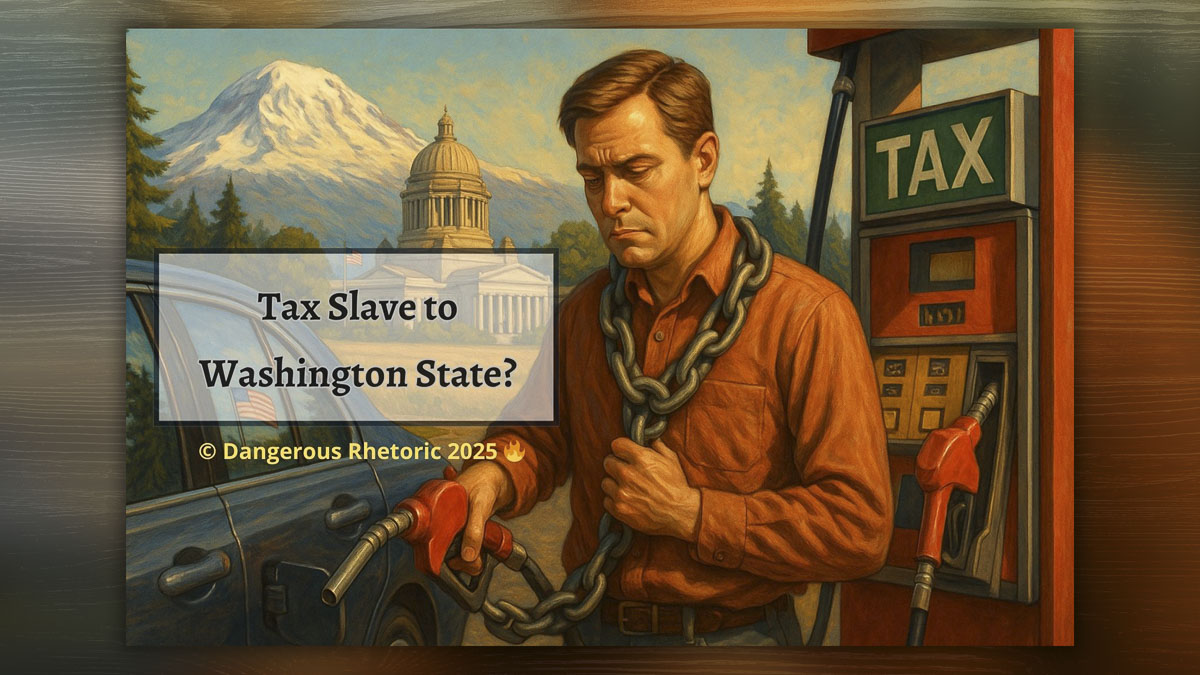
Nancy Churchill believes that a government that answers to no one will eventually take everything it can
Nancy Churchill
Dangerous Rhetoric
There was a time when taxes were considered a necessary but limited tool of government. In Washington state today, it increasingly feels like lawmakers believe your income belongs to them. That shift turns citizens into revenue streams, and that should alarm everyone who believes the government exists to serve the people.

Instead of serving citizens, lawmakers act as if working people exist to serve an ever-growing government. When your paycheck is treated as theirs to spend, taxation stops being a civic responsibility and starts feeling like economic slavery.
This is not an abstract concern. It is a pattern, visible year after year, session after session. No matter how much revenue Olympia collects, it is never enough. And the solution is always the same: more taxes.
Self-inflicted policy failures
Washington lawmakers have made “more taxes” a governing philosophy rather than a last resort. Even after adopting the largest tax increase in state history in the 2025 session, legislators are already lining up the next round of taxes for the 2026 session!
As Washington Policy Center notes, “Another proposed tax that could soon be added to the list of Washington state lawmakers’ self-inflicted health care pains was pitched last year and is back for the coming legislative session.”
Sold as a plan to expand health care access, House Bill 1560 and its Senate companion, SB 5638, would impose a new excise tax on the paychecks of certain hospital employees. The language is carefully crafted to sound compassionate, even urgent, but the structure is familiar: create a policy problem, then use that problem to justify new taxes.
The framing matters. These are not unavoidable fiscal emergencies. They are self-inflicted policy failures followed by predictable demands for more revenue.
A troubling assumption
Behind each new tax proposal lies a deeper and more troubling assumption: that the state is entitled to a fixed portion of what you earn.
Not because government spending has been proven efficient. Not because programs have been evaluated and prioritized. But simply because lawmakers believe that as the economy grows, the government’s share must grow with it. Washington Policy Center describes this mindset plainly: “State government is entitled to a fixed portion of what you earn, even if it is wasted or isn’t needed to fund important programs.”
This is not fiscal policy. It is a moral claim. It reframes the relationship between citizen and state, shifting government from a servant of the people to the primary owner of every paycheck. Under this logic, the burden is no longer on lawmakers to justify spending. Instead, the burden is on taxpayers to justify keeping their own earnings.
Punishing prosperity
One of the most common tools used to defend higher taxes is the “total personal income” metric. Lawmakers argue that if state revenue falls as a share of personal income, the state is underfunded. That claim does not hold up.
A growing private economy does not mean the government is being shortchanged; it means citizens and businesses are thriving. When lawmakers treat economic growth as a reason to demand more, they put government interests ahead of the people who created that growth.
As Washington Policy Center explains, the government is not a shareholder in economic productivity. When private-sector growth outpaces government revenue, it is not a failure of taxation but a sign of economic freedom. Yet lawmakers use this metric to justify higher taxes, effectively punishing prosperity instead of rewarding it.
A refusal to control spending
Another common claim is that population growth and rising costs require higher taxes. That argument ignores basic facts. Large organizations, including the government, should benefit from economies of scale. When more people move into the state, existing taxes already bring in more revenue without raising rates. The demand for higher taxes every time the population grows is simply a refusal to control spending.
Lawmakers also argue that taxes must rise to “balance the budget without cuts.” This language is meant to shut down debate. Cuts are portrayed as morally unacceptable, while tax increases are framed as responsible. With this mindset, they treat the taxpayer as an endless ATM, rather than citizens with finite incomes.
Are you just a tax slave?
This is how free people slowly become slaves. One tax at a time. One justification at a time. Each framed as modest, targeted, or temporary. Each defended as necessary. And each implemented tax moves Washington further away from the principle that government exists to serve the people, not the other way around.
Take Action: Step 1
If you believe our state has reached the point where “enough” should finally mean enough, the first step is simple.
Washington Policy Center has created a webpage that allows you to automatically email your governor, state senator, and state representatives with a clear message: no new taxes. Drawing that line matters, especially before the legislative session gains momentum. Go there today. Take Action.
Take Action: Step 2
Sustainable resistance does not require rallies or professional activism. It requires consistency. In Kitchen Table Advocacy, I provide a practical guide to how ordinary citizens can influence the legislature in just ten to fifteen minutes a day.
As I remind readers, “You don’t need to be an expert. You just need to start—right at your own kitchen table.”
You are the limit to government power
The government-first system only works when people believe they are powerless. It grows when citizens stay silent and assume someone else will push back. History shows the opposite is true.
Government changes when ordinary people refuse to be treated like slaves and reclaim their rightful place as free citizens. A few minutes a day is enough to draw a line and remind those in power who they work for. Government exists to serve the people, not the other way around.
A government that answers to no one will eventually take everything it can. The only real limit on that power is citizens who are willing to speak, write, and stay engaged. Refusing to give up is not symbolic; it works. When people act, even in small and steady ways, they slow the rush toward authoritarian control and help preserve and repair the republic we inherited.
Nancy Churchill is a writer and educator in rural eastern Washington State, and the chair of the Ferry County Republican Party. She may be reached at DangerousRhetoric@pm.me. The opinions expressed in Dangerous Rhetoric are her own. Dangerous Rhetoric is available on Substack, X, and Rumble

Also read:
- Letter: ‘President Trump has stopped the flooding’
 Camas resident Anna Miller argues that the immigration system’s due process framework has failed under volume and backlog, and credits President Donald Trump with prioritizing enforcement to stop illegal border crossings.
 - Letter: ‘If we want workable immigration reform, we must first restore basic human dignity to the debate’
 Vancouver resident John Ford argues that restoring human dignity to public discourse is essential before meaningful immigration reform can occur.
 - Opinion: Is the cheap fast-food burger a thing of the past?
 Mark Harmsworth argues that rising minimum wages and B&O tax increases are driving higher food prices and squeezing low-income consumers and small businesses across Washington state.
 - Opinion: Blood on the highways fails to move Ferguson and Kotek
 Lars Larson criticizes Washington and Oregon governors over licensing policies he says are linked to deadly truck crashes and ongoing highway safety risks.
 - Letter: ‘When we curtail one group’s rights we leave open the door to losing our rights too’
 Camas resident Anthony Teso argues that constitutional protections apply to immigrants and warns that limiting one group’s rights risks undermining everyone’s civil liberties.
