



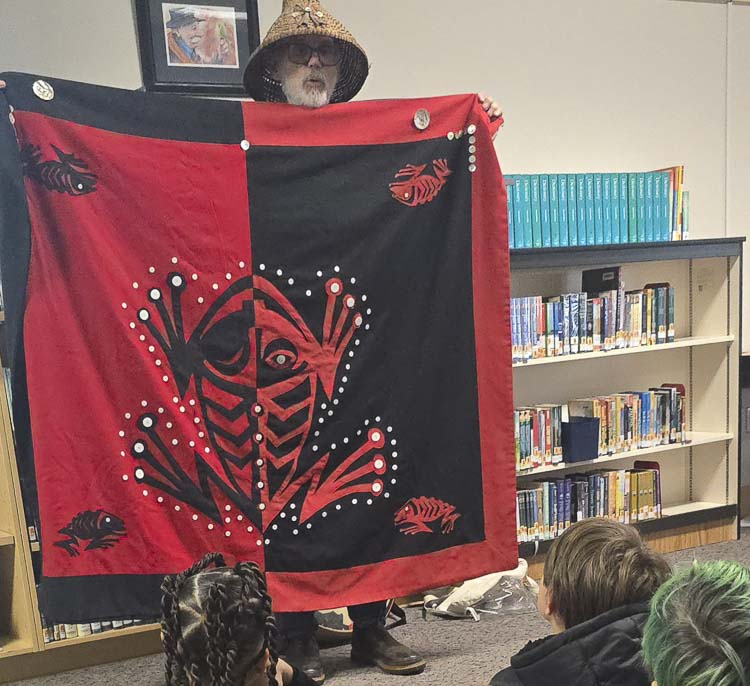
A private grant funded Chinook Indian Nation Vice Chairman Sam Robinson for three years as part of a larger project to incorporate local history into the Washougal schools
WASHOUGAL – Fourth graders across Washougal schools are getting a rare, firsthand glimpse into thousands of years of Chinook history and culture presented by Sam Robinson, Vice Chairman of the Chinook Indian Nation, and a Confluence Board Member. A private grant funded Robinson for three years as part of a larger project to incorporate local history into the Washougal schools.
Sam has completed three of four visits. He started this presentation by drumming and singing a traditional Chinook blessing. After the song, Sam talked about the Duwamish art on the drum as it was a gift from one of Chief Seattle’s descendants. When a student asked about the sources of the vibrant colors used in Chinook art, Robinson listed natural materials such as the colored inside of bark, clay in hues of yellow, blue, and red, and various berries.
Sam also shared the significance of the “spirit face” on his shirt, a symbol tied to the sacred rock carvings found along the Columbia River. Sam clarified that the Chinook people were not totem pole makers. Instead, they used art on useful things like drums, patterned baskets, Plankhouses, and canoe carving.
When Sam spoke about the 50,000 Chinook people who once lived on both sides of the Columbia River and the countless canoes that once filled its waters, a student asked what had happened to all those canoes. Sam explained that many were hidden and could still be found today. To preserve the cedar wood—which would crack if left to dry in the sun — the Chinook would fill the canoes with rocks to submerge them in water or in swampy silt. Some canoes were also sent out to sea as burials.
Another student wanted to know about how the Chinook made beads. Sam explained how some beads came from trading while others were made from shells by the Chinook people.
He detailed the traditional use of cedar for making baskets, clothing such as skirts and capes, and how, in more recent history, the Chinook incorporated wool blankets into their culture. He proudly showed his own wool blanket, featuring his spirit animal—the frog — affectionately named, “shwiqiq” (pronounced squeaky).
Sam showed images as he shared what Chinook people ate and how they traveled with the double tip design of their canoe paddles distinguishing them from other tribes. Chinook beliefs include a caution when telling a sacred story outside of the correct season – from the first frost until the frogs started singing. Sam explained he could change the story a little and ask for forgiveness from the Ancestors.. Breaking a Chinook Taboo (a rule),might lead to a bee sting or snake bite but nothing more harmful than that.
The classroom buzzed with excitement, as students asked over 20 thoughtful questions. Robinson’s enthusiasm was contagious, his pride and passion shining through every moment he spent with the students. Come meet Sam Robinson and see his colorful 31-foot canoe, Bear, at the fourth annual Parkersville Day, happening Saturday, June 7, 2025, from 12 p.m. to 3 p.m. at Parker’s Landing Historical Park.
For more information, visit: https://www.facebook.com/ParkersLandingHistoricalPark/
Also read:
- County seeking young people to fill 10 volunteer positions on Youth Commission
 Young people ages 12-19 from across Clark County can now apply for at least 10 open seats on the Youth Commission, providing input on community decisions.
 - Washougal High School students pitch energy ideas to Clark PUD
 High schoolers modeled power grid solutions, balancing future growth, clean energy laws, and everyday reliability challenges with direct input from utility experts.
 - ‘Cram the Cruiser’ to benefit Battle Ground and Prairie High Schools
 Officer Phil Anderson’s food pantry at Battle Ground High inspired Prairie High to launch its own, providing snacks and building bridges between students and law enforcement.
 - 60th Annual Hazel Dell Parade of Bands returns this May
 Twelve retired local band directors will be featured as Grand Marshals when the Hazel Dell Parade of Bands celebrates its 60th year with 120 entries and thousands of spectators.
 - Battle Ground students launch youth-led group to elevate student voices in school Funding Conversations
 Students in Battle Ground formed Youth4PS to bring their voices and fact-based information into funding and policy discussions, aiming for better communication and understanding in the school community.
