




Nonprofit organization in Vancouver distributed more than $1.6 million in medical equipment in 2024
Paul Valencia
Clark County Today
A few months ago, a woman showed up with a list of items that she could use to help support her husband who was dealing with a medical condition.
“Yep, we have that,” Jenny Thompson told her.
“We have that, too.”
Thompson, now the interim director of A Caring Closet, continued.
“It’s not going to cost you any money,” she told the wife.
“Tears were brought to her eyes. We were able to fill a need and take that burden off her shoulders,” Thompson said. “She knew that she was going to leave the warehouse that day and support her husband in a way she wasn’t sure she could support her husband.”
These stories happen often at A Caring Closet, a place where those in need can receive gently used, durable medical equipment at no cost.
Wheelchairs. Walkers. Crutches. Hospital beds. And more.
Plus donated items such as incontinence supplies are popular items.
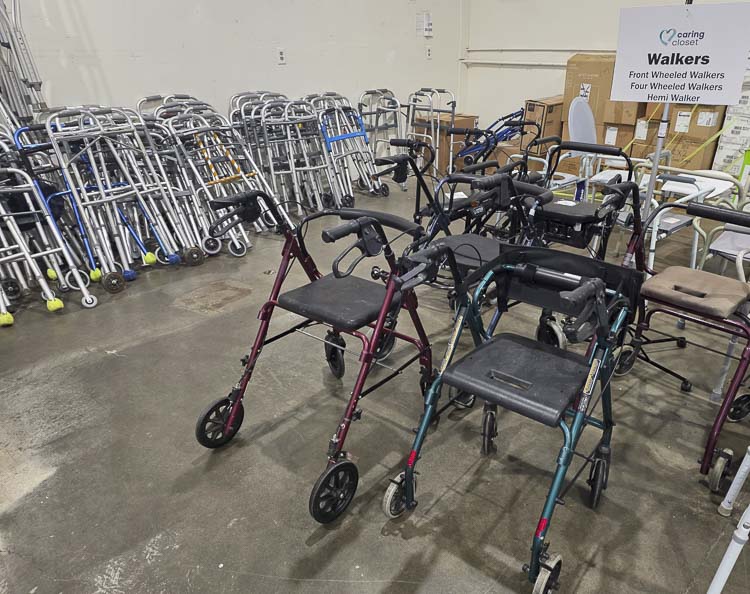
In 2024, A Caring Closet distributed $1.6 million in equipment to the community — at no cost to the recipients.
There were more than 20,000 interactions, with people either donating items or people taking items home with them for their own use or for a loved one in need.
“A Caring Closet’s Mission is to restore dignity and self-sufficiency by providing gently used durable medical equipment to those in need at no cost,” according to its 2024 Impact Report.
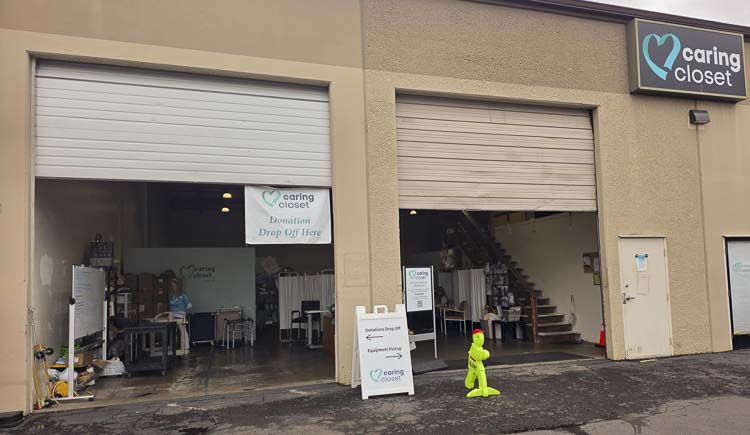
A Caring Closet is open three times a week — Tuesdays, Thursday, and Fridays from 10 a.m. until 1 p.m. — at 7500 NE 16th Ave., Suite 1C in Vancouver.
Volunteers are there to receive donations of equipment or to help give away equipment to those in need. Many of the volunteers have expertise from their work in the medical field so they can answer questions regarding the proper use of the equipment.
A Caring Closet only asks for a name of whoever takes the equipment and a zip code to record each transaction. A Caring Closet also asks that folks sign a waiver. But the equipment is free.
Co-founders Sara Scheetz and Jodie Zelazny both work in senior care. They saw a need. Some needing equipment to make their lives better or during physical rehabilitation might not have the money for such items. Even those who are insured might have to go through a lot of paperwork to use that insurance. Or sometimes insurance companies create frustrating barriers.
“Maybe we can do something about it,” Thompson said, referring to Scheetz and Zelazny’s philosophy when they started A Caring Closet roughly 10 years ago.
At first, the operation was just out of a garage. It quickly became apparent that they were right, there was a need. And a year later, A Caring Closet became an official nonprofit organization.
Besides the many people who could use equipment, there are a lot of families who do not know what to do with equipment they have that they no longer need. A loved one is rehabilitated and no longer needs the crutches, the walker. Or a loved one has passed away and the family no longer needs the hospital bed. A Caring Closet will accept those items as donations.
“This equipment had nowhere to go. It’s really good equipment,” Thompson said. “They wanted to create a space where they could reuse this equipment. They could take this gently used durable medical equipment and give it to individuals who need it.”
Thompson is a longtime supporter of A Caring Closet and a former board member and volunteer. She knew Scheetz and Zelazny, and she also grew up working with seniors in need.
“I heard the stories of how hard it was for these amazing individuals to be able to have access to basic needs and equipment to allow them to have a better quality of life,” Thompson said. “I love the fact that this is an organization that removes those barriers and allows individuals to have a better quality of life at no cost, without having to jump through hoops of insurance or copayments and other things. It does so much for our community.”
This community, and beyond.
Thompson said she is unaware of any other organization like A Caring Closet in the area. The warehouse often has visitors from as far north as Olympia and as far south as Salem.
All of this effort is made possible by volunteers and donations, Thompson said.
A Caring Closet “gives out millions of dollars of equipment to individuals in need in Clark County and beyond,” Thompson said. “But we can’t do it without our donors and our supporters.”
To give to A Caring Closet, go to: https://www.zeffy.com/en-US/donation-form/support-our-mission-with-a-donation
Also read:
- VIDEO: WA income tax signed into law with legal challenge right behind
 A 9.9% income tax affecting high earners in Washington faces swift legal opposition and a proposed citizen initiative seeking repeal.
 - Income tax signed in Washington with a legal challenge close behind
 A new law will tax households earning over $1 million, with funds aimed at expanding credits for lower-income residents. Lawsuits and challenges are already underway.
 - Peter Silliman announces candidacy for Clark County Council
 Peter Silliman, small business owner and Charter Review Commissioner, is seeking the District 5 seat and promises action on transparency, housing, and park development.
 - Opinion: Defend bail now or face more chaos on our streets
 A proposed Washington court rule would cap bail for most misdemeanors and allow defendants to bypass bondsmen, raising concerns about accountability and public safety.
 - County seeking young people to fill 10 volunteer positions on Youth Commission
 Young people ages 12-19 from across Clark County can now apply for at least 10 open seats on the Youth Commission, providing input on community decisions.
 - State Representatives McClintock and Ley answer questions at town hall in Battle Ground
 Residents voiced rising concerns about property taxes, school funding debates, the impact of new income tax legislation, and major costs tied to the Interstate Bridge plan.
 - As Washington gets an income tax, the fight to overturn it begins
 Opponents are organizing lawsuits and potential ballot measures to challenge the new 9.9% income tax on Washington households earning over $1 million.
 wpDiscuz
