


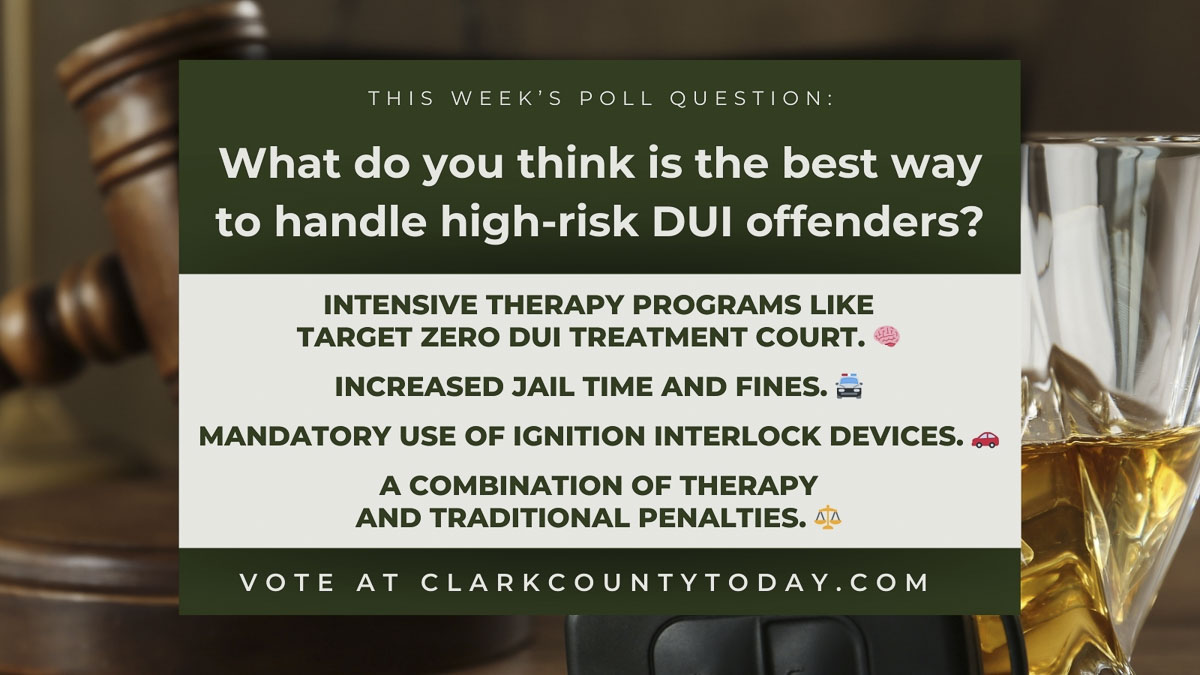
This week’s poll focuses on exploring the best ways to handle high-risk DUI offenders. As detailed in our recent story, the Target Zero DUI Treatment Court is one of the intensive therapy programs designed to address the root causes of dangerous driving behaviors. However, there are other methods to consider, such as increased jail time and fines or mandatory ignition interlock devices to prevent repeat offenses. Some believe that a combination of therapy and traditional penalties might be the most effective solution. We want to hear your thoughts—cast your vote and let us know what you think could best reduce DUI incidents and make our roads safer!
Read more about these approaches in the two-part story here:
Target Zero: DUI Treatment Court provides intense therapy for high-risk offenders

Clark County's DUI Treatment Court offers intensive therapy to high-risk offenders.
Read more
Vancouver man turns his life around, with help from DUI Treatment Court

Vancouver man Mack White turns his life around through Clark County's DUI Treatment Court.
Read more

Also read:
- Opinion: Were Republican voters just sleeping during the August primary election?
 CCRP Chairman Matt Bumala says 60% of primary no-shows in the 17th and 18th districts were Republicans.
 - Opinion: WA Cares’ launch showcased care WA Cares did not provide
 Gov. Ferguson showcased a caregiving arrangement at the WA Cares launch that the program had not paid for a single day of.
 - Opinion: Portland’s War on Cars Part 4 – A smarter automobile strategy to end gridlock
 O’Toole argues fuel wasted in Portland-area congestion has sextupled since 1982, generating 250,000 tons of extra greenhouse gases annually.
 - Opinion: The Tooth Fairy’s secrets to making brushing & flossing magical
 Delta Dental of Washington’s Tooth Fairy Experience offers free resources to help children build lifelong brushing and flossing habits.
 - Opinion: Transit ridership trends are dismal but regional plans are oblivious
 Puget Sound transit passenger-miles fell 31% from 2015 to 2024 despite a half-million-resident population increase.
 wpDiscuz