


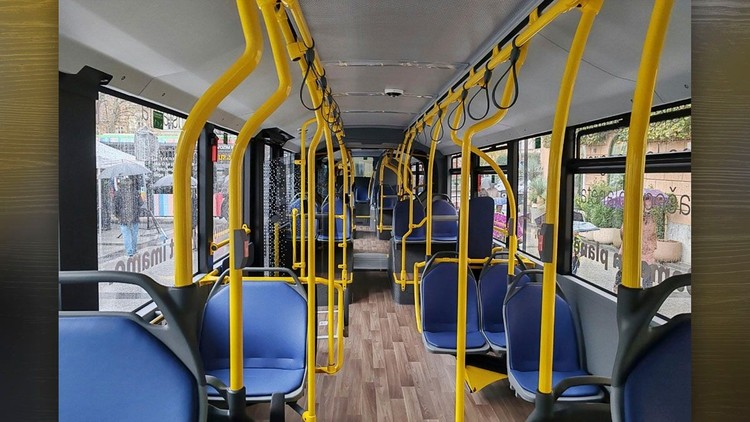
Randal O’Toole says transit ridership remains stagnant or declining and trips per average urban resident have fallen to less than half as many transit trips per year compared to 60 years ago
Randal O’Toole
The Antiplanner
Since 1965, when Congress began subsidizing urban transit, taxpayers have spent well over $1.4 trillion on transit. When adjusted for inflation to today’s dollars, that’s more than $2.1 trillion: that’s right up there in the same territory as the U.S. budget deficit.
Despite these subsidies, transit ridership remains stagnant or declining and trips per average urban resident have fallen to less than half as many transit trips per year compared to 60 years ago.
Instead of improving efficient transportation, however, transit agencies have bloated their bureaucracies by hiring thousands of extra workers. While transit operating costs increased 500 percent, worker productivity has plummeted.
The number of transit employees has nearly tripled, while the number of riders in 2025 is only 80 percent of what it was in 2019. Nonetheless, agencies are spending 55 percent more on “general administration.” (See Chart 1, below.)
Most transit makes congestion worse, not better. Outside of New York City, transit uses more energy and emits more greenhouse gases per passenger-mile than cars and light trucks. Transit does more harm than good for low-income people because most of the taxes supporting it are regressive and only 5 percent of low-income workers commute by transit.
Transit has become a colossal scam that is 10 percent transportation and 90 percent political patronage. Since transit agencies get most of their funding from taxpayers rather than fares, they have little incentive to attract new riders. The main supporters of transit today are transit unions, many of whose members earn more than $100,000 a year. Transit construction companies and manufacturers earn huge profits from building transit megaprojects.
It’s time to stop this trillion-dollar boondoggle and put transit agencies on a sensible footing. Congress will be considering new legislation, known as the Surface Transportation Reauthorization bill, in 2026. It should either end transit subsidies or make subsidies proportional to fare revenues to give transit agencies an incentive to boost ridership, not spending.
Chart 1
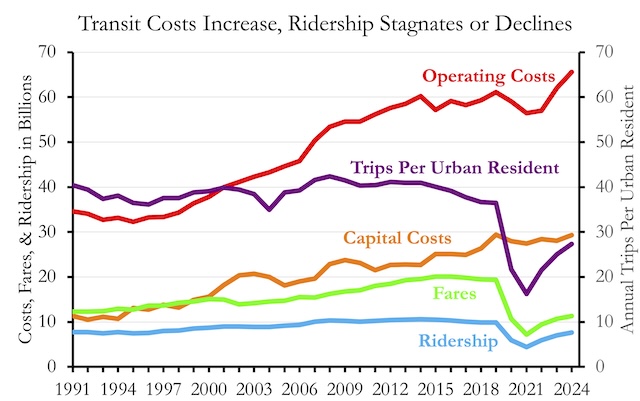
Caption: From 1965 (when Congress began subsidizing transit) to 2024, transit operating costs have increased 500 percent (after adjusting for inflation); fare revenues increased by 10 percent; ridership decreased by 10 percent; and trips per urban resident fell by 50 percent. (Source: National Transit Database Historic Time Series, 2024 edition.)
Read more at The Antiplanner by Randal O’Toole, “$1.8 Trillion for Nothing.”
Randal O’Toole is an Adjunct Scholar at Cascade Policy Institute, Oregon’s free market public policy research organization. He is a transportation and land-use policy analyst and the author of several books, including American Nightmare: How Government Undermines the Dream of Homeownership and Romance of the Rails: Why the Passenger Trains We Love Are Not the Transportation We Need. He writes from Central Oregon.

Also read:
- Opinion: ‘It may be time for McCleary 2.0’
 Dick Rylander examines the Battle Ground School District’s proposed $116,830,000 three-year EP&O levy heading to the November 2026 ballot.
 - Opinion: Were Republican voters just sleeping during the August primary election?
 CCRP Chairman Matt Bumala says 60% of primary no-shows in the 17th and 18th districts were Republicans.
 - Opinion: WA Cares’ launch showcased care WA Cares did not provide
 Gov. Ferguson showcased a caregiving arrangement at the WA Cares launch that the program had not paid for a single day of.
 - Opinion: Portland’s War on Cars Part 4 – A smarter automobile strategy to end gridlock
 O’Toole argues fuel wasted in Portland-area congestion has sextupled since 1982, generating 250,000 tons of extra greenhouse gases annually.
 - Opinion: The Tooth Fairy’s secrets to making brushing & flossing magical
 Delta Dental of Washington’s Tooth Fairy Experience offers free resources to help children build lifelong brushing and flossing habits.