


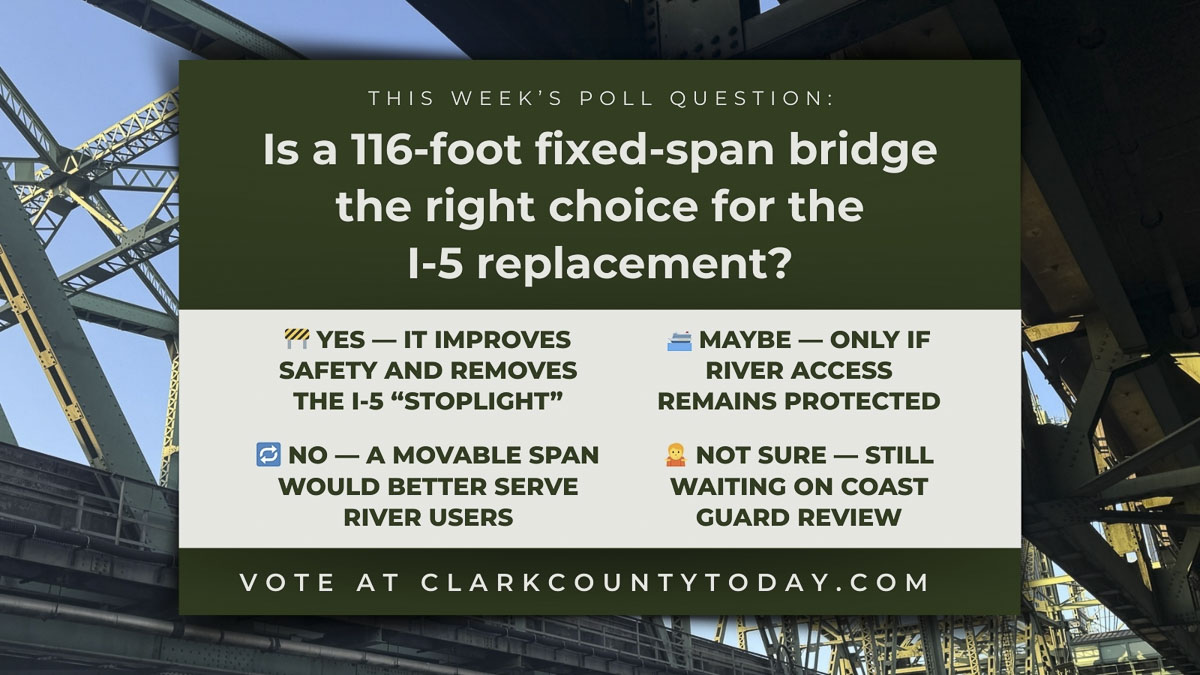
New agreements with affected river users move the I-5 Bridge project closer to a fixed-span design, raising questions about whether 116 feet of clearance is the right solution
Oregon and Washington transportation officials have signed agreements with the four river users identified as impacted by the proposed 116-foot fixed-span I-5 Bridge replacement, clearing a major hurdle as the project heads to the U.S. Coast Guard for review. Supporters say the taller fixed span would eliminate the only “stoplight” on I-5 between Canada and Mexico, improve reliability, and avoid the higher construction and long-term maintenance costs associated with a movable bridge. The agreements — totaling $140 million, paid only if the Coast Guard approves the design and construction begins — are intended to address economic impacts to river users and demonstrate project readiness. With the Coast Guard’s decision expected in early 2026, this week’s poll asks: is a 116-foot fixed span the right choice for the I-5 replacement?
More info:
Agreements reached with four river users identified as impacted by proposed I-5 Bridge replacement
Also read:
- Opinion: Portland’s War on Cars Part 4 – A smarter automobile strategy to end gridlock
 O’Toole argues fuel wasted in Portland-area congestion has sextupled since 1982, generating 250,000 tons of extra greenhouse gases annually.
 - Opinion: Transit ridership trends are dismal but regional plans are oblivious
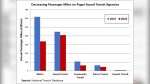 Puget Sound transit passenger-miles fell 31% from 2015 to 2024 despite a half-million-resident population increase.
 - Interstate Bridge Replacement Program seeks qualified firms for bridge replacement contract
 The CRBR project is backed by $5.7 billion from state funds, federal grants, and future tolling.
 - Opinion: Bankrupt – A $3.5 billion Rose Quarter Freeway widening project
 Joe Cortright argues ODOT’s Rose Quarter project has grown from a $450M approval to a $3.5B estimate, with a $2B funding gap.
 - Opinion: Portland’s War on Cars 3 – Ending the war on automobiles
 O’Toole argues Portland should add toll lanes, fix safety hazards, and redesign TriMet routes to end its anti-auto policies.