



Rep. John Ley provides his latest legislative update
Rep. John Ley
Legislative Update
As we approach our nation’s 249th Anniversary, let us be grateful for the wisdom and vision of our founding fathers who created this nation where we have the right to “life, liberty, and the pursuit of happiness.” Let us also be mindful that our Washington State Constitution provides that “All political power is inherent in the people, and governments derive their just powers from the consent of the governed and are established to protect and maintain individual rights.”

In this update, I’ll touch on the new budget, a decline in state revenue, record new taxes, increased recreation fees, and more. Additionally, I am pleased to have been appointed to the Joint Oregon-Washington Legislative Action Committee, which provides oversight to the Interstate Bridge Replacement project.
State Budget
On July 1, the new state budget took effect. It includes $78 billion in General Fund spending over the next two years, the largest tax increase in state history.
Washington families, seniors, and small businesses will be hard hit by the $9.5 billion in new general fund taxes the majority party chose to enact, plus an additional $3.2 billion in Transportation taxes. Gasoline taxes increased by 6 cents per gallon, and diesel fuel taxes rose by 9 cents per gallon. Overall, Washington citizens are paying roughly $1.25 per gallon more than the national average.

In June, the state’s Economic and Revenue Forecast Council provided an update to the governor and Legislature. Tax dollar “revenue” was coming in slower than forecast, reported as “grim” in one news report. The state’s bank account could be empty by the end of the biennium, despite the record level of new taxes. That’s the result of poor choices and overspending by the majority party. The state may have to dip into emergency reserves, says one report.
You communicated to me loud and clear that you are feeling the significant financial challenges of living in our state. Your groceries, utilities, insurance, medical care, transportation costs, and everything else are making our state less affordable. A new report indicates that Washington has the third-highest childcare costs in the country. I proudly fought against increasing taxes and fees, seeking to lower the burden the state puts on you and your family budget.

Home ownership is out of reach for far too many people. You can’t have affordable housing when property taxes are unaffordable. A recent report indicated Washington’s hidden housing costs are $27,444 annually. These include property taxes, home insurance, maintenance, utilities, and internet, which are the fifth-highest in all states.
Washington businesses, both large and small, are also facing challenges, as the huge increase in the state’s B&O taxes kicks in. Microsoft just announced its second round of layoffs – 9,000 people. In May, 6,000 employees were let go, targeting product and engineering jobs, Bloomberg reported. Another 300 jobs were cut in June.
Unemployment & Homeless Crisis
Over the past several months, several constituents have reached out to my office, seeking help with unemployment claims. Generally, we don’t get involved until six to eight weeks after you’ve filed. We will use your case number and the last four digits of your Social Security number to escalate the case to the Employment Security Division.
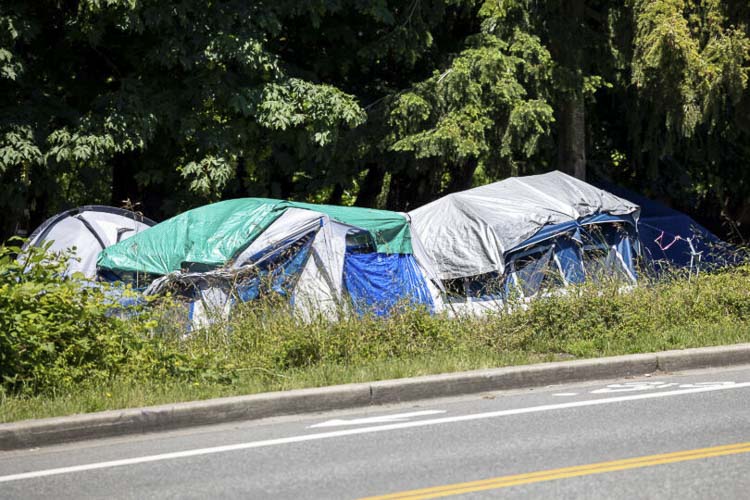
A recent report reveals that over 50 percent of homeless individuals in Spokane moved there after losing housing. Apparently, local policies have turned it into a destination city with “the potential for the number of homeless to double within five years”. Many citizens have expressed similar concerns about policies that are “attracting” the homeless to Clark County and the rest of the state.
The City of Vancouver has declared a state of emergency, and taxpayers have allocated $100 million to address the issue. They recently moved a significant tent city on Mill Plain against the sound wall for the Hough neighborhood.
Transportation Issues
Last month, the Speaker of the House appointed me to serve on the Bi-State Legislative Action Committee, which provides oversight of the $7.5 billion Interstate Bridge Replacement Program. I look forward to sharing your concerns with the other 15 members of this committee.
In June, I expressed concerns to the C-TRAN Board of Directors, which is considering rescinding its approval of the “Locally Preferred Alternative” (LPA). IBR Program Administrator Greg Johnson claimed, “You can’t build your way out of congestion”. I rebutted his claim in this column, showing numerous examples, including the significant improvement in SR-14 after new lanes were added in East Vancouver.
At the July 1st Regional Transportation Council (RTC) Board meeting, we were briefed on the 2024 Congestion Management Process. The “good news” was that SR-14 saw congestion reduced by 5 hours compared to 2023. The reason we saw this improvement is that WSDOT spent approximately $28 million on adding a new lane in each direction between 164th and I-205.
During the afternoon peak travel period, traffic congestion worsened on I-5, I-205, and SR-500 by four hours. The largest intersection for traffic volume is Fourth Plain at the SR-500/SR-503 intersection, with 70,700 vehicles passing through it. Mill Plain at Chkalov is second at 66,100 cars, and Padden Parkway at SR-503 is third with 61,600 vehicles.
Overall, the Columbia River crossings (both I-5 & I-205) saw a 1 percent increase in traffic. Clark County’s population increased by 1.7 percent in 2024, adding approximately 8,900 people. Employment grew by 2,800 jobs, and the percentage of people working from home (telework) declined from 20 percent to 18.7 percent.
The City of Ridgefield is planning to add a new vehicle corridor (map here), providing a southern connection with I-5 at SR-502, to accommodate its growing population. They are considering several options and are moving forward with Phase Two of their study, which is designed to narrow down the options.
Battle Ground continues moving forward with plans for improvements at SW Eaton Blvd.
I asked that the RTC Board get an update on TriMet’s financial situation at our next meeting in September. The Oregon legislature did not pass a huge transportation tax increase, which included a 200 percent increase in a statewide employee head tax. Therefore, the agency is threatening to cut bus service by 27% and MAX light rail service by 10%. This is extremely relevant to our ongoing discussions related to the IBR and the 1.8-mile light rail extension into Vancouver.
Over the next few months, I will participate in multiple committee meetings throughout the state. These include our Environment and Energy Committee, our Post Secondary Education Committee, and a variety of other topics.
Thank You!
It is an honor to represent you in Olympia. Please feel free to reach out to my office if you have specific concerns regarding issues at the state level. You can call the office at (360) 786-7812 or email me at John.Ley@leg.wa.gov. Have a safe and patriotic Independence Day celebration! May God continue to bless America!

Also read:
- State Representatives McClintock and Ley answer questions at town hall in Battle Ground
 Residents voiced rising concerns about property taxes, school funding debates, the impact of new income tax legislation, and major costs tied to the Interstate Bridge plan.
 - As Washington gets an income tax, the fight to overturn it begins
 Opponents are organizing lawsuits and potential ballot measures to challenge the new 9.9% income tax on Washington households earning over $1 million.
 - VIDEO: WA diesel hits record $6.53, crushing truckers and school budgets
 With diesel nearing $6.53 per gallon in Washington, trucking businesses and school districts now confront sharply higher fuel expenses affecting budgets and workers.
 - WA’s status solidifies as one of the most expensive places in US
 A new study shows Washington outpaces most states on cost of living, with metrics revealing a sharp rise in daily expenses and major metro areas ranking among the nation’s most expensive.
 - Opinion: Someone explain the Democrat Party to me please
 Lars Larson criticizes Democrat politicians for shutdown threats, Homeland Security funding refusals, and positions on election laws, housing, and gun rights.
 wpDiscuz
