


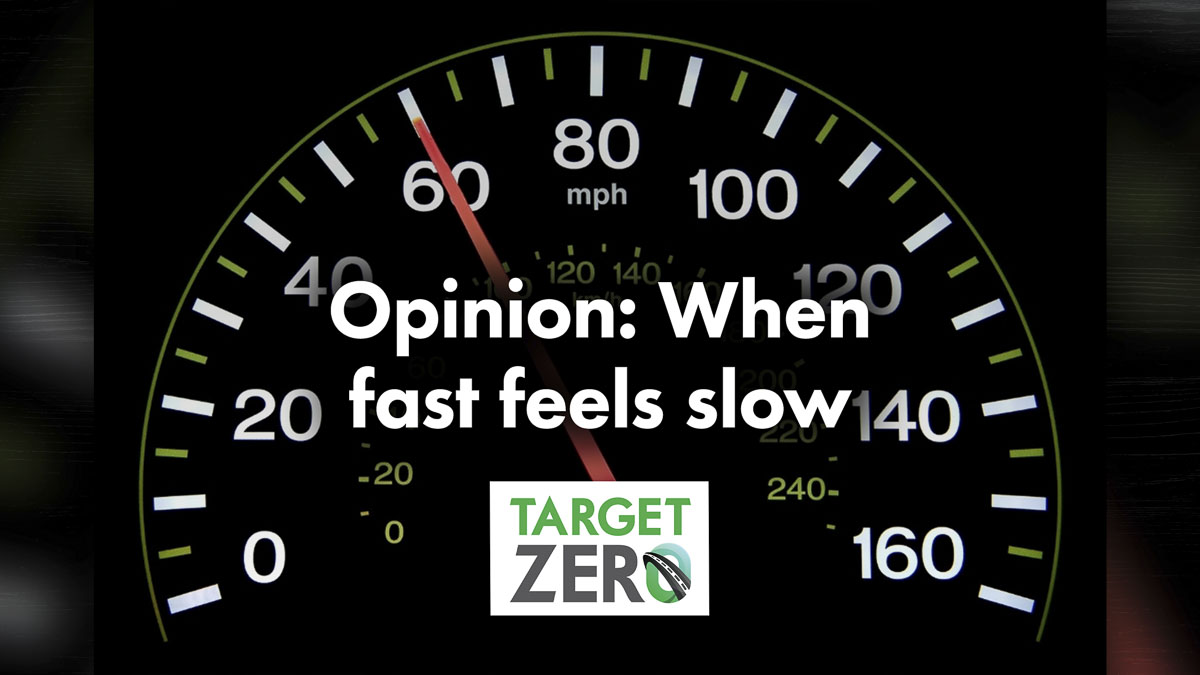
Doug Dahl answers the question of why we misperceive driving speed
Doug Dahl
The Wise Drive
Q: Why does it feel like I’m driving slower when I have cruise control on? Same goes for if I’m driving on the freeway and then exit onto a city street.
A: Have you ever been in a boring meeting, looked at your watch, and been shocked to realize that what felt like fifteen minutes was only sixty seconds? We humans aren’t the best with our internal sense of measurement. Sometimes the minutes and hours drag on, and sometimes they seem to fly by.

It’s not just time. There’s weight: thirty pounds of groceries feel heavy, but a happy thirty-pound grandchild feels almost buoyant. And distance: as someone not completely comfortable with heights, I like to say that twenty feet down is farther than twenty feet up. When I look up at something twenty feet above me it doesn’t seem that far, but when I’m standing on a twenty-foot cliff about to jump into a lake, it looks like the Grand Canyon.
We also misperceive speed. Driving 35 mph, especially after you’ve been on the freeway, feels slow, while 35 mph on a bicycle feels like a bullet train. In a modern luxury car, even 70 mph can feel tedious.
There are a few things going on here. Our eyes and our ears provide input for our perception of speed. On the freeway everything is far away, compared to city driving. The shoulders are wide, the road signs are set back, the closest trees might be 50 feet from the edge of the road, the other traffic nearly matches our speed. We don’t have any nearby markers to indicate how fast the world is zipping by.
Compare that to when you’ve encountered a freeway work zone with concrete barriers at the edge of your lane. The lane width hasn’t gotten any narrower, but now you’re zooming past objects right next to you and suddenly it feels too fast.
Then there’s the audible feedback. The sound of the engine and the road noise of the vehicle communicate how fast you’re going. As cars have become quieter and more insulated, the audio cues diminish, masking your speed. On average, drivers in noisier cars drive slower.
When you add cruise control, we notice speed even less. Our bodies don’t actually feel speed; we feel acceleration, or changes in speed. Without cruise control, a driver is continuously making small speed adjustments. With cruise on, those changes are minimized, distorting your perception of speed. Acceleration can also be felt up and down. That’s why a luxury car with smooth suspension feels slow, compared to a car with stiffer suspension.
Once you exit the freeway, you may experience something called the adaptation effect. When you travel at a fixed speed for a while, it becomes normal. If you quickly reduce your speed, you might perceive that you’re driving slower than you really are. After a few miles your brain recalibrates and sets a new normal.
The thing is, no matter how fast or slow we feel like we’re traveling, physics determines how much force there is in a crash based on our actual speed. We drive at speeds that are evolutionarily absurd. Maybe that’s partly why we have a hard time recognizing how fast we’re going; we’ve only been driving for a bit more than a century. That’s a blip on the timeline of human development; not nearly enough time for our brain to adapt to the reality and consequences of driving at super-human speeds. Regardless of how fast or slow a road feels, it’s up to us as drivers to choose a safe speed.

Also read:
- Opinion: Were Republican voters just sleeping during the August primary election?
 CCRP Chairman Matt Bumala says 60% of primary no-shows in the 17th and 18th districts were Republicans.
 - Opinion: WA Cares’ launch showcased care WA Cares did not provide
 Gov. Ferguson showcased a caregiving arrangement at the WA Cares launch that the program had not paid for a single day of.
 - Opinion: Portland’s War on Cars Part 4 – A smarter automobile strategy to end gridlock
 O’Toole argues fuel wasted in Portland-area congestion has sextupled since 1982, generating 250,000 tons of extra greenhouse gases annually.
 - Opinion: The Tooth Fairy’s secrets to making brushing & flossing magical
 Delta Dental of Washington’s Tooth Fairy Experience offers free resources to help children build lifelong brushing and flossing habits.
 - Opinion: Transit ridership trends are dismal but regional plans are oblivious
 Puget Sound transit passenger-miles fell 31% from 2015 to 2024 despite a half-million-resident population increase.