



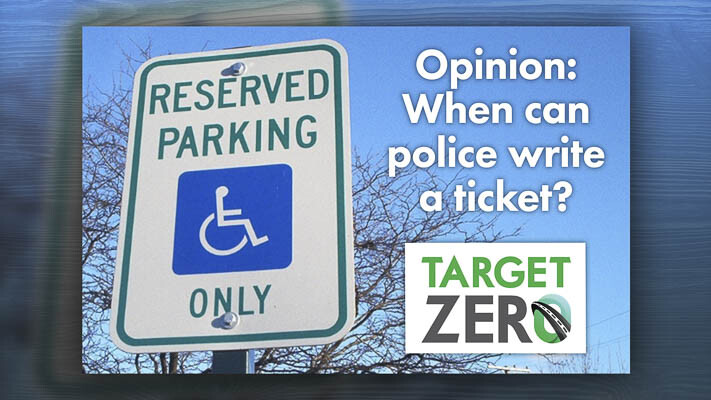
Target Zero Manager Doug Dahl answers a citizen’s question about the use of handicapped parking spaces
Doug Dahl
TheWiseDrive.com/
Q: I went to a business and was blocked from parking in a handicapped spot, even though I have a placard. The owner said they had it blocked off for an event. Later I reported it to the police. They said they’d talk to the business owner, but I feel like they’re blowing me off. How do I get the police to write the owner a ticket?
A: Sometimes the law doesn’t say exactly what it intends to say. In my first sentence I’ve already criticized law makers and made a giant assumption. Off to an inauspicious start.
The law is clear that it’s not legal for a person without a state-issued placard or special license plate to park in a spot reserved for people with disabilities. Blocking off that same spot with something other than a vehicle though, well, the Revised Code of Washington seems to leave out an important part. The paragraph titled “Inaccessible access” (a bit of an oxymoron) makes it a parking infraction to “block, or otherwise make inaccessible the access aisle located next to a space reserved for persons with physical disabilities.” Oddly, blocking the space itself without blocking the access aisle would seem to be permitted. I presume that wasn’t the intent of the people who wrote that law.
Other states make it clear. For example, California law says, “It is unlawful for any person to obstruct, block, or otherwise bar access to those parking stalls or spaces.”
I would hope that anyone charged with enforcing or interpreting this law would lean toward the side of the person with mobility challenges. In contrast, I expect that a violator’s attorney would argue the letter of the law. To keep things simple let’s say that both the access aisle and the parking spot itself were blocked off for this event. And let’s stipulate that the police have no reason to doubt your claim. How do you get them to write that ticket?
You’re not going to like this answer: You can’t. Not because I question your veracity or the willingness of the police to enforce the law, and not because I think what that business owner did was okay; it’s because the law itself doesn’t allow it. Not the laws about parking for people with disabilities; I’m talking about the one that draws a line on when police can issue an infraction.
This doesn’t just apply to disabled parking. Pick any traffic infraction. The police can’t write a ticket based on a citizen report. As prescribed by law, an officer has authority to issue a traffic infraction only when: the violation is committed in their presence, when acting at the request of another law enforcement officer who witnessed the violation, at the scene of a crash (if the evidence at the crash provides reasonable cause), or when the infraction was captured by an authorized safety camera.
That leaves a lot of violations unenforced, doesn’t it? Maybe you don’t like where that line is drawn, but you probably agree there needs to be a line somewhere. Imagine if the police issued you a traffic infraction based solely on the statement of your neighbor, who has been out to get you ever since you said his freshly painted house was the same color as baby snot. Your 25 mph might look like 35 or 40 mph to a vengeful grouch.
The limits on enforcement of infractions act as a safeguard to protect people from getting a ticket without solid evidence. Imagine a day where we don’t need this law, because no one commits traffic infractions. I can dream.
Doug Dahl is the Target Zero Manager and Communications Lead at the Washington Traffic Safety Commission.

Also read:
- Letter: ‘Public trust in elections isn’t maintained by repeating talking points’
 Camas resident demands answers after ballots discovered next to trash can, endorses Quiring O’Brien for auditor.
 - Opinion: Tax day is painful enough without Washington adding its own
 Washington’s new 9.9% income tax mirrors federal pattern: start narrow, expand to hit everyone within years.
 - POLL: What do you believe is the biggest reason school districts are facing budget shortfalls?
 Districts across Washington warn of budget gaps as debate grows over rising costs versus inadequate state funding.
 - Opinion: The high cost of hiding – Why IBR’s delayed revenue study is a $15 billion warning sign
 IBR delays critical toll revenue analysis until June 2027, hiding financial details until after project approval.
 - Opinion: The high cost of hiding – Why IBR’s delayed revenue study is a $15 billion warning sign
 IBR delays critical toll revenue analysis until June 2027, hiding financial details until after project approval.
 wpDiscuz
