



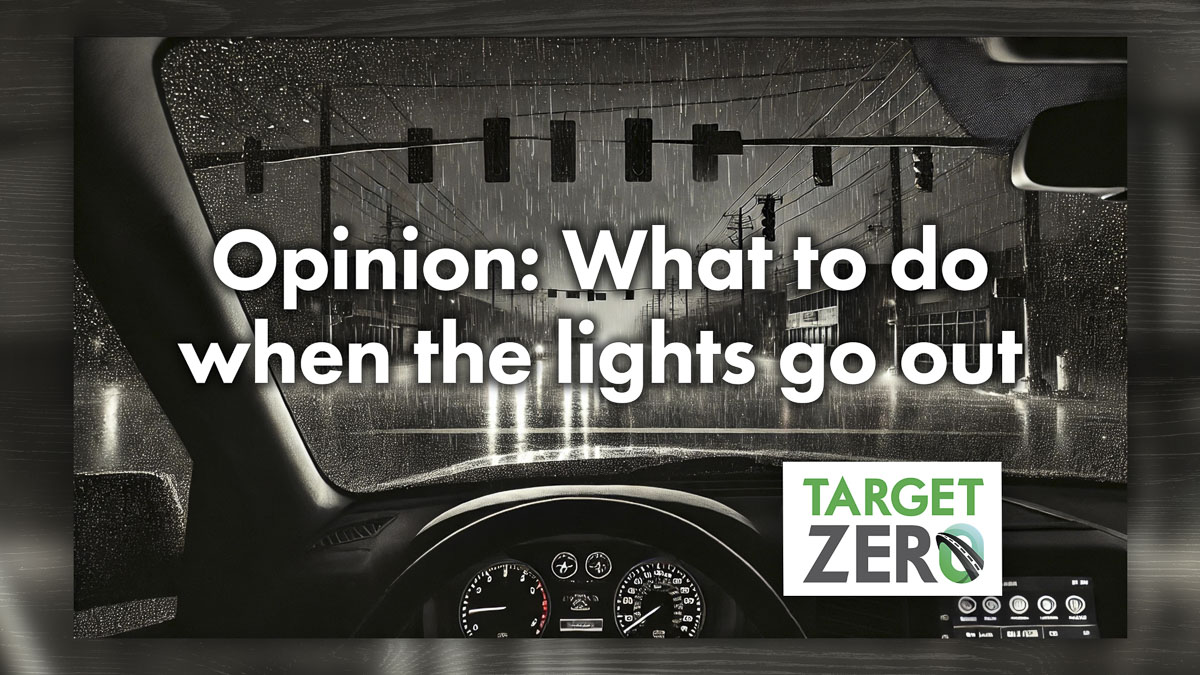
Doug Dahl answers a question about what drivers should do during a power outage
Doug Dahl
The Wise Drive
Q: Yesterday, my neighborhood had a power outage. The traffic light nearby was impacted and had no power. I believe the rule is that you treat a dead traffic light like a stop sign. I was surprised to see everyone I came across treating it like a green light and proceeding through at almost normal speed, even though I was waiting at the intersection. Am I missing something?
A: As someone completely unqualified to make any sort of psychological assessment, I’m going to do it anyway. Years ago in an intro to psychology class I learned about the fight, flight, or freeze responses to stress. And maybe that’s what you’re observing. Specifically, the freeze response.

Fight and flight are both decisive responses. I’m not sure how you’d fight a traffic signal in a blackout, but flight would be an option; you could decide to turn around and go home (or whatever route avoided traffic signals). Freeze, though, is an indecisive response. When you’re caught off guard by the unexpected situation of a dark traffic signal it triggers a bit of anxiety. You don’t know what to do, so you don’t do anything. And since your car is already traveling toward the intersection, you freeze up and let your car keep going.
Or maybe the other drivers on the road with you that day were a bunch of jerks. But I tend to subscribe to Hanlon’s Razor: Never attribute to malice that which can be explained by ignorance.
It’s power outage season. Last week’s bomb cyclone left over a half a million people in western Washington in the dark, so I suspect that many folks encountered similar situations. Fortunately, the law gives drivers directions on how to handle a non-functioning traffic signal. You’re correct in your belief; you treat it as an all-way stop. After stopping, yield to drivers already in the intersection, and if two drivers arrive at the same time, the one on the left yields to the one on the right.
In the interest of self-preservation though, I’d recommend a heightened sense of caution. As you experienced, when the driving environment deviates from the norm, not everyone acts predictably.
I mentioned earlier the unexpected situation of dark traffic signals. But really, it shouldn’t be unexpected. We had forecasts predicting the weather we got. And we should know the potential hazards that show up in bad weather.
So here’s my suggestion to all those folks that were on the road with you when the power was out. When you grab your car keys, consider the weather and ask yourself some relevant questions. Last week you might have asked, “What do I do if the traffic signals are dark? What do I do if there’s a power line on the road? What do I do if my car starts hydroplaning? What do I do if I’m stuck with a bunch of other drivers who didn’t ask themselves these questions before driving off into the storm?”
I remember thinking to myself when I first started driving, “It’s crazy that we’re allowed to drive a multi-ton projectile at 70 mph just a few feet away from someone else doing the same thing.” Once you’ve been driving for a while though, it’s easy to be lulled by miles of uneventful driving into believing it’s a mundane task that doesn’t require much attention. But storms and power outages are a reminder that a routine trip can quickly become non-routine. With a little bit of forethought we can anticipate how the weather might change our drive, so even if the roads freeze up, we won’t.
The Wise Drive is hosted by Doug Dahl, a Target Zero manager for the Washington Traffic Safety Commission.

Also read:
- POLL: After hearing state leaders describe the I-5 Bridge as vulnerable in an earthquake, what is your reaction?
 State and local leaders describe the I-5 Bridge as structurally at risk but recommend drivers continue crossing it while complex replacement plans unfold.
 - Opinion: Historical state income tax and another massive operating budget highlight the end of the 2026 legislative session
 Rep. John Ley details the passage of a state income tax, an expanding $80 billion budget, and new Clark County infrastructure funding following the 2026 legislative session.
 - Opinion: Fighting for transparency in Washington government
 A recent court decision allows Washington lawmakers broad new secrecy over internal records, as advocates report rising obstacles to government transparency and public engagement.
 - Opinion: Attacking Democracy in the name of Democracy
 Ryan Frost critiques several 2024 legislative bills, warning unchecked Democrat dominance enables policies that erode local accountability, block referenda, and threaten citizen participation.
 - Opinion: Washington passed an income tax to fund education, then the same majority cut education — and left $700+ million on the table
 State officials passed a new income tax to fund education, then approved over $1 billion in cuts—while forgoing $700 million in annual federal scholarships students could have received.
