


Todd Myers believes a combination of factors mean we are likely to see the impact of the tax on CO2 emissions increase in 2024
Todd Myers
Washington Policy Center
Washington’s new tax on CO2 emissions ended up adding about 43 cents per gallon of gas for 2023. The final price was reduced by several market interventions by Department of Ecology staff, but prices are likely to increase next year.

Ecology staff released the results from the fourth-quarter auction of CO2 emission allowances. The settlement price was $51.89, a significant drop from the previous auction price of $63.03.
The average tax on CO2 in 2023 ended up at $54.74 per metric ton, which equates to about 43 cents per gallon of gasoline and 53 cents per gallon for diesel.
The most notable thing about the allowance price is that it is one penny below the threshold of $51.90 that triggers a special auction of CO2 allowances from the credit reserve. If the settlement price had been one cent higher, Ecology officials would have held a special auction to put more emission credits on market in an effort to drive prices down.
The result of the auction is not a coincidence. Bidders recognized that Ecology’s special auction strategy was to offer a significant number of credits at the flat rate of $51.90. In the first special auction, Ecology offered just over one million allowances split between $51.90 and $66.68. In the second special auction, Ecology offered another five million credits at $51.90.
If the settlement price for the fourth quarter reached $51.90, Ecology said it would have put about two million more allowances on the market. Bidders seem to have reasonably assumed that those credits would again be offered at a flat rate of $51.90.
As a result, bidders offered $51.89, knowing that if they failed to win the allowances they needed it would be because the price hit $51.90, triggering another special auction, and there would be another opportunity to buy credits for one penny more per allowance.
A penny doesn’t seem like a lot, but for entities looking to purchase one million credits, that savings amounts to $10,000.
Ecology’s strategy of flooding the market with flat-rate CO2 allowances essentially turned the auction into a flat carbon tax. Having set the pattern in 2023, bidders may do the same in 2024. The cost, however, will be higher since the trigger price for the special auction will increase 8.2 percent to $56.16.
Additionally, the number of allowances offered for auction will decrease by 7 ½ percent in 2024, which is likely to push prices up. Unless consumer demand falls significantly, bidders who need allowances may not have a choice but to bid above the price trigger if they need the credits to comply.
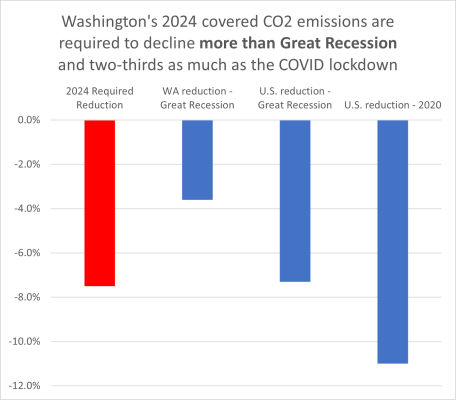
To put that 7 ½ percent reduction in context, energy-related CO2 emissions in the United States fell 7.3 percent between 2008-09 during the Great Recession. In Washington state, emissions fell only 3.6 percent during the Great Recession. We will have to double that in one year, hopefully without a recession.
During the COVID lockdowns of 2020, U.S. energy-related CO2 emissions fell 11 percent.
The combination of those factors mean we are likely to see the impact of the tax on CO2 emissions increase in 2024.
Todd Myers is the director of the Center for the Environment at the Washington Policy Center.

Also read:
- Opinion: Were Republican voters just sleeping during the August primary election?
 CCRP Chairman Matt Bumala says 60% of primary no-shows in the 17th and 18th districts were Republicans.
 - Opinion: WA Cares’ launch showcased care WA Cares did not provide
 Gov. Ferguson showcased a caregiving arrangement at the WA Cares launch that the program had not paid for a single day of.
 - Opinion: Portland’s War on Cars Part 4 – A smarter automobile strategy to end gridlock
 O’Toole argues fuel wasted in Portland-area congestion has sextupled since 1982, generating 250,000 tons of extra greenhouse gases annually.
 - Opinion: The Tooth Fairy’s secrets to making brushing & flossing magical
 Delta Dental of Washington’s Tooth Fairy Experience offers free resources to help children build lifelong brushing and flossing habits.
 - Opinion: Transit ridership trends are dismal but regional plans are oblivious
 Puget Sound transit passenger-miles fell 31% from 2015 to 2024 despite a half-million-resident population increase.
 wpDiscuz