


🎧 Share House Food Service: A Public Health Double Standard?
Peter Bracchi says compassion should never mean allowing unsanitary conditions to become permanent.
Editor’s note: Opinions expressed in this letter to the editor are those of the author alone and may not reflect the editorial position of ClarkCountyToday.com
For years, the public discussion around the Men’s Share House has focused on homelessness, blocked sidewalks, garbage, police response, cleanup costs and neighborhood impacts.

Peter Bracchi
But one issue has not received enough public attention: food service and public health.
This is not a small food operation. Share’s own 2024 Annual Report says its Hot Meals Program and Outreach Food Kits provided 96,987 free meals to the public. Share’s current Hot Meals page says it prepares, plates and serves more than 12,000 meals every month at Share House. Its website also says the program helps prepare and serve 425-plus free meals to the public every day of the year.
That scale matters.
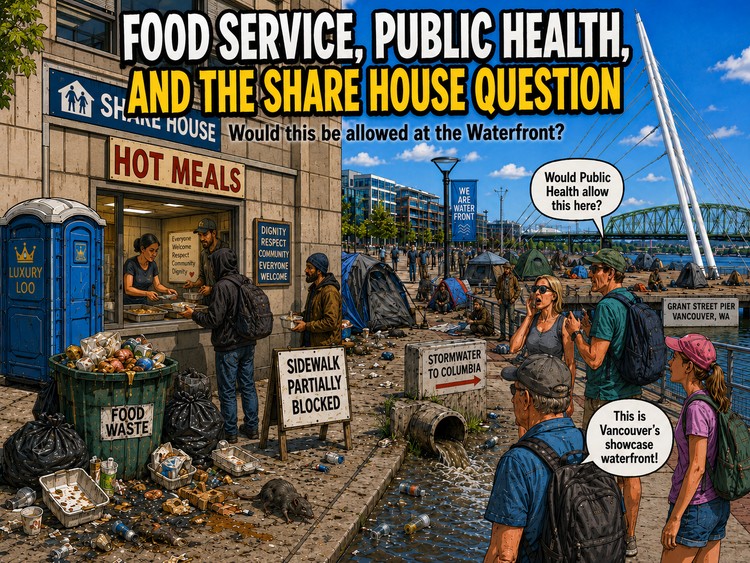
Share House is not just a shelter. It is also a major food-service location. Meals are prepared, served, handed out, carried outside, eaten nearby, and discarded in the surrounding area. That changes the public-health question. This is not only about what happens inside a kitchen. It is about the full food-service environment — inside the building, outside the doors, on the sidewalks, in the street, near storm drains, and throughout the surrounding neighborhood.
If food service at this scale contributes to outdoor gathering, food waste, garbage, rodents, blocked sidewalks, portable toilets, human waste concerns, repeated cleanups and runoff into storm drains, then Public Health should not stop at the kitchen inspection checklist.
A clean kitchen does not automatically mean a safe public-health environment.
Now imagine this same situation at the Vancouver Waterfront.
Imagine a lodging and food-service operation near Grant Street Pier serving tens of thousands of meals a year, surrounded by outdoor meal activity, trash bags, food containers, rodents, blocked walkways, portable toilets, human waste concerns and runoff flowing toward the Columbia River. Would Public Health allow that to continue for years?
Would waterfront restaurants, hotels, tourists and investors be told this was just part of the homelessness crisis?
Of course not.
There would be inspections, corrective orders, sanitation requirements, waste-control plans, sidewalk access demands, and clear public accountability. The Waterfront would be protected immediately because it is visible, valuable and important to Vancouver’s public image.
So why has the Share House neighborhood been treated differently?
This is not about opposing meals for people in need. Feeding people matters. Shelter matters. But food service must be managed safely, especially when its impacts extend beyond the building and into the public right-of-way.
Public Health should answer basic questions:
What permits or approvals cover the food service at Share House? Do they cover meals served to shelter residents only, or also meals distributed to people outside the facility? Have inspectors reviewed the outside impacts of nearly 100,000 meals a year? Who is responsible for food waste, garbage, rodents, portable toilets, blocked sidewalks and stormwater runoff connected to the surrounding meal activity? What written corrective plan exists?
The public should not have to guess.
If these conditions would be unacceptable outside a Waterfront restaurant or hotel, they should be unacceptable outside the Men’s Share House. Public-health standards should not depend on whether the neighborhood is a tourist destination.
Compassion should never mean allowing unsanitary conditions to become permanent.
Peter Bracchi Vancouver

Also read:
- Opinion: Were Republican voters just sleeping during the August primary election?
 CCRP Chairman Matt Bumala says 60% of primary no-shows in the 17th and 18th districts were Republicans.
 - Opinion: WA Cares’ launch showcased care WA Cares did not provide
 Gov. Ferguson showcased a caregiving arrangement at the WA Cares launch that the program had not paid for a single day of.
 - Auditor, auditor candidate address scrutiny over job title
 Greg Kimsey says roughly 40 county employees hold the deputy county auditor designation Kelly used in his campaign.
 - Opinion: Is Mitchell Kelly misleading voters with his ‘deputy auditor’ claim?
 Clark County HR records show no position called “Deputy County Auditor” has ever existed, Anderson argues.
 - Opinion: Democrats rig the ballot to save their income tax
 Churchill argues the ballot disclosure warning voters of education cuts describes revenue never collected and not yet allocated.