



Jason Mercier of the Washington Policy Center points out that many of the violations were with accounting and use of federal COVID relief funds
Jason Mercier
Washington Policy Center
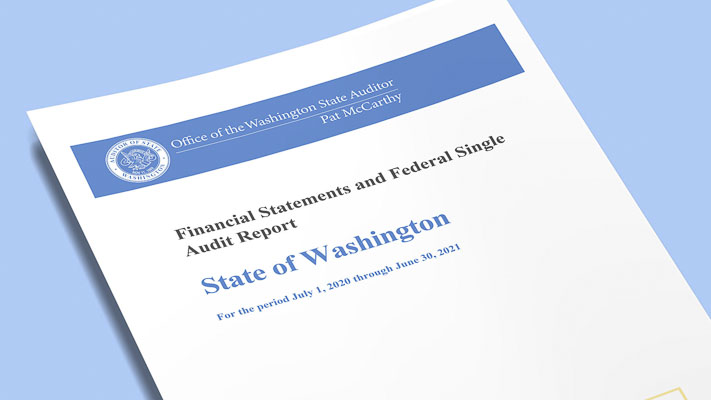
The state auditor today released Washington’s “Financial Statements and Federal Single Audit Report” covering agency compliance with federal rules in 2021. The state auditor identified 62 violations, several dealing with accounting and use of federal COVID relief funds. According to the report:

“We issued an adverse opinion on the state’s compliance with requirements applicable to the 21.019 Coronavirus Relief Fund, 21.027 Coronavirus State and Local Fiscal Recovery Funds, and 93.558 Temporary Assistance for Needy Families programs.”
Here is a sampling of the 62 audit findings:
- “The State lacked adequate internal controls over financial reporting for ensuring accurate recording and monitoring of financial activity in its financial statements.”
- “The Department of Social and Health Services did not have adequate internal controls to ensure payments were allowable and properly supported, and did not comply with federal requirements to conduct fiscal monitoring of subrecipients for the Coronavirus Relief Fund.”
- “The Department of Commerce did not have adequate internal controls over and did not comply with federal requirements to conduct fiscal monitoring of subrecipients and ensure payments were allowable and properly supported for the Coronavirus Relief Fund.”
- “The Office of Financial Management did not have adequate internal controls over and did not comply with reporting requirements for the Coronavirus Relief Fund.”
- “The Department of Commerce did not have adequate internal controls over and did not comply with federal requirements to ensure subrecipients of the Coronavirus Relief Fund received risk assessments.”
- “Washington State University did not establish adequate internal controls over and did not comply with federal requirements to conduct risk assessments of student information security for the Student Financial Assistance programs.”
- “The Office of Superintendent of Public Instruction did not have adequate internal controls over and did not comply with requirements to ensure payments to subrecipients were adequately supported for the Special Education programs.”
- “The Office of Superintendent of Public Instruction did not have adequate internal controls over and did not comply with requirements to perform risk assessments for subrecipients of the Education Stabilization Fund programs.”
- “The Department of Children, Youth, and Families did not have adequate internal controls over and did not comply with financial reporting requirements for the Child Care and Development Fund Cluster.”
- “The Health Care Authority did not have adequate internal controls over and did not comply with federal provider eligibility requirements for the Medicaid and Children’s Health Insurance programs.”
The complete 1,083 page audit and the state’s response to the 62 findings are available here.
Jason Mercier is the director of the Center for Government Reform at the Washington Policy Center.

Also read:
- Opinion: Sheriffs fight back
 Four county sheriffs are suing to block a new law giving a governor-appointed board power to decertify and remove sheriffs, bypassing voter oversight in Washington.
 - Opinion: The growing gap between public voice and political power
 Todd Myers describes how large-scale protest and sign-ins often fail to sway state leaders, and argues authentic influence is most likely found through local action.
 - Opinion: Who is winning the race for affordable power?
 Hydroelectric power keeps Washington competitive, but new laws and carbon pricing are driving up electricity costs for residents each year.
 - Opinion: Half the road, full stop – Understanding pedestrian right-of-way
 Doug Dahl explains how Washington’s law requires drivers to stop when a pedestrian is within one lane of their half of the road, not just when directly in front.
 - Opinion: The state’s RFK-proofing bill comes with a cost
 Mandates like HB 2242 can lead to higher premiums as insurance companies absorb costs for new preventive services, affecting affordability statewide.
