



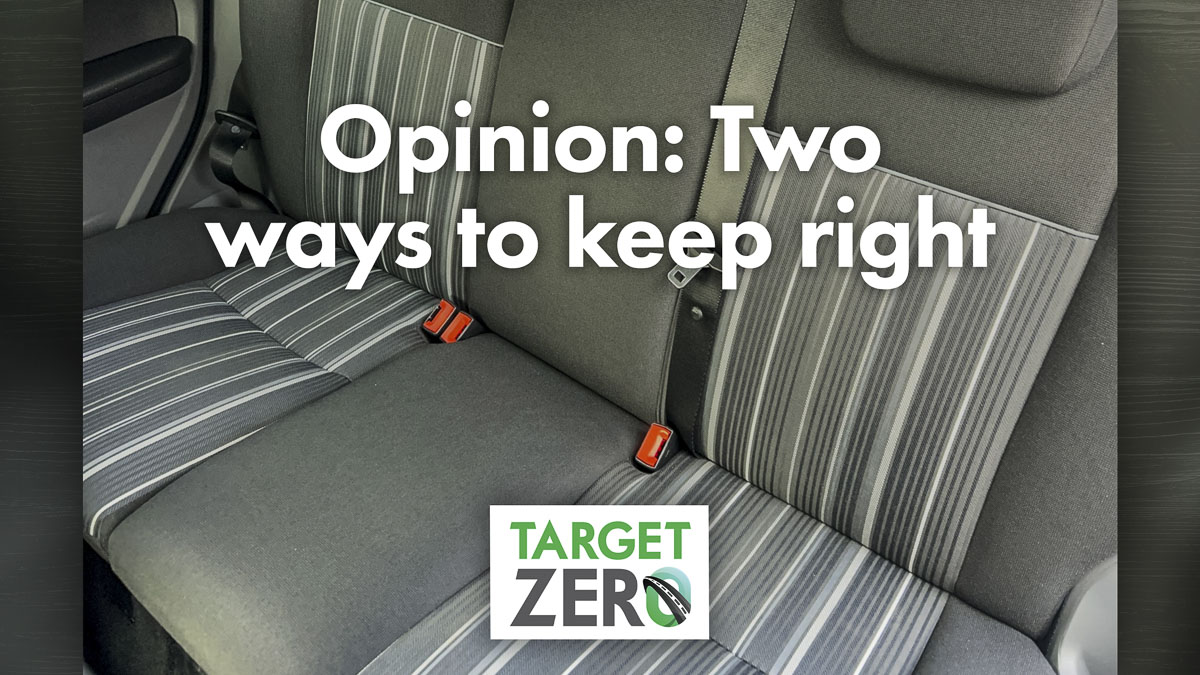
Target Zero Manager Doug Dahl provides context to an exception to the “Keep Right” Law
Doug Dahl
The Wise Drive
Q: Could you define this exception to the “Keep right” law: “Upon a roadway divided into three marked lanes and providing for two-way movement traffic?” There’s a road I drive where some sections have two-way turn lanes, and some have a cable separation where no cross traffic can happen. Do both of these areas require “keeping right”?
A: When I was a kid, the back seat of our car had three zones, defined by changes in the upholstery – my side, my brother’s side, and no-man’s land. We had to stay out of each other’s zones, but the middle area was open to both of us until it became a battle ground. Then we had to retreat to our own sides. And I promise, this does relate to the question.

I can see why there could be some confusion. It’ll probably help to point out that there are two ways to “keep right” in Washington’s law. The first way is staying on the right half of the roadway. Whether there’s one lane in each direction or four, you’re required to stay on the half of the road that’s going the same direction you are. After establishing that, the law lists five exceptions: passing a vehicle going the same direction (with some limits), going around an obstruction, one-way roads, when approaching an emergency vehicle, and the one you mentioned; two-way left turn lanes.
That middle lane is sort of like the no man’s land in the back seat of our 1976 Mercury Comet. It’s available to drivers traveling in both directions, but with limitations. It can’t be used for passing another vehicle going in the same direction. You’re not supposed to drive more than three hundred feet in the lane. It’s only for drivers turning left, and it’s obvious but I’ll still say it for the small percentage of drivers who haven’t figured it out yet, you need to use your turn signal. And like our back seat, if opposing drivers both want to use the two-way left turn lane, they have to find a way to do it without creating a conflict.
The other kind of “keep right” is when there are two or more lanes moving in the same direction. We tend to think of this as the slow people driving in the left lane on the freeway, but the law doesn’t limit this to freeways. It applies any time there are two or more lanes going the same direction. Does that mean on a freeway with four lanes in one direction, we’re all supposed to cram into the far-right lane? No, the law doesn’t insist that you drive in the farthest-right lane, but in the “right-hand lane then available for traffic.”
And again, there are exceptions: when passing another vehicle, when traveling at a speed greater than the flow of traffic (no, that’s not permission to speed), when moving over to allow traffic to merge, and when preparing to make a left turn.
The short answer to your question, then, is yes, both areas require drivers to keep right, but in different ways. In roads with traffic going in opposing directions we stay on the right half (with some exceptions), and on roads with multiple lanes in one direction we stay in the rightmost lane available (with some exceptions.)
And if you have two boys in the back seat of your car that can’t keep their hands to themselves, you tell them the lines in the upholstery are actual boundaries with real consequences, in hopes that you’ll get a few minutes of peace while you drive.
Also read:
- Opinion: Half the road, full stop – Understanding pedestrian right-of-way
 Doug Dahl explains how Washington’s law requires drivers to stop when a pedestrian is within one lane of their half of the road, not just when directly in front.
 - Opinion: What is the cost of a bridge?
 John Ley argues the I-5 Bridge replacement’s soaring cost stems from costly extras like light rail, noting other states deliver larger, toll-free bridges for much less.
 - Letter: Vancouver Mayor Anne McEnerny-Ogle makes several serious and incorrect engineering statements
 Bob Ortblad critiques engineering claims by Vancouver Mayor Anne McEnerny-Ogle, highlighting cost and safety advantages of an immersed tunnel for the I-5 crossing.
 - Washington’s studded tire deadline is March 31
 Drivers must remove studded tires by March 31 or face a $137 fine, with WSDOT urging early action due to busy service centers and no planned deadline extension.
 - VIDEO: WA diesel hits record $6.53, crushing truckers and school budgets
 With diesel nearing $6.53 per gallon in Washington, trucking businesses and school districts now confront sharply higher fuel expenses affecting budgets and workers.
