



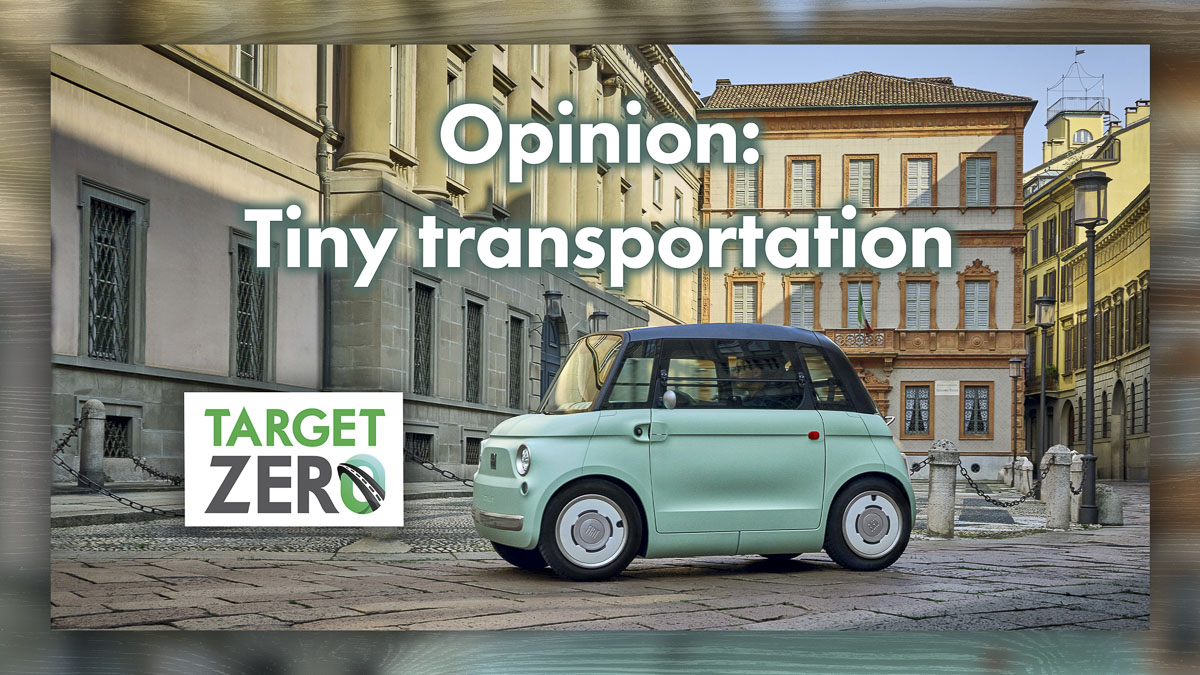
Target Zero Manager Doug Dahl answers a question about tiny car-like vehicles called quadricycles
Doug Dahl
The Wise Drive
Q: I’ve seen some tiny car-like vehicles available in Europe (from Citroen and Fiat, for example), called quadricycles. Any chance we’ll see those in the US any time soon? Are they street-legal here?
A: I don’t know how interested a car manufacturer like Fiat or Citroen is in importing their tiny quadricycles into a market that’s obsessed with giant SUVs and pickups, even if they could. But in Washington you’d be allowed to drive one on the road, with limitations, if you could get one (and that’s the tricky part).

For anyone unfamiliar with the modern quadricycle, do an image search for the new Fiat Topolino and tell me it’s not the cutest thing you’ve ever seen with a steering wheel. It would be nearly impossible to drive it in a bad mood. However, if you currently drive a Suburban because you think you need it for protection, there’s probably no way you’d ever get in that Fiat.
To answer the street-legal question we need some background. In 1998 the National Highway Traffic Safety Administration (NHTSA) created a vehicle class called “Low Speed Vehicle” (LSV). These are small car-like vehicles with a maximum speed of 25 mph. The intention was to allow these vehicles primarily in “self-contained communities” like retirement villages. Given the anticipated use of LSVs, NHTSA didn’t require the same safety standards of typical passenger cars.
In 2003 Washington approved the use of Neighborhood Electric Vehicles (NEVs) on roads with speed limits of 35 mph or less (along with a few other restrictions.) NEVs are similar to LSVs, except that NEVs, as the name implies, are always electric, while LSVs don’t have a defined power source.
In 2007 Washington added the Medium-speed Electric Vehicle (MEV) to the mix (as have several other states). An MEV is basically an NEV with a top speed of 35 mph instead of 25 mph, and the rules on where they can be driven are identical. But here’s the problem: NHTSA requires any car with a maximum speed above 25 mph to meet all the federal safety standards, while Washington requires MEVs to meet the same minimal standards as an NEV.
Since vehicle manufacturers can’t import or sell vehicles that don’t meet federal standards, you could drive an MEV in Washington, but a vehicle company can’t sell you one. Both the Citroen and the Fiat have a top speed of 28 mph (or 45 kph), the maximum for the category in many European countries, bumping it up to an MEV.
But rather than bore you with minutia about bureaucratic standards, let’s consider whether it’s even a good idea to drive one of these on our roads. Your answer probably depends on how you’re currently getting around.
No doubt there’s an economic advantage to a quadricycle. They’re cheap to buy, and pocket change to drive. But they don’t provide the protection of a modern car. Our traffic fatality rate today is far lower than it was in 1969, and much of that is due to safety improvements in vehicle design. (And some recent increases in traffic fatalities can be blamed on vehicle design – tall trucks and SUVs are killing more pedestrians.) Drive an MEV and you’re giving up much of the safety engineering of the past several decades. But if your usual mode of transportation is a bike or motorcycle, an MEV might feel like a protection upgrade.
Of course, so much of the driving risk comes from our own choices. In some circumstances (slow speeds), for some people (safe drivers), an MEV might be the right option. If you can ever get one.

The Wise Drive is hosted by Doug Dahl, a Target Zero manager for the Washington Traffic Safety Commission.

Also read:
- Opinion: Someone explain the Democrat Party to me please
 Lars Larson criticizes Democrat politicians for shutdown threats, Homeland Security funding refusals, and positions on election laws, housing, and gun rights.
 - POLL: Do you agree with requiring board members to follow council direction?
 Disagreement among county councilors centers on whether C-TRAN board members should reflect the council’s collective wishes or act independently, highlighting ongoing concerns about public accountability.
 - Opinion: In plain sight – yielding to pedestrians
 Drivers often fail to see pedestrians due to inattentional blindness, which highlights the need for more focused awareness at intersections and stronger safety practices.
 - Opinion: The legislature has committed $2.4 billion to recurring pension increases since 2018
 Six legislative COLAs have raised public employer costs by $2.38 billion since 2018, driving up unfunded pension liabilities and increasing burdens on county and city budgets.
 - Opinion: ‘Just because they got away with it doesn’t mean they weren’t wrong’
 A Skamania County deputy’s report found violations of county rules and the Open Public Meetings Act, but no prosecutor acted on the findings.
 wpDiscuz
