



Chris Cargill says the data suggests that the consequences will be measurable—in dollars, in jobs, and in opportunity
Chris Cargill
Mountain States Policy Center
 See Grok’s analysis of this story
Reviewing data can be tedious and time consuming. But important lessons can be found in statistics.
The latest IRS migration data is not simply another annual dataset—it is a window into a structural shift in the American economy. For years, analysts have tracked population movement across states, but the more important story has always been less visible: the movement of income.

What the 2022–2023 IRS data makes unmistakably clear is that the United States is undergoing a reallocation of wealth across state lines, and that reallocation is neither random nor temporary. It is directional. It is persistent. And increasingly, it appears to be influenced by policy choices made at the state level.
At its core, this is not just about where people live. It is about where economic capacity resides—where investment capital accumulates, where businesses are started, and where opportunity expands.
On one side are states like California, New York, Illinois, and New Jersey—jurisdictions with relatively high tax burdens, complex regulatory environments, and high costs of living. These states continue to experience net outflows of income, often measured in the tens of billions annually.
On the other side are states such as Florida, Texas, and Tennessee. These jurisdictions consistently post net gains in AGI, capturing a disproportionate share of mobile, high-income households.
The directional flows are not subtle. They form clear corridors: New York to Florida, California to Texas, Illinois to the Sun Belt. These are not random migrations driven solely by weather or lifestyle. They align closely with differences in tax structures, regulatory climates, and cost burdens.
Nowhere is this dynamic more visible than in the Mountain West, where Idaho, Montana, and Wyoming are increasingly positioned as beneficiaries of outbound migration from the West Coast – including Washington state.
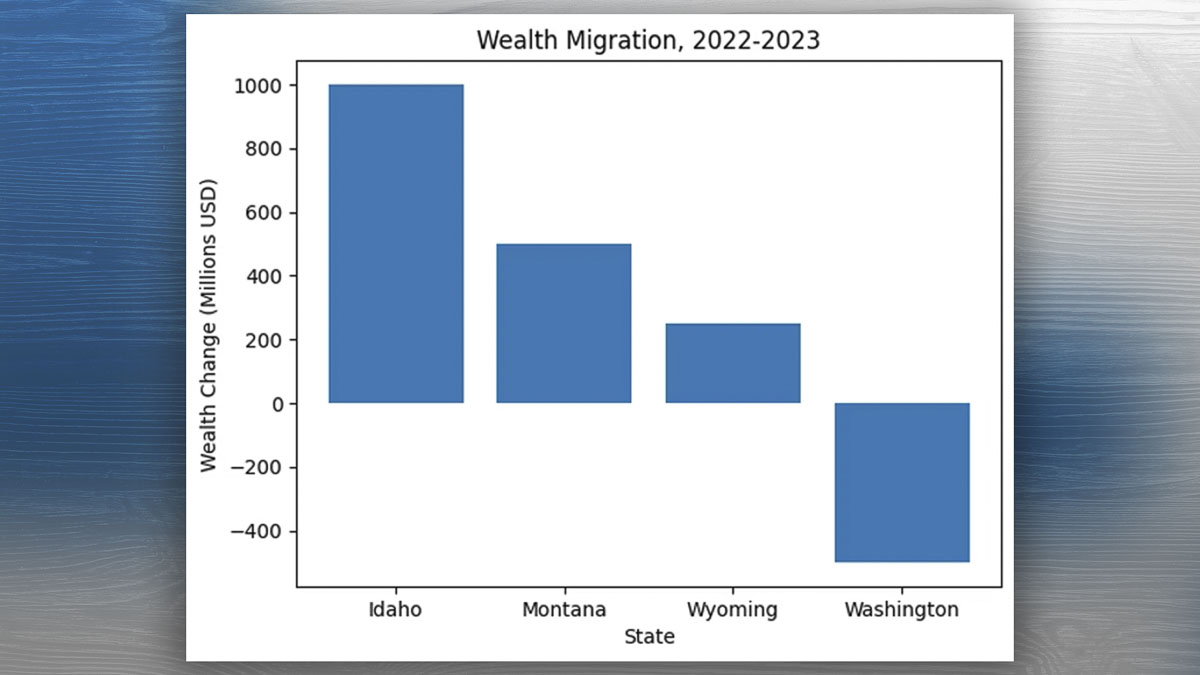
For example, Washington was one of the states that had a net outflow of wealth – and it wasn’t subtle. Washington lost half a billion dollars in wealth from 2022-2023 – just as the state was implementing its new capital gains income tax.
Meantime, Idaho, Montana and Wyoming all added more residents and more wealth.
Idaho gained more than $1 billion in wealth from its new citizens. Wyoming gained about $250 million, and Montana gained about a half billion.
In Idaho and Montana, the highest amount of in-bound wealth is coming from Washington state and California.
The IRS migration data does not tell a story of sudden collapse or dramatic exodus. It tells a more consequential story: one of gradual but persistent realignment.
States are competing—whether intentionally or not—for mobile households and the income they represent. Those that maintain competitive tax structures and predictable policy environments are increasingly positioned to win that competition.
Those that do not risk becoming net exporters of their economic base.
Idaho, Montana and Wyoming should continue to do what leaders are doing: keeping taxes low, keeping regulations predictable, and giving more entrepreneurs the tools they need to succeed.
Washington state, however, now faces a clear choice. It can preserve the conditions that have historically attracted growth, or it can adopt policies that align it more closely with states that are already losing income. The state’s new 9.9% income tax will not help.
The data suggests that the consequences will be measurable—in dollars, in jobs, and in opportunity.
And once wealth leaves, it rarely returns on its own.
Chris Cargill is the president of Mountain States Policy Center, an independent free market think tank based in Idaho, Montana, Wyoming and Eastern Washington. Online at mountainstatespolicy.org.

This independent analysis was created with Grok, an AI model from xAI. It is not written or edited by ClarkCountyToday.com and is provided to help readers evaluate the article’s sourcing and context.
Quick summary
In this opinion column, Mountain States Policy Center President Chris Cargill points to IRS migration data showing Washington lost about $500 million in wealth from 2022 to 2023 while Idaho, Montana, and Wyoming posted significant gains. He argues the pattern reflects an ongoing shift of wealth and economic capacity away from higher-tax states such as Washington and toward lower-tax neighbors, especially after Washington’s adoption of a capital gains tax.
What Grok notices
- Uses IRS migration data as the column’s backbone, highlighting net wealth movement figures such as Washington’s reported loss and Idaho’s reported gains to illustrate directional change.
- Frames the trend as a regional comparison, contrasting Washington’s newer tax policies with the lower-tax positioning of Idaho, Montana, and Wyoming.
- Links wealth migration to broader economic consequences, suggesting that movement of high-income households can affect jobs, investment, and future opportunity, not just tax collections.
- Emphasizes policy predictability and low-tax environments as competitive advantages for states receiving inbound wealth.
- Signals that readers who want to test the argument further should review the latest IRS state-to-state migration tables and compare them with state revenue and population data over time.
Questions worth asking
- How could continued outbound wealth migration affect Washington’s long-term revenue base, business formation, and funding for public services?
- What policy changes, if any, have helped other high-tax states slow or reverse similar wealth outflows?
- How much of these migration patterns can be explained by taxes versus other factors such as housing costs, regulation, lifestyle, or remote-work flexibility?
- How do Washington’s recent tax changes compare with migration patterns seen in other states after major tax-policy shifts?
- What strategies could lower-tax states use to convert inbound wealth gains into sustained local investment rather than temporary residency changes?
Research this topic more

Also read:
- Opinion: State is rightly emphasizing experience and skills, not degrees
 Elizabeth New explains how a new state policy removes unnecessary advanced degree requirements, supporting skills-based employment and broadening opportunities for capable workers.
 - Opinion: The wealth migration is real – which states are benefiting?
 IRS data shows Idaho, Montana, and Wyoming attracted significant wealth from new residents, while Washington state saw a loss of $500 million as its new capital gains tax took effect.
 - Opinion: Voting with the Democrat Party – Back to the future!
 Lars Larson connects the history of election rules to today’s debates, highlighting Supreme Court concerns over counting ballots after Election Day.
 - Opinion: ‘Stay close, stay informed, stay the course’
 Anna Miller calls on residents to join Clark County Republican Women’s dinner, urging perseverance and unity as local government faces turbulent times.
 - Opinion: Will the income tax cause a drop in charitable giving?
 High-income households leaving Washington after new tax may redirect donations, possibly shrinking local nonprofits’ funding despite the intended deduction benefit.
