




Area resident Carolyn Schultz-Rathbun offers her insight and perspective on the Hockinson School Bond
Carolyn Schultz-Rathbun
for Clark County Today
At first glance, the Hockinson school bond measure looks like every school bond conversation everywhere. Parents and administrators enthuse over things the new bond would provide: a second elementary school, safety improvements at existing schools, a high school career and technical building, a covered outdoor area at the middle school, improved traffic flow at the current elementary school, a new high school track, and artificial turf on the high school football/soccer field.

Opponents argue that the $88 million dollar bond, on top of an existing bond and levies, is too expensive for a small, semi-rural community with no industry and few businesses.
But dig a little deeper, and there’s much more to see.
Nestled into the foothills of the Cascades, downtown Hockinson is still barely more than a wide spot in the road: three churches, two schools, two small markets, a fire station, a gas station, and a stop sign. The huge white frame Cloverleaf Mercantile & Event Center building, built in 1931 by the United Finnish Kaleva Brothers and Sisters and commonly known as Finn Hall, stands as a mute memorial to the town’s origins as a largely Finnish farming and logging community.
But people came, and kept coming – from Oregon, California, Seattle, and other places – attracted by cheaper land, rural beauty, and good schools. Now the community is a mixture of tiny farmhouses and huge new homes; of three generations on the same road and recent arrivals.
On the surface the bond conversation revolves around data: numbers of students in schools and programs, cost of the bond per thousand dollars of assessed property value. But after a while you can hear a split at the heart of the conversation.
The voice of the bond for the district is Superintendent Steve Marshall, a 25-year Camas resident and former principal of Camas High School. In the community, the most visible member of the Facilities Planning Committee is Brian Hebert, a Colorado native who has volunteered in a variety of roles since moving to Hockinson 10 years ago. They emphasize crowding at the elementary school, which uses 24 portables to handle being 224 students over capacity, and the district’s frugality.
“We operate efficiently,” Marshall said at a recent bond open house. We pursue grants and matching funds. We’ve received technology grants, for example, that have allowed us to update our Chromebooks, among other things.”
The chair of the committee writing the County Voters’ Guide Opposed statement is Connie Pietila Keen, a fourth-generation Hockinson resident who still farms the land her great-grandparents homesteaded in 1895. Keen says she has always supported school bonds and levies, until now.
“I feel like the district is focusing so much on what school-age families are requesting right now, and they haven’t really considered the long-term consequences,” says Keen. “There are items included in the bond that can be accomplished less expensively. What happens in 10 years when the middle school is bursting at the seams? The way this bond is structured leaves no room to add another bond until 2045 without adding significant tax dollars on taxpayers’ bills.”
Hockinson Citizens for Responsible HSD Spending, a Facebook page run by residents opposing the bond, emphasizes not only the numbers – if the bond passes, they say, the average Hockinson homeowner will be paying just over $5,100 a year for schools alone–but the effect bond passage would have on long-time residents.
Marla Burns, part of the group, says she’s fighting for her father, Harvey Mason. Mason and his wife, Susan, moved to Hockinson in 1975 and ran a small dairy farm, where they raised Burns and her brother. Mason recently sold most of his farm.
“Rising taxes and a school going in directly across from his very quiet property is very upsetting to him,” says Burns. “His hard work and love has gone into our family home. But the reality of keeping a large property with continuously increasing taxes is just not logical.”
Mason is still here for now, but others aren’t. A single parent moved out of Hockinson in the face of rising property taxes.
“I voted with my tax dollars,” said the parent, “by selling off my farm.”
One resident says Social Security isn’t enough to cover both mortgage and property taxes since her husband’s recent death. A Hockinson resident for almost 40 years, she is putting her house on the market and moving to a retirement home. An active gardener, the resident says she is “completely distraught” to lose her garden and her home.
Even strong school supporters are getting caught in the rising tide. Christi and Loren Carlson moved to Hockinson in 1997 and raised two children who attended Hockinson schools. Loren was an assistant high school football coach; Christi held a succession of board positions with the PTO and booster clubs. But a few years after their kids graduated, they moved to Mossyrock. Both children have moved out of the community as well. “It’s too expensive in Hockinson any more,” says their daughter, Emily Carlson. “I just bought a house in Kelso.”
Keen says property taxes averaged just over $7,000 last year, most of that for schools, and will be higher this year, even without the bond.
“We’re losing the people who made Hockinson what it is,” says Burns. “Of course we have to take care of our kids. But we need to take care of our neighbors, too.”
For more information:
Hockinson Citizens for Responsible HSD Spending
SW Washington Education: “Hockinson School District 2025 Bond”

Also read:
- Opinion: Tax day is painful enough without Washington adding its own
 Washington’s new 9.9% income tax mirrors federal pattern: start narrow, expand to hit everyone within years.
 - POLL: What do you believe is the biggest reason school districts are facing budget shortfalls?
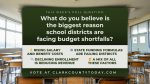 Districts across Washington warn of budget gaps as debate grows over rising costs versus inadequate state funding.
 - Opinion: The high cost of hiding – Why IBR’s delayed revenue study is a $15 billion warning sign
 IBR delays critical toll revenue analysis until June 2027, hiding financial details until after project approval.
 - Opinion: The high cost of hiding – Why IBR’s delayed revenue study is a $15 billion warning sign
 IBR delays critical toll revenue analysis until June 2027, hiding financial details until after project approval.
 - Opinion: Washington fails the test for affordability
 Mountain States Policy Center analysis reveals Washington ranks 5th most expensive state as residents migrate to Idaho and Texas.
 wpDiscuz
