


Area resident and former County Councilor Dick Rylander attempts to help you better understand where your taxes are going and what the future impact of new taxes may be
Dick Rylander
for Clark County Today
When we see tax proposals come to the ballot those in support frequently refer to the “rate” rather than the total dollars to be collected. This “rate” is shown as an estimate of $$$ per $1000 of assessed value. Those writing the tax proposals usually show examples of the average or median home price and then do some math to show the impact.
For instance a tax may be $1/$1000. If the home value example used is say $400,000 then the actual amount of taxes would be $1 x 400 = $400. What is the median home value in Clark County. WA estimated to be currently? (Note: median means ½ of values are higher and ½ are lower). It appears that $550,000 is a reasonable estimate.
The higher the assessed value the higher the cost to the property owner. If, in this example, the assessed value was $1,000,000 then the tax owed would be $1 x 1000 = $1,000 or 2.25x more than the $400,000 example.
In today’s market what’s the distribution of assessed values as of 2024? Are there a lot of high value homes?
The Assessors Office did some research and were able to supply the following chart. Please accept that it is an estimate and a snapshot.
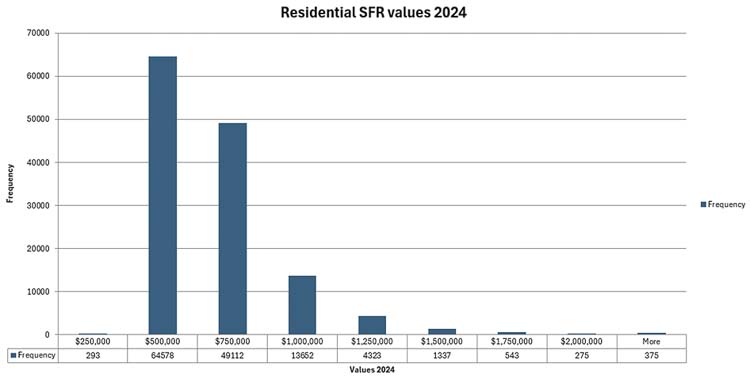
There are a total of 134,488 properties. Of those it appears that there are 20,505 of $1,000,00 or more which works out to about 15.2%.
What’s the value in knowing this distribution and knowing your own assessed value (and how the taxes are distributed) you can better understand where your taxes are going and what the future impact of new taxes may be.

Also read:
- Opinion: Were Republican voters just sleeping during the August primary election?
 CCRP Chairman Matt Bumala says 60% of primary no-shows in the 17th and 18th districts were Republicans.
 - Opinion: WA Cares’ launch showcased care WA Cares did not provide
 Gov. Ferguson showcased a caregiving arrangement at the WA Cares launch that the program had not paid for a single day of.
 - Opinion: Portland’s War on Cars Part 4 – A smarter automobile strategy to end gridlock
 O’Toole argues fuel wasted in Portland-area congestion has sextupled since 1982, generating 250,000 tons of extra greenhouse gases annually.
 - Opinion: The Tooth Fairy’s secrets to making brushing & flossing magical
 Delta Dental of Washington’s Tooth Fairy Experience offers free resources to help children build lifelong brushing and flossing habits.
 - Opinion: Transit ridership trends are dismal but regional plans are oblivious
 Puget Sound transit passenger-miles fell 31% from 2015 to 2024 despite a half-million-resident population increase.
 wpDiscuz