



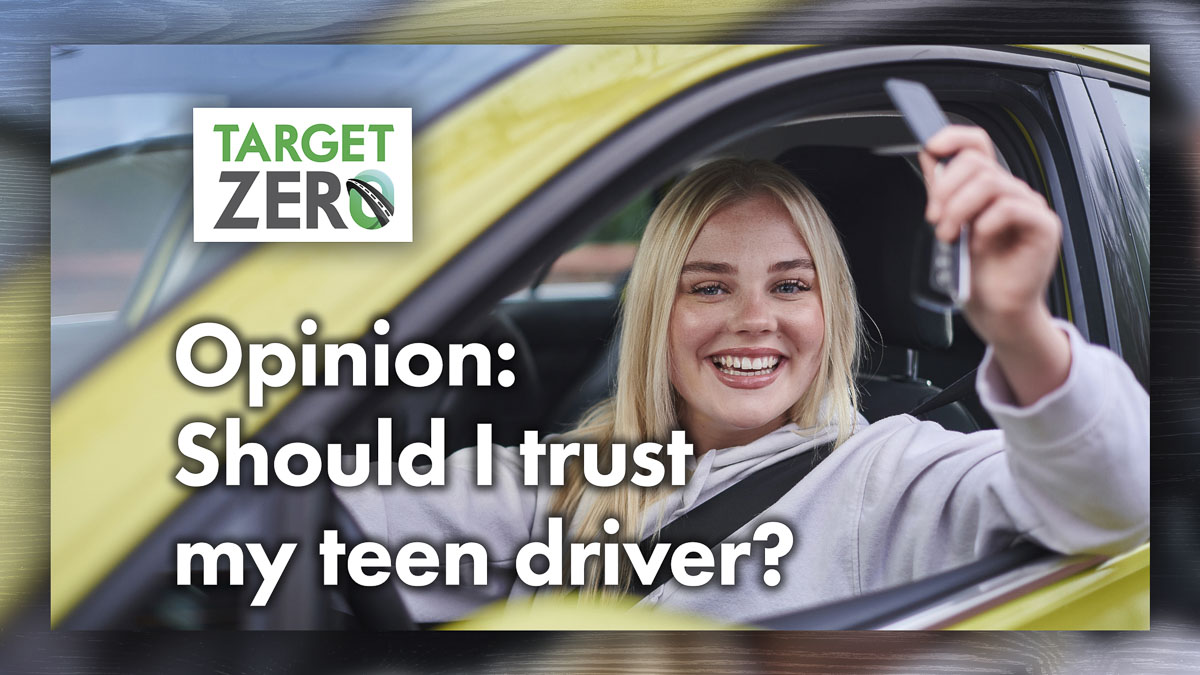
Target Zero Manager Doug Dahl addresses a question about teen drivers and safe driving decisions
Doug Dahl
The Wise Drive
Q: How much should parents trust their teen drivers to make safe driving decisions?
A: Almost every week I respond to a reader’s question, but this week’s question is mine. I got to wondering after reading a new survey of teen drivers and parents.

We’re not always the best at assessing reality. What do I mean by that? Well, as one example, somewhere between 70 percent and 93 percent of American drivers (depending on the study) consider themselves better than the average driver. Either there’s some strange new math going on, or at least some of us are wrong about our driving skills. And, despite crash data saying otherwise, about 15 percent of Americans think we’re the best drivers in the world. (It should be noted that nearly the same amount of us think we’re the worst.)
Maybe the problem is all those giant foam hands with the extended index finger claiming, “We’re number one!” More likely, it’s something called illusory superiority, a fancy way of saying we overestimate our abilities compared to other people.
And apparently, we extend that illusion to our kids too. A recent survey from Progressive Insurance asked, “Are teens cautious drivers?” Sixty percent of parents said yes, while only 47 percent of teens agreed. Parents were even more confident (70 percent) in their own teens’ safe driving. And even though nine percent of teens admitted to aggressive driving, only three percent of parents thought their kids drove aggressively.
There’s nothing wrong (and a lot right) about believing the best of our kids. But we should also stay connected with reality. Young drivers (age 15-24) make up about 11 percent of licensed drivers in Washington; they were involved in 29 percent of all traffic fatalities in 2023. Traffic crashes are the leading cause of death for people age 15-24 in the US, and the third-leading cause in Washington.
It’s easy to blame the next generation, but part of the problem might be the adults. In the same survey, 48 percent of parents said they were cautious drivers; the teens thought it was more like 35 percent. And while only three percent of parents admitted to aggressive driving, 20 percent of teens said the parent they most often ride with drives aggressively.
It’s hard to model good driving for our kids if we don’t even judge ourselves accurately. For anyone who considers themselves an above-average driver, how did you come to that conclusion? If you think you’re an above-average basketball player, it’s pretty easy to prove it. Just get on the court with other players and you’ll quickly see where you land. But when there’s not a clear standard for measuring (like with driving), we tend to emphasize where we’re strong and minimize where we could improve.
So I’m proposing some measurements for safe driving. The first six should be a cakewalk: drive sober, drive the speed limit, eliminate distractions, wear a seat belt, use your turn signals, and don’t tailgate. Let’s call that the bare minimum. Then, maintain situational awareness (including other drivers as well as pedestrians and cyclists), be courteous, remain calm under pressure, and maintain your vehicle.
I could list more, but that’s ten so it’s easy to score. And even if you don’t agree with my ten measurements, at least we’re thinking about what it takes to be a good driver.
For the parents, talk with your kids about your own list of good driving traits and observe their driving to see how they stack up. Then you’ll have at least some indication of how much you can trust that they’re driving safely.
The Wise Drive is hosted by Doug Dahl, a Target Zero manager for the Washington Traffic Safety Commission.

Also read:
- Opinion: Half the road, full stop – Understanding pedestrian right-of-way
 Doug Dahl explains how Washington’s law requires drivers to stop when a pedestrian is within one lane of their half of the road, not just when directly in front.
 - Opinion: The state’s RFK-proofing bill comes with a cost
 Mandates like HB 2242 can lead to higher premiums as insurance companies absorb costs for new preventive services, affecting affordability statewide.
 - Opinion: What is the cost of a bridge?
 John Ley argues the I-5 Bridge replacement’s soaring cost stems from costly extras like light rail, noting other states deliver larger, toll-free bridges for much less.
 - POLL: Do you agree with giving a state commission the power to remove an elected sheriff?
 A new poll asks if a state commission—not voters—should have the power to remove an elected sheriff, following concerns raised by Clark County Sheriff John Horch.
 - Opinion: Defending Democracy by denying it?
 Washington voters are blocked from weighing in on new income taxes as state lawmakers and officials bypass public input, drawing criticism from Northwest voices.
