



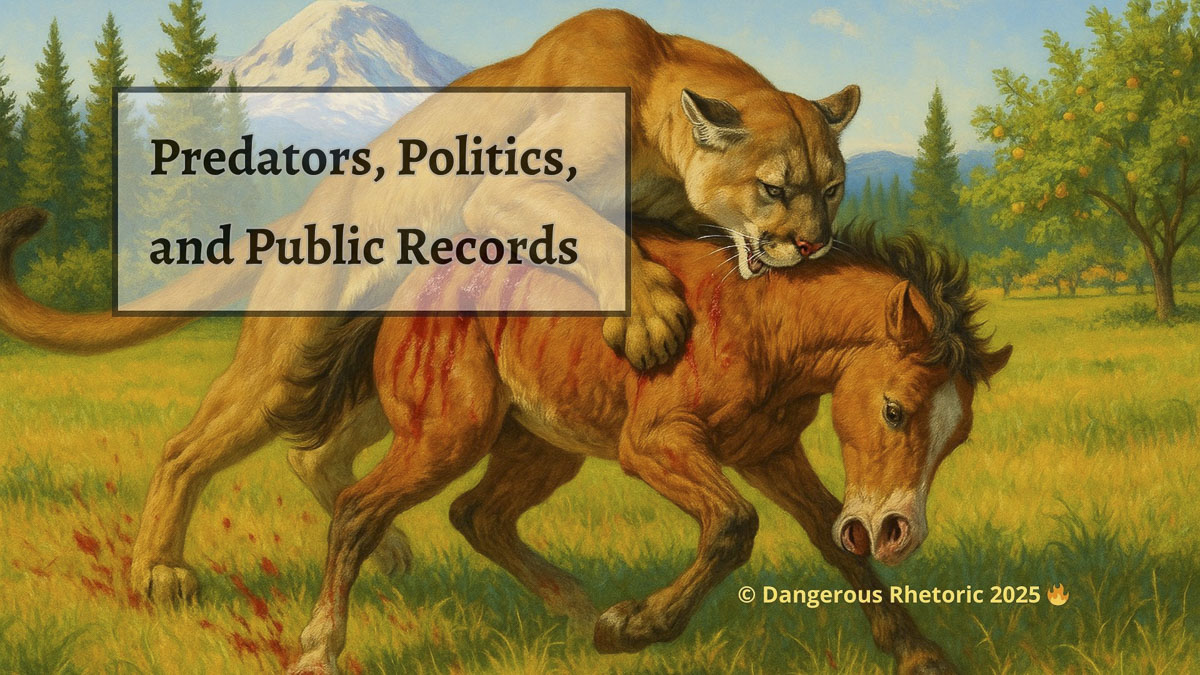
Nancy Churchill provides the ugly truth about Washington’s Wildlife Commission
Nancy Churchill
Dangerous Rhetoric
Washington State’s Fish and Wildlife Commission is supposed to protect the balance of nature through science-based conservation. Instead, it has become a staging ground for ideological warfare against hunters, ranchers, and common-sense wildlife management.

Four commissioners — Barbara Baker, Lorna Smith, Melanie Rowland, and John Lehmkuhl — now stand accused not just of pushing extreme anti-hunting policies, but of violating state transparency laws in the process. Their actions are not only undermining the North American model of conservation — they may be illegal.
It’s no wonder the public’s trust in this commission is evaporating.
Appointed power, zero accountability
Washington’s Fish and Wildlife Commission is made up of nine unelected members, all appointed by the governor to six-year terms. This structure is meant to ensure diverse representation from across the state and from a variety of stakeholders—tribes, sportsmen, conservationists, and the public.
But that balance has collapsed. Under Governor Jay Inslee and now Governor Bob Ferguson, the commission has been packed with environmental activists openly hostile to the hunting and ranching communities that fund and support real conservation. Instead of science, we get secrecy. Instead of representing all Washingtonians, they serve a narrow political base.
Email daisy chain?
The Sportsmen’s Alliance, a national advocacy group that defends hunting and fishing rights, uncovered a troubling pattern: Possible illegal coordination among four commissioners aimed at banning the spring bear hunt and advancing a preservationist agenda while actively avoiding the public transparency required by law.
In their July 1 report, the Alliance released findings from a lawsuit which forced the disclosure of internal records that these commissioners initially withheld or deleted in violation of Washington’s Public Records Act. These records show commissioners developing policy in private, outside of public meetings, with a clear intent to avoid scrutiny.
This isn’t just unethical — it’s a betrayal of the public trust. These four commissioners weren’t just advancing personal ideology. They were hiding it from the very citizens they’re supposed to serve. On May 16, the Sportsmen’s Alliance formally petitioned Governor Ferguson to remove them, citing clear and documented misconduct. If this behavior isn’t grounds for dismissal, what is?
The Spring Bear Ban and the Inslee agenda
This controversy isn’t about bureaucratic process — it’s about real-world damage. In November 2022, the commissioners voted to permanently eliminate the spring bear hunt, calling it a procedural update. Instead of listening to state biologists and decades of data, the commission adopted a preservationist mindset that sees all hunting as morally wrong (bit.ly/3U824ay).
But make no mistake — this was the first major act of what insiders now call the “Inslee era” of fish and wildlife policy: top-down, anti-hunting, and dismissive of rural Washingtonians and tribal hunting culture.
Predators protected, prey and property ignored
The ripple effects are already being felt. Cougar, bear, and wolf populations are growing past sustainable levels. Ranchers across eastern Washington report escalating livestock losses, while deer and elk herds suffer from unchecked predation.
Former Rep. Joel Kretz, a rancher in Okanogan County, has lost at least eight foals so far this spring to cougar attacks. These animals aren’t just livestock — they represent generations of hard work and heritage under siege. Both his livelihood and the important bloodlines he’s working to preserve are under attack. The WDFW might be out to “help” in a few days.
Instead of managing predators in line with ecological balance, the commission has chosen a narrow and reckless path: protect predators at all costs.
Even with data showing cougars are “doing exceedingly well,” the commission is pushing rigid harvest caps by management unit and even counts animals euthanized after attacking livestock against those caps. These caps aren’t just unnecessary — they may be illegal.
Hunting is conservation
But here’s the truth they won’t say out loud — regulated hunting is conservation.
For more than a century, sportsmen and women have done more for wildlife than any environmental lobbying group. In the early 1900s, whitetail deer and turkeys were nearly gone. It wasn’t activists who brought them back — it was hunters. Through license fees, habitat funding, and science-based wildlife management, hunting has been the most reliable tool for protecting and restoring animal populations in the U.S.
This isn’t some theoretical debate. It’s about science and results. Modern predator management relies on harvest limits, population modeling, and boots-on-the-ground knowledge. When populations exceed thresholds, regulated hunting helps keep things in check. Take that tool away, and nature doesn’t rebalance — it collapses.
The commission’s policies are not just misguided — they’re biologically irresponsible.
More records, more evidence
And the story doesn’t stop here. On June 3, the Sportsmen’s Alliance filed additional records requests seeking communications between the Inslee administration and WDFW officials. They want to know how far this goes — whether Olympia’s top brass coordinated these predator policies behind closed doors.
This may not be a few rogue commissioners. It could be an orchestrated campaign from the top down.
The choice: Remove or reform
The Sportsman’s Alliance and Washington’s sportsmen, ranchers, and rural families are done waiting. The laws around transparency exist for a reason. When unelected officials push radical policy behind closed doors, they violate not just the law — but the people’s trust. It’s time for consequences.
Governor Ferguson now has a choice: defend the status quo or remove the commissioners who have turned Washington’s wildlife policies into a political circus. These four commissioners need to be replaced. If the governor won’t act, the public must work with legislators to develop changes to reform how commissioners are appointed, and ensure these positions are filled by people who respect science, transparency, and the people they serve.
Government of the people — or the predators?
This fight isn’t just about bears or cougars or public records. It’s about who government belongs to.
Does it belong to the people — or to the predators hiding in the tall grass and in the board rooms?
Nancy Churchill is a writer and educator in rural eastern Washington State, and the chair of the Ferry County Republican Party. She may be reached at DangerousRhetoric@pm.me. The opinions expressed in Dangerous Rhetoric are her own. Dangerous Rhetoric is available on Substack, X, and Rumble

Also read:
- Opinion: Tax day is painful enough without Washington adding its own
 Washington’s new 9.9% income tax mirrors federal pattern: start narrow, expand to hit everyone within years.
 - POLL: What do you believe is the biggest reason school districts are facing budget shortfalls?
 Districts across Washington warn of budget gaps as debate grows over rising costs versus inadequate state funding.
 - Opinion: The high cost of hiding – Why IBR’s delayed revenue study is a $15 billion warning sign
 IBR delays critical toll revenue analysis until June 2027, hiding financial details until after project approval.
 - Opinion: The high cost of hiding – Why IBR’s delayed revenue study is a $15 billion warning sign
 IBR delays critical toll revenue analysis until June 2027, hiding financial details until after project approval.
 - Opinion: Washington fails the test for affordability
 Mountain States Policy Center analysis reveals Washington ranks 5th most expensive state as residents migrate to Idaho and Texas.
