



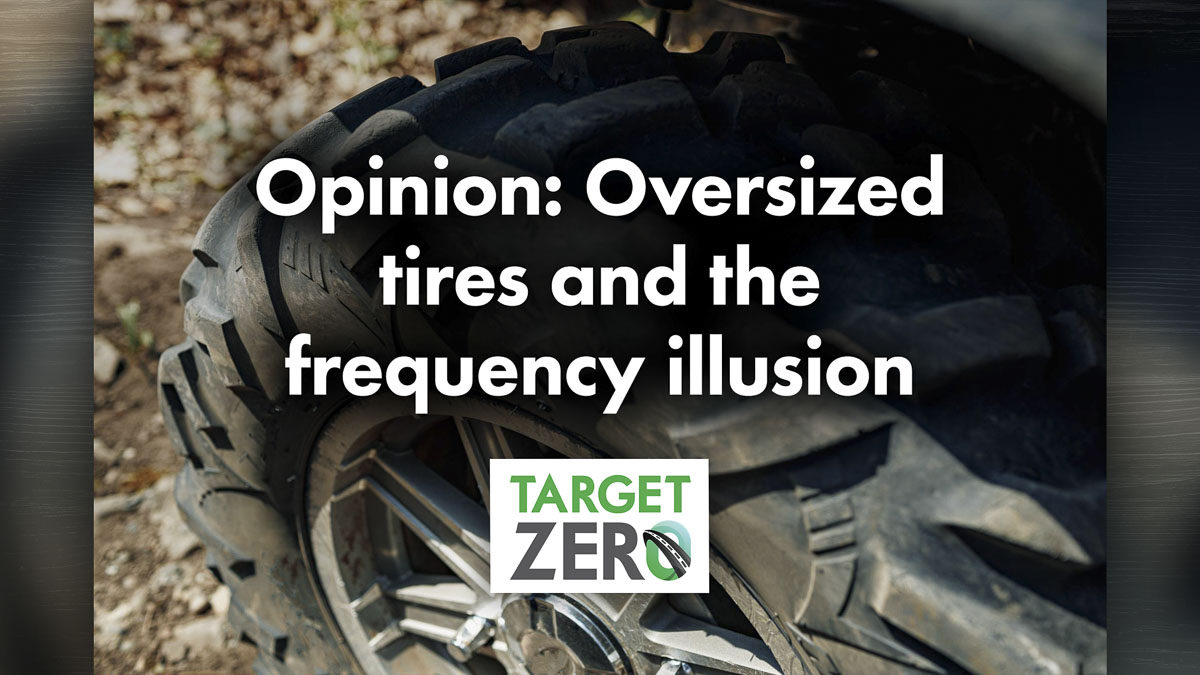
Target Zero Manager Doug Dahl addresses how traffic laws address oversize tires
Doug Dahl
The Wise Drive
Q: There are many pickup trucks with giant oversize tires that extend beyond the fenders; even beyond add-on fenders. How is this legal? (I lost a windshield due to a flying rock. The windshield cost almost $2000!)
A: The short answer: it’s not legal. But before we get into the law, I want to make clear that I’m not here to besmirch the good names of most pickup truck drivers. I agree with you that there are too many pickups (and SUVs) with pointlessly large tires. However, most truck tires (and by most I mean nearly all) are just fine. In a completely unscientific survey (I looked at the tires on 72 trucks while I walked my dog), only three vehicles had tires that stuck out past the fenders.

If you’re surprised by that number, you might be experiencing frequency illusion. Not to brag, but in 2013 I bought a Chevy Spark. Prior to that purchase I hadn’t noticed that model of car on the road. Once I owned one though, I saw them everywhere. Was I a trend-setter? No. It was frequency illusion, a cognitive bias in which we notice something more frequently after we become aware of it or it becomes important to us. I had no reason to care about who was driving one of the cheapest economy cars available until I was driving one too, and then they showed up all over.
Frequency illusion has real consequences for traffic safety. Social norms theory says, “We tend to do what we think most people do. And often what we think most other people do is wrong.” If you think most people are distracted by their phone while driving, you’re more likely to be tempted to give in to that distraction too. The reality is that at any given moment between five and nine percent of drivers are distracted. If that seems too low, blame frequency illusion. A distracted driver next to you captures your attention, while you don’t notice all the focused drivers. The Washington Traffic Safety Commission has done these studies for several years, and the number consistently hovers within a few percentage points. The problem is that even though only a small percentage of drivers are distracted, it contributes to one in five fatal crashes in Washington.
But let’s get back to oversize tires. Some traffic laws aren’t inherently about right and wrong; instead, they establish a shared set of rules for all of us. For example, there’s nothing inherently safer about driving on the right or left side of the road, as long as we all agree on which side.
And then there are laws that prohibit something because it increases risk. Tires that stick way out are more likely to throw rocks than tires protected by fenders. That can result in property damage, like your windshield, and it can also cause real injury to people if they’re struck by a stray rock. That’s why the law requires vehicles to have fenders or other covers that are as wide as the tires and extend down to at least the center of the axle.
For the folks with tires sticking out past your fenders, you might have made that choice for style or off-road performance. But here’s another way to frame it: you’ve paid extra money to make your vehicle a hazard to other road users.
When we drive we’re in a shared space, and it’s up to all of us to do what we can to make it safer. That includes not just how we drive, but also the vehicles we drive.

Also read:
- Letter: Freeze the scope and build the bridge
 Vancouver resident calls for project discipline after 22 years of planning and nearly half a billion in costs.
 - Opinion: Public workers’ First Amendment rights are getting attention – in Idaho, not Washington
 Idaho moves to stop public schools from collecting union dues through government payroll while Washington continues favoring unions over worker choice.
 - Opinion: Lawsuit filed against the unconstitutional income tax in Washington state
 Former Attorney General Rob McKenna and Supreme Court Justice Phil Talmadge challenge the 9.9% income tax in Klickitat Superior Court.
 - Letter: ‘Oregon and Washington aren’t refusing to clean their rolls — they’re contesting federal jurisdiction and timing’
 Camas resident challenges Lars Larson’s fraud claims, explaining legal disputes over federal jurisdiction.
 - Opinion: ‘When are we going to get the full and complete details of the Interstate Bridge Replacement Program’s I-5 Bridge replacement project?’
 IBR team buried key details about light rail ending at waterfront with massive elevator system required.
