


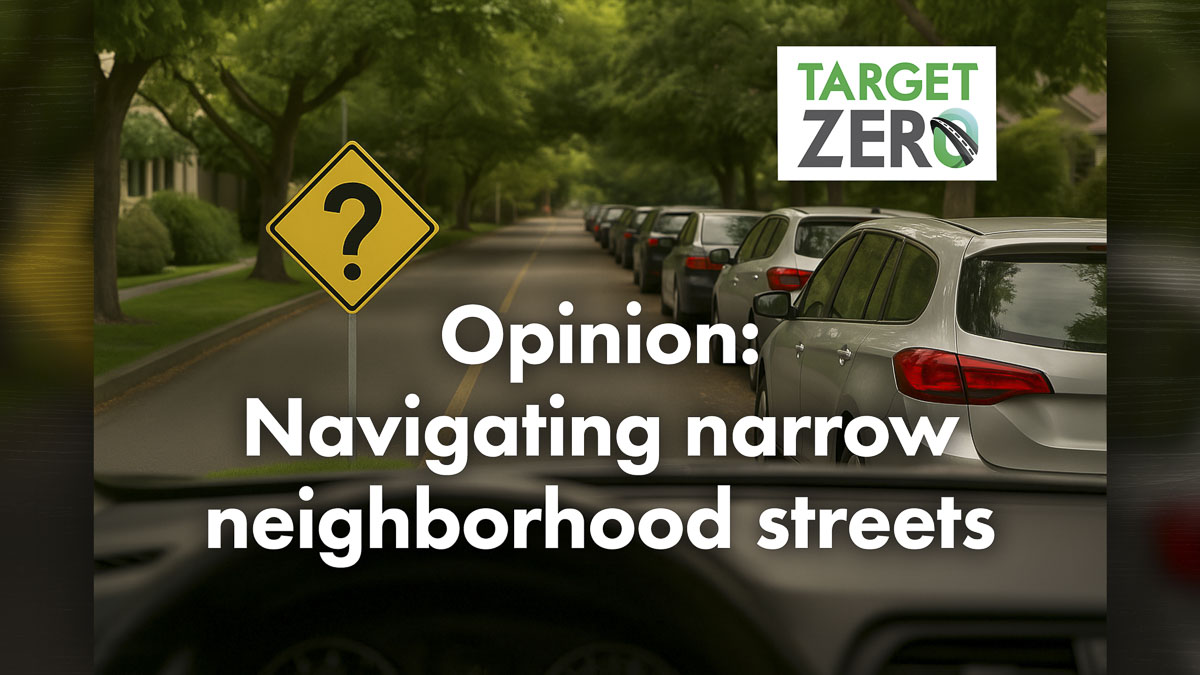
Who has to yield when there are cars parked on one side and not the other?
Doug Dahl
The Wise Drive
Q: I live in a neighborhood with some two-way roadways that, when cars are parked on the side of the road, are too narrow for cars approaching each other from opposite directions to pass. Who has to yield when there are cars parked on one side and not the other?
A: I used to think that what you’ve described was a problem. Now I think it might be a feature. Sure, it’s a little inconvenient to drive through a neighborhood with narrow roads, but maybe that same inconvenience makes it a better place to live.

In a study of over a half-million calls to 911, traffic complaints ranked eighth out of 30 call categories. Clearly, speeding drivers plague some neighborhoods. Posted speed limits tell us how fast we’re allowed to drive, but the width of a road is a big factor in how fast people actually drive. You might think that wider roads are safer; you’ve got extra room when passing oncoming vehicles, and more space to respond to surprises. That would be true, except for one problem: humans. Drivers tend to squander the benefits of wider roads by driving faster. As those speeds increase, so does crash severity.
Narrow lanes in neighborhoods compel drivers to pay attention. Narrow lanes don’t feel as safe, so we respond with slower speeds and more focus. Crash frequency on narrower roads is typically similar or slightly less than on wider roads, but crash severity is reduced.
And now that I’m done preaching about why narrow lanes (at least in some situations) are actually a good thing, let’s consider how to navigate them. I’ll start with the basics. The law requires drivers (with a few exceptions) to drive on the right half of the roadway. And when two drivers pass each other in opposite directions, they’re required to give each other at least one-half of the roadway.
That’s all fine until you come upon a parked car. If the roadway is narrow enough that you have to cross the center of the road to go around it, have you violated the law about driving on the right half of the road? Nope. There’s an exception that permits drivers to cross the center of the road if there’s an obstruction in their lane.
However, there’s a caveat; a driver avoiding an obstruction must yield to “all vehicles traveling in the proper direction upon the unobstructed portion of the highway within such distance as to constitute an immediate hazard.” If a parked car forces you across the center of the road to go around it, you’re the one required to yield.
There’s a trickier question though. Who yields when cars are parked on both sides of the road? I’ve seen this play out a couple of ways. Often the person who gets to the bottleneck second yields to the driver who’s already in it. When there’s a string of parked cars and you can’t tell who’s first to get there, sometimes whoever is nicest finds a gap and gets out of the way. Whatever the outcome, yielding is required when not doing so would create a hazard.
Conceivably, this could get bothersome. On a road with cars down both sides and two opposing drivers meeting mid-block, you might need some creative problem solving. But is that so bad? In a space that’s shared with folks walking dogs, kids learning to ride bikes, and middle-schoolers having multi-block Nerf battles (at least where I live) it’s probably a good trade for overall slower speeds in neighborhoods, where it’s less about traveling efficiency and more about the quality of life.
The Wise Drive is hosted by Doug Dahl, a Target Zero manager for the Washington Traffic Safety Commission.

Also read:
- Opinion: Were Republican voters just sleeping during the August primary election?
 CCRP Chairman Matt Bumala says 60% of primary no-shows in the 17th and 18th districts were Republicans.
 - Opinion: WA Cares’ launch showcased care WA Cares did not provide
 Gov. Ferguson showcased a caregiving arrangement at the WA Cares launch that the program had not paid for a single day of.
 - Opinion: Portland’s War on Cars Part 4 – A smarter automobile strategy to end gridlock
 O’Toole argues fuel wasted in Portland-area congestion has sextupled since 1982, generating 250,000 tons of extra greenhouse gases annually.
 - Opinion: The Tooth Fairy’s secrets to making brushing & flossing magical
 Delta Dental of Washington’s Tooth Fairy Experience offers free resources to help children build lifelong brushing and flossing habits.
 - Opinion: Transit ridership trends are dismal but regional plans are oblivious
 Puget Sound transit passenger-miles fell 31% from 2015 to 2024 despite a half-million-resident population increase.