



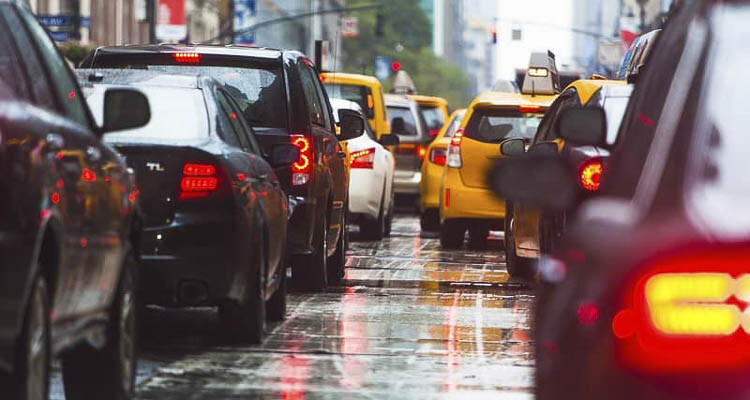
John A. Charles Jr. of the Cascade Policy Institute says congestion is likely to get worse, because the regional government ‘simply doesn’t care’
John A. Charles, Jr.
Cascade Policy Institute
For the past 30 years, opinion polls have consistently shown that highway congestion relief is the top transportation priority for Portland-area residents. Nonetheless, congestion is likely to get worse, because the regional government, Metro, simply doesn’t care.
Every five years, Metro is required to update its Regional Transportation Plan, which provides the blueprint for how transportation facilities will be built and operated. The current update, now available for public review, has a short list of performance measures. One of them states that congestion (defined as travel on regional throughways that falls below an average speed of 35 MPH) will be acceptable for up to four hours per day. If your commute happens to occur within that four-hour period, congestion will be a permanent feature of your life.
The RTP shows that the region experienced more than four hours of delay on 15% of highways in 2020. Metro predicts this number will rise to 16% in 2045.
Metro thinks it can mitigate traffic by tripling the levels of biking, walking, and transit use. That sounds nice, but various agencies have been trying to “get people out of their cars” for decades without much success. The RTP predicts that transit use will rise from 4% to 5% of trips by 2045, while walking and biking will remain flat.
Metro does not anticipate a significant increase in road capacity. The RTP shows that by 2045 regional population will grow by 29% from 2020 levels, employment will increase by 23%, while total road miles will only increase by 2%.
No other type of infrastructure is artificially constrained this way. When public schools experience a growth in students, school districts build or buy more classroom space. Regional drinking water providers spend billions of dollars on new pipes and treatment facilities to accommodate growth. Only highways are subject to scarcity by design.
Metro is focusing almost entirely on reducing vehicle miles traveled (VMT) by every person in the region. This is another strategy that will fail. We know this because in 1991, the Oregon Land Conservation and Development Commission adopted the Transportation Planning Rule (TPR), which required per capita VMT reductions in seven large urban areas by 10% over 20 years, and 20% over 30 years. By the end of the planning horizon (2021), there was no evidence that this ever happened, or that it could even be measured.
Moreover, reducing VMT is not socially beneficial, especially for low-income families and those seeking employment. Jobs and housing are scattered throughout the region, and getting from home to work by transit is not practical for most people. Improved access to car ownership, especially by low-income individuals and single parents, would vastly increase employment opportunities and wage growth. We should be promoting automobile travel, not stifling it with more regulation.
The RTP also embraces ODOT’s ill-advised use of highway tolling as a rationing mechanism. This is not the way to implement the concept of tolling in a region with little history of tolls. The better way is by building new highways, lanes, or bridges and offering premium driving service for a fee. These new facilities are generally known as “Express Toll Lanes,” and more than 60 of them have been built in the U.S. since 1995. None are in Oregon.
A good way to test this idea would be to abandon the 25-year effort to replace the I-5 Interstate Bridge and use tolling to finance two new bridges across the Columbia River – one upstream from I-205, and one downstream from I-5.
The RTP will be adopted by Metro later this year, and public testimony will be taken on November 30. Metro Councilors are elected and accountable to voters, so if congestion is a concern, this is your chance to speak up.
John A. Charles, Jr. is president and CEO of Cascade Policy Institute, a nonprofit policy research organization based in Portland.
Also read:
- High-value WA home listings increase by 65% after income tax passage
 After lawmakers approved an income tax targeting millionaires, listings for homes priced at $2 million or more jumped 65 percent compared to last year, with experts urging caution about interpreting the spike.
 - 18th District lawmakers to host town hall meeting on Saturday, March 28, in Battle Ground
 Stephanie McClintock and John Ley will meet with Battle Ground constituents to answer questions, review the new income tax, and discuss the effects of the $80 billion budget.
 - Opinion: In plain sight – yielding to pedestrians
 Drivers often fail to see pedestrians due to inattentional blindness, which highlights the need for more focused awareness at intersections and stronger safety practices.
 - NBA vote clears way for expansion to Seattle
 The NBA Board of Governors has voted to explore adding teams in Seattle and Las Vegas, moving Seattle closer than ever to hosting pro basketball again.
 - Opinion: The legislature has committed $2.4 billion to recurring pension increases since 2018
 Six legislative COLAs have raised public employer costs by $2.38 billion since 2018, driving up unfunded pension liabilities and increasing burdens on county and city budgets.
 - Opinion: ‘Just because they got away with it doesn’t mean they weren’t wrong’
 A Skamania County deputy’s report found violations of county rules and the Open Public Meetings Act, but no prosecutor acted on the findings.
 - More drama at Clark County Council in regard to its representatives on the C-TRAN Board
 Councilors debated whether C-TRAN board representatives must follow group mandates, with Michelle Belkot refusing to commit to new voting rules and Glen Yung opposing her nomination.
