



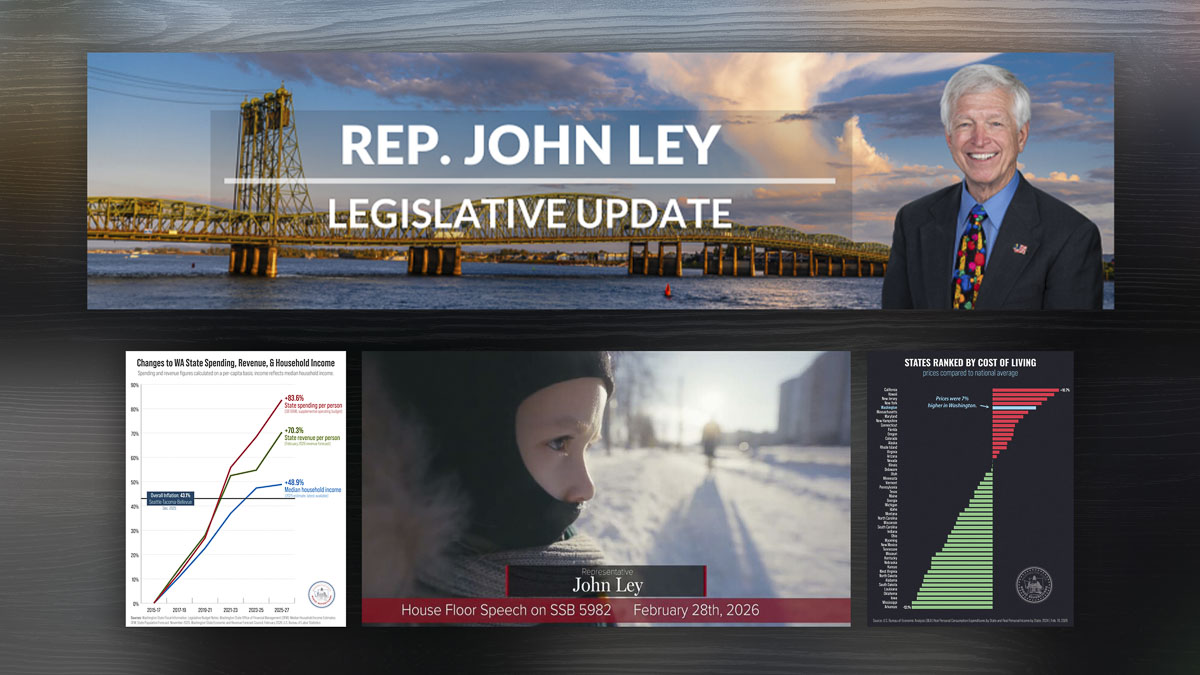
Rep. John Ley provides his latest legislative update
Rep. John Ley
18th Legislative District
As the 2026 legislative session nears its conclusion, there’s still important work to be done that will affect families, schools, and small businesses across Washington. Lawmakers are in the final stretch of debating and finalizing the three state budgets, which will set spending priorities for the next year. At the same time, the Legislature is considering a proposed state income tax, which could have long-term consequences for households and job creators alike. Several other major issues also remain unresolved, from education funding and public safety to programs that support vulnerable residents.

I remain focused on protecting taxpayers, promoting fiscal responsibility, and ensuring that government lives within its means. My goal is to find solutions that make life more affordable for families, support local businesses, and protect essential services.
Majority party’s Supplemental Operating Budget continues to grow
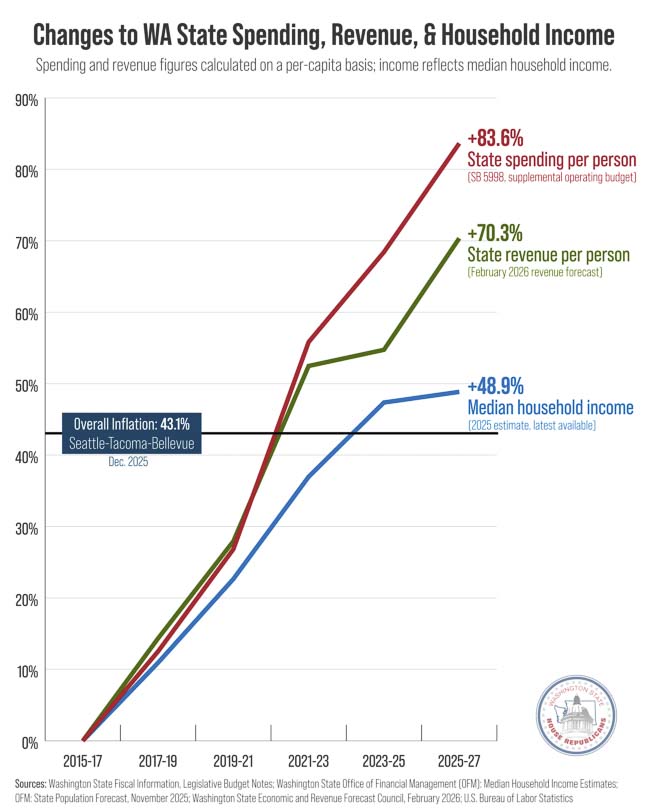
Arguably, the biggest task we have each session is to craft the state’s operating budget. On Saturday, House Democrats passed an $80 billion budget, the largest in Washington history, increasing spending to record levels while doing little to address the affordability challenges facing families and small businesses. The plan relies on uncertain revenue sources, including a proposed state income tax expected to generate billions of dollars. Even worse, they rob the LEOFF 1 pension system, taking $4 billion from the law enforcement and firefighters’ pension fund. If those assumptions fail, the state will face significant budget shortfalls in the future. The chart below reflects the February revenue forecast and the supplemental budget passed on Saturday. As you can see, the state continues to outspend its revenue.
The budget also depends on one-time funding maneuvers, including hundreds of millions of dollars taken from the Rainy-Day Fund and other dedicated accounts. These actions mask long-term structural spending problems rather than solving them.
House Republicans offered more than 20 amendments focused on protecting classrooms, restoring Medicaid funding, safeguarding SNAP benefits, investing in public safety, providing property tax relief, issuing a gas tax rebate, and creating a week-long sales tax holiday for families. Most of those proposals were rejected.
The spending plan also includes more than $1 billion in Medicaid reductions and cuts to certain education funding programs, which could particularly affect property-poor and rural school districts.
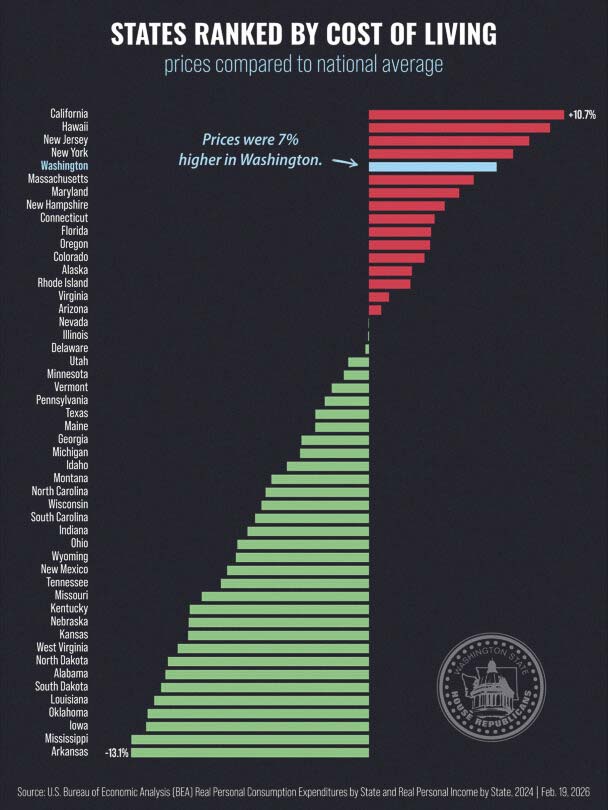
Despite rising costs for housing, groceries, child care, and fuel across Washington, the budget provides little to provide relief for taxpayers. Critics argue the plan increases spending and financial risk while leaving affordability concerns largely unaddressed. Meanwhile, Washington continues to be one of the least affordable states to live in the entire country, as you can see in the chart below.
New legislation is bad for state’s energy crisis
Another crisis we are dealing with in Washington is a lack of sustainable energy. The state continues to push for green energy, but it’s ignoring other viable options. We all want an environmentally healthy Washington, but we need to be open to all possible solutions, and we can’t keep passing policies that hurt our output.
Last Saturday, we debated Senate Bill 5982, which would update Washington’s Clean Energy Transformation Act (CETA) by expanding the scope of who must comply with the state’s clean-energy standards. The bill adds port districts that distribute electricity and broadens the definition of “market customers” to include large businesses that generate some of their own power.
These entities must meet CETA’s greenhouse-gas-neutrality and 100% clean-electricity requirements. The bill also directs the Utilities and Transportation Commission to establish reporting rules and enforce compliance, while exempting limited fossil-fuel use for emergency backup power.
If it becomes law, SB 5982 could create new regulatory burdens and increase energy costs for businesses and economic development projects. By expanding CETA requirements to more nonresidential electricity users and port districts, the bill would make it harder for industries that generate some of their own power to operate efficiently.
This will discourage investment in energy-intensive facilities such as manufacturing or data centers. Ports, which often rely on flexible energy solutions to attract employers, may face additional compliance costs and reporting requirements. At a time when Washington already faces power supply challenges, the bill could add uncertainty and limit practical energy options. Listen to my floor speech about this policy:
Democrats pass bill to change state control over local law enforcement
Unfortunately, the House also passed Senate Bill 5974 earlier this morning, after nearly 8 hours of debate and 31 amendments offered by Republicans to improve it. All were rejected. This policy changes eligibility, certification, and background requirements for sheriffs, police chiefs, marshals, and law enforcement volunteers. It expands state oversight, allowing decertification to create vacancies in elected offices and imposes strict controls on volunteers and youth cadets.
The bill undermines voter sovereignty by letting unelected boards remove sheriffs. It also creates costly unfunded mandates, limits rural volunteer programs, and could trigger expensive legal challenges. It effectively shifts local accountability from voters to state authorities. This is a bad bill for law enforcement and for our communities.
Legislation to keep an eye on
There are also several bills that I’m watching this final week that would negatively impact affordability in our state, that still “might” be brought up for a vote. These include House Bill 1334, which could raise annual property tax increases from the current 1% cap to 3% per year. Additionally, House Bill 2745 could create an alleged “one-time” 37.5% tax on insurance premiums. While it taxes insurance companies, it will likely be passed on to consumers as higher premiums next year. Lastly, there’s House Bill 2626, another separate tax on health insurance premiums.
Save the date – In District Town Hall
Lastly, be sure to save the date for our 18th district in-person town hall meeting. Join Rep. Stephanie McClintock and me on Saturday, Mar. 28, at 10:00 a.m. at the Battle Ground City Hall, 109 SW 1st Street, Battle Ground, WA 98604.
Please continue reaching out
Although session is nearing the end, remember that I represent you throughout the entire year, and I can’t do my work without your input. Please continue reaching out with your comments, questions, and concerns. I also encourage you to stay informed on House Republicans’ efforts to fix Washington by following us on Facebook, Instagram, X, and YouTube. Thank you for allowing me to serve.
It’s an honor to serve you.

Also read:
- VIDEO: WA diesel hits record $6.53, crushing truckers and school budgets
 With diesel nearing $6.53 per gallon in Washington, trucking businesses and school districts now confront sharply higher fuel expenses affecting budgets and workers.
 - WA’s status solidifies as one of the most expensive places in US
 A new study shows Washington outpaces most states on cost of living, with metrics revealing a sharp rise in daily expenses and major metro areas ranking among the nation’s most expensive.
 - Opinion: Someone explain the Democrat Party to me please
 Lars Larson criticizes Democrat politicians for shutdown threats, Homeland Security funding refusals, and positions on election laws, housing, and gun rights.
 - POLL: Do you agree with requiring board members to follow council direction?
 Disagreement among county councilors centers on whether C-TRAN board members should reflect the council’s collective wishes or act independently, highlighting ongoing concerns about public accountability.
 - High-value WA home listings increase by 65% after income tax passage
 After lawmakers approved an income tax targeting millionaires, listings for homes priced at $2 million or more jumped 65 percent compared to last year, with experts urging caution about interpreting the spike.
 wpDiscuz
