



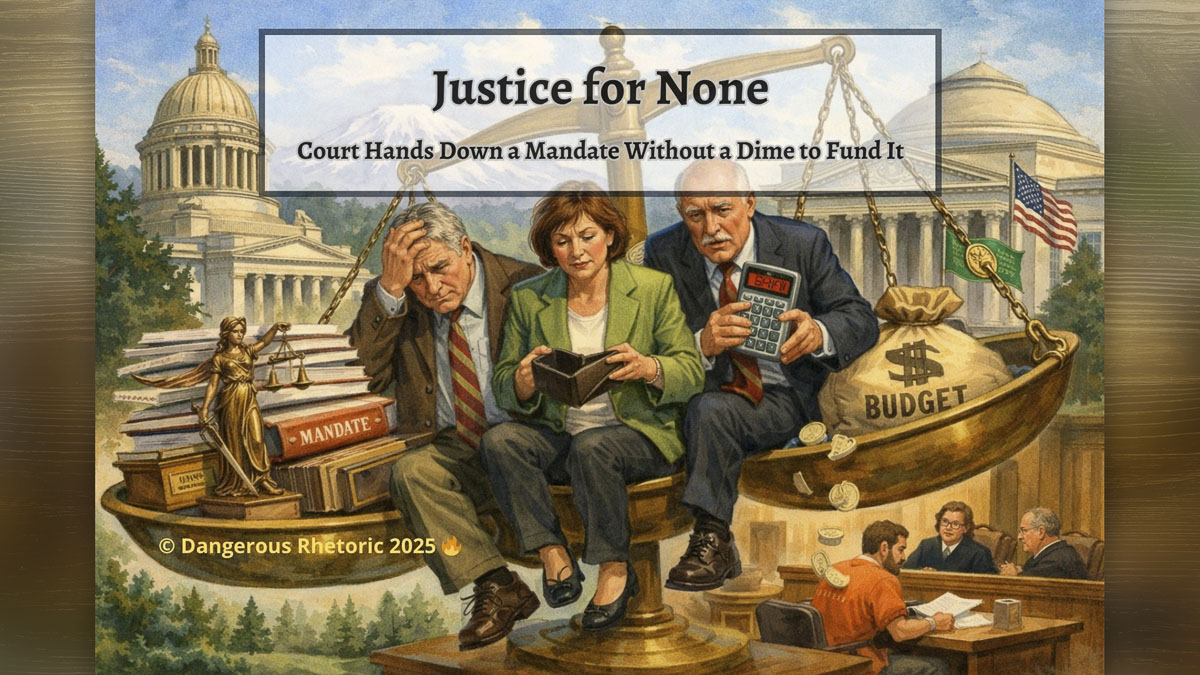
Nancy Churchill says we owe it to our families, friends, and neighbors to fight for fair funding, local control, and real justice, not courtroom fantasies dreamed up in Olympia
Nancy Churchill
Dangerous Rhetoric
 See Grok’s analysis of this story
Here we go again. Just like with the McCleary education ruling in 2012, the Washington State Supreme Court has handed down another grand new mandate, only this time about public defense lawyers. Just like with McCleary, the justices are expecting the legislature to go find the money to pay for the mandate. The Court is demanding massive changes to how cities and counties handle public defenders, but they left the taxpayers and small-town governments holding the bag.

The ruling, Order No. 25700-A-1644, might sound dry, but its impact will be anything but. Cities and counties are already stretched thin trying to handle current caseloads, and hiring more public defenders is easier said than done. There just aren’t enough qualified attorneys available across the state, and even when they are, many small towns simply can’t afford to bring them on. If the funding doesn’t come through, local governments could be forced to start dropping cases altogether. That kind of breakdown would hit public safety hard and erode trust in the justice system from the ground up.
We’ve seen this game before
If that sounds familiar, it should. The McCleary ruling told the Legislature it had to fully fund education, and for years, Olympia scrambled to meet the Court’s impossible demands. Local schools didn’t magically improve, but property taxes sure went up. And now the Court is using the same playbook to reshape our criminal justice system, starting with public defense.
Here’s the kicker. The people who made this decision won’t be the ones paying for it. That job falls on local leaders, especially in smaller counties and cities already struggling to keep the lights on. The Association of Washington Cities (AWC) warns that the cost of public defense could triple over the next ten years.
Imagine being a mayor in Colville or a county commissioner in Ferry or Lincoln County. You’re already scraping together dollars to fix potholes and fund the sheriff’s office, and now you’re being told to come up with money for a bunch of extra lawyers, new training programs, and ongoing audits.
And if you don’t? You risk lawsuits, sanctions, or even more meddling from Olympia and the Court.
This isn’t justice, it’s judicial overreach
Don’t get me wrong. People deserve fair trials. That’s not up for debate. But justice doesn’t happen by throwing down unfunded mandates and crossing your fingers. It happens when courts respect the balance of powers, and when local governments have a seat at the table. Instead, the Court handed out a ruling that could wipe out rural budgets like recent floods took out Highway 2.
The new rules require each city and county to start reducing caseloads by at least 10% per year until they meet the new thresholds. That means more attorneys, fewer cases per lawyer, and a steady increase in costs every single year. It’s government math. Mandate first, funding later — maybe.
Here’s the good news
Now, the Association of Washington Cities (AWC) is begging the legislature for help. In a letter to the court, AWS noted, “Cities must either find a way to recruit and pay more public defenders or deal with the consequences of having to prosecute fewer offenses.” That means that in the future, residents may be facing declining public safety outcomes if their cities or counties can’t find or fund enough public defenders.
Several bills have been introduced to address the public defense funding crisis. HB 1592 was filed last year, and got one public hearing before it died. This year, SB 5914 has been pre-filed with a different funding formula. Both of these bills would increase state support for indigent defense, create better training pipelines, and build up the workforce in a way that doesn’t bankrupt small towns. I’m guessing that 5914 has a better chance of moving forward.
SB 5914 is not perfect, but it’s a start. Take a look at the bill text, and see if you can find ways to improve the bill. If you see something, say something to your legislators. I see several problems. First, the reimbursement is very small. Next, it appears most of the funds will be prioritized for Western Washington jurisdictions (those with the largest trial backlog), instead of going to ALL counties based on population. Another problem is the increased amount of tracking that each county will have to submit to the state. This will increase costs. Finally the funds are distributed a year AFTER the expenses are incurred, instead of on a month by month disbursement.
President Reagan warned us that “a government big enough to give you everything you want is a government big enough to take away everything you have.” Well, the Court gave us a new system, and now it’s time for the Legislature to step in and make sure we don’t lose everything else to pay for it.
This is where we take action
We can’t afford to sit this one out. We MUST comply with the court rules. If a funding bill doesn’t pass, the cost of implementing the rule will fall hardest on rural Washingtonians, small-town taxpayers, and local leaders already doing more with less.
Start by reviewing SB 5914, and leave a comment for your legislators. Do you support it, or does it need changes? Follow up with a phone call. Are they backing a funding fix with SB 5914? Are they fighting for funding fairness?
Call them. Email them. Visit their offices if you have to. Let them know that justice isn’t just about fancy court rulings — it’s about the taxpayers who have to live with the consequences.
Ask your city council and county commissioners to testify or send letters in support of SB 5914. Remind them justice and public safety is one fight we can’t ignore.
Because here’s the truth: if we let this slide, the justices will keep writing blank checks the rest of us are forced to pay for.
We’re the stewards of what comes next
Our republic doesn’t survive by accident. It survives because regular people — farmers, loggers, nurses, welders, parents — stand up and say “This doesn’t work.” That’s what this moment demands.
We owe it to our families, friends, and neighbors to fight for fair funding, local control, and real justice, not courtroom fantasies dreamed up in Olympia. The Supreme Court handed down the order, but our counties and cities are left to figure out how to pay for it. So let’s speak up, show up, and make sure our voices are heard in every committee room and hearing hall until this mess gets fixed.
Let’s get to work.
Nancy Churchill is a writer and educator in rural eastern Washington State, and the chair of the Ferry County Republican Party. She may be reached at DangerousRhetoric@pm.me. The opinions expressed in Dangerous Rhetoric are her own. Dangerous Rhetoric is available on Substack, X, and Rumble.

This independent analysis was created with Grok, an AI model from xAI. It is not written or edited by ClarkCountyToday.com and is provided to help readers evaluate the article’s sourcing and context.
Quick summary
In this opinion column, Nancy Churchill criticizes the Washington State Supreme Court’s order adopting lower public‑defender caseload standards as an unfunded mandate that shifts costs onto local governments, particularly rural communities. She compares the move to the McCleary school‑funding decision and calls for legislative fixes such as SB 5914 to provide state funding for the new requirements.
What Grok notices
- Explains the court’s phased caseload‑reduction plan over about ten years and notes possible local impacts such as higher public‑defense costs, pressure on county budgets, or fewer prosecutions if staffing cannot keep up.
- Draws a parallel to the McCleary school‑funding case to argue that major constitutional rulings can leave local governments struggling until the Legislature supplies more state money.
- Points to concerns raised by groups like the Association of Washington Cities (AWC) and highlights specific bills, including SB 5914, that are intended to shift more responsibility to the state level.
- Suggests that readers may want to review the exact numerical caseload limits, the implementation timeline, and the status of related litigation and legislation to understand local obligations.
- Reflects Nancy Churchill’s perspective on judicial overreach, local control, and tax burdens in rural Washington rather than presenting a neutral policy brief on public‑defense reform.
Questions worth asking
- How might the phased 10‑year implementation timeline influence recruitment, retention, and workload stability for public defenders in rural and under‑resourced counties?
- What state‑level funding mechanisms or revenue sources could help counties comply with the standards without significantly raising local property or sales taxes?
- Could more detailed case‑weighting systems or regional public‑defense collaborations help jurisdictions meet caseload limits more efficiently?
- How do Washington’s current and projected public‑defense funding levels compare with states that have adopted similar or stricter caseload standards?
- What role might ongoing or future litigation by counties and cities play in clarifying how much of the public‑defense burden must be borne by the state?
Research this topic more
- Washington Courts – Supreme Court orders, public‑defense caseload standards, and implementation materials
- Office of Public Defense – state public‑defense funding, grant programs, and improvement initiatives
- Washington State Legislature – status and text of SB 5914 and other public‑defense‑related bills
- Association of Washington Cities – policy statements and advocacy on municipal public‑defense costs
- Washington State Bar Association – Council on Public Defense reports and recommendations

Also read:
- Opinion: Half the road, full stop – Understanding pedestrian right-of-way
 Doug Dahl explains how Washington’s law requires drivers to stop when a pedestrian is within one lane of their half of the road, not just when directly in front.
 - Opinion: The state’s RFK-proofing bill comes with a cost
 Mandates like HB 2242 can lead to higher premiums as insurance companies absorb costs for new preventive services, affecting affordability statewide.
 - Opinion: What is the cost of a bridge?
 John Ley argues the I-5 Bridge replacement’s soaring cost stems from costly extras like light rail, noting other states deliver larger, toll-free bridges for much less.
 - POLL: Do you agree with giving a state commission the power to remove an elected sheriff?
 A new poll asks if a state commission—not voters—should have the power to remove an elected sheriff, following concerns raised by Clark County Sheriff John Horch.
 - Opinion: Defending Democracy by denying it?
 Washington voters are blocked from weighing in on new income taxes as state lawmakers and officials bypass public input, drawing criticism from Northwest voices.
 wpDiscuz
