




Rep. Chris Corry provides a report on the updated forecast for the Washington Policy Center
Chris Corry
Washington Policy Center
The Washington State Economic and Revenue Forecast Council met Tuesday (June 27) to present the Q2 2023 economic and revenue forecast. You can find the recording of the meeting here and the meeting documents here.
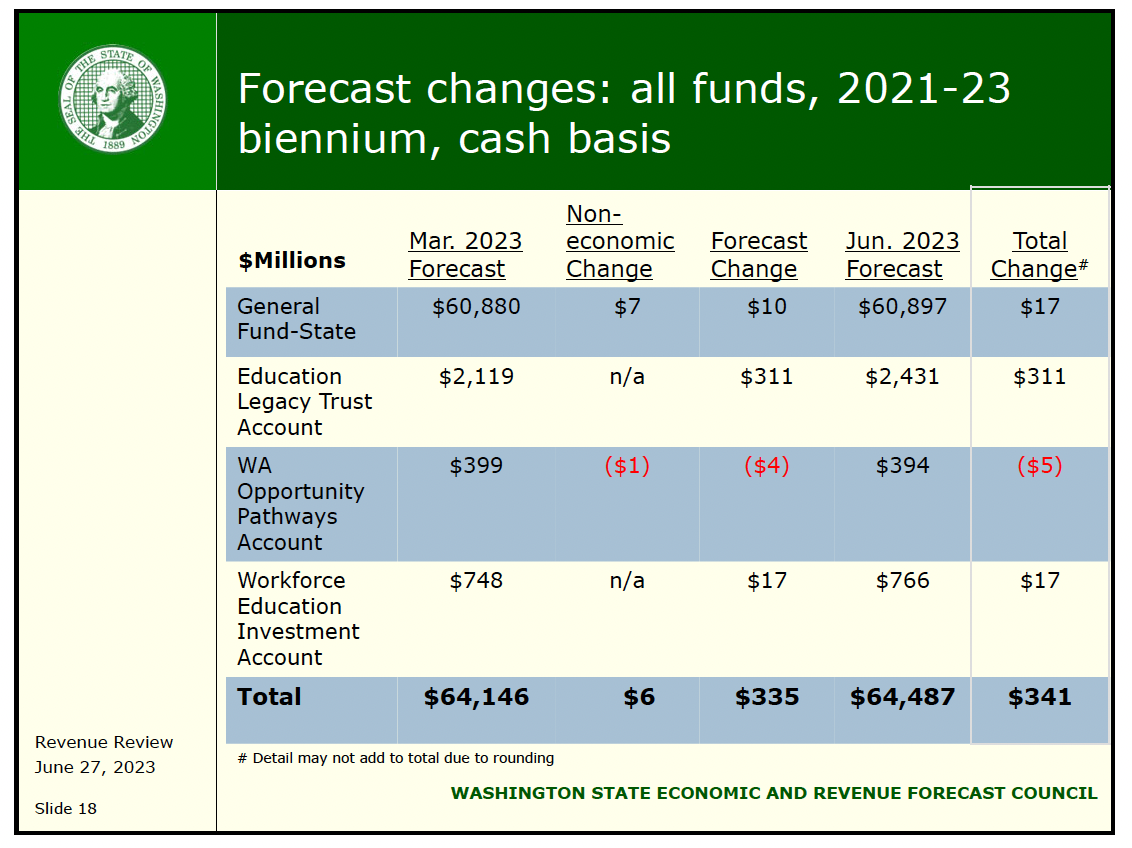
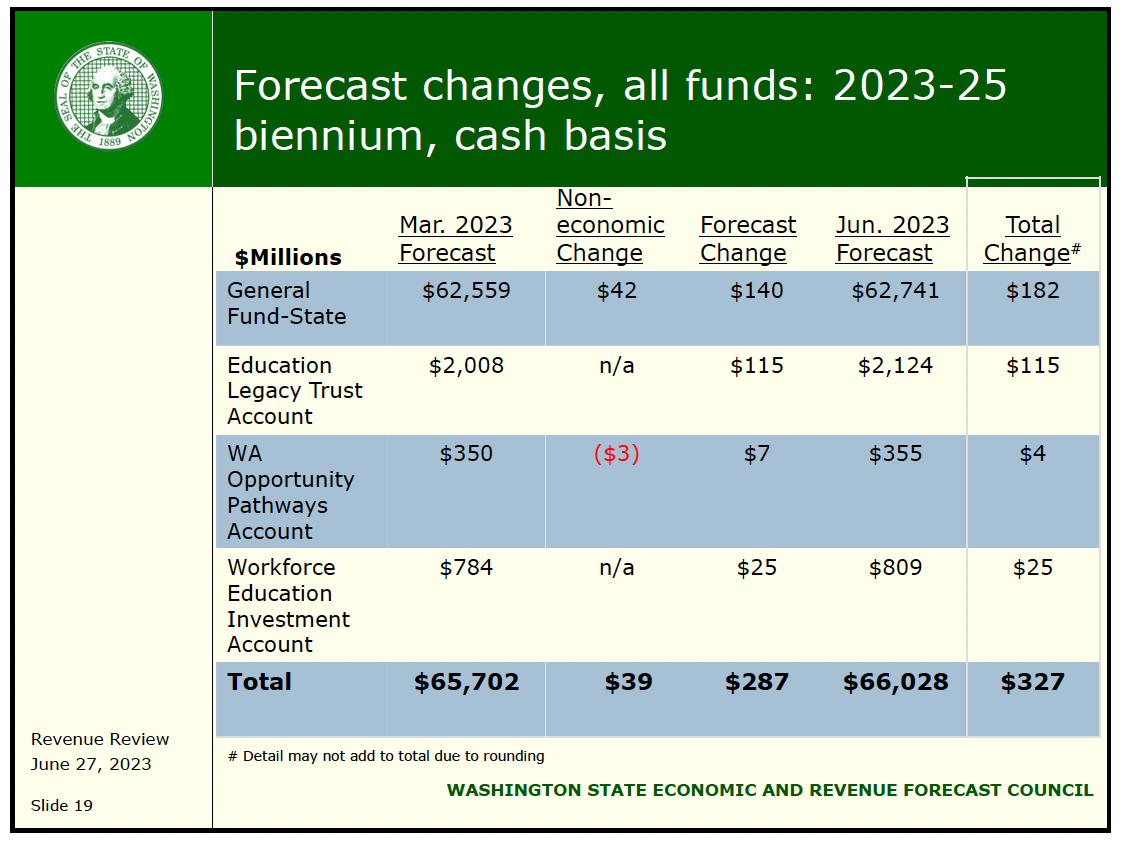
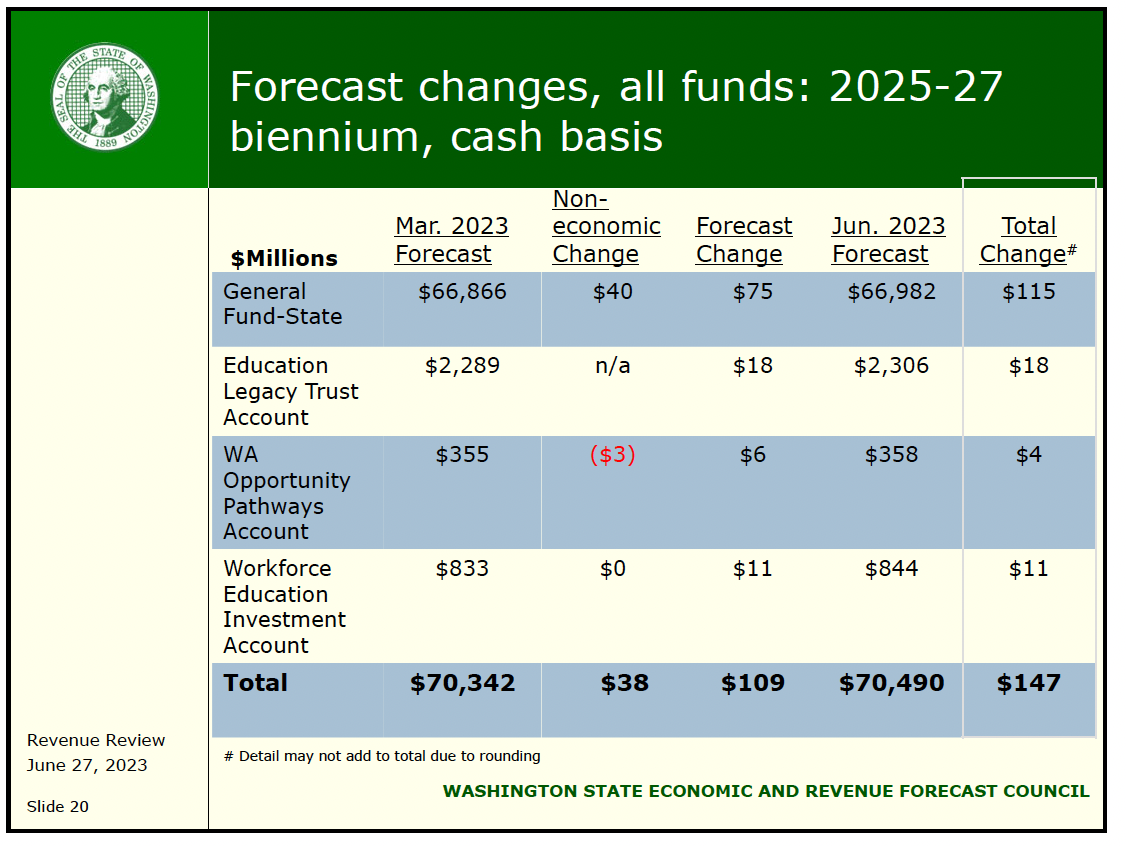
The updated forecast from Q1 shows an increase in revenue of $815 million over the current biennium (ending June 30) and the 2023-2025 and 2025-2027 biennium. The state is required by law to adopt a four-year balanced budget and the revenue forecasts are instrumental in shaping budgets for lawmakers.
The increase from the Q1 revenue forecast was $341 million for 2021-23, $327 million for 2023-25, and $147 million for 2025-27.
Capital Gains Collections Drives Growth
Unsurprisingly the biggest driver of change was the higher-than-anticipated collection of income tax on capital gains. As noted by the ERFC report “Revised capital gains forecast reflects higher than expected collections.”
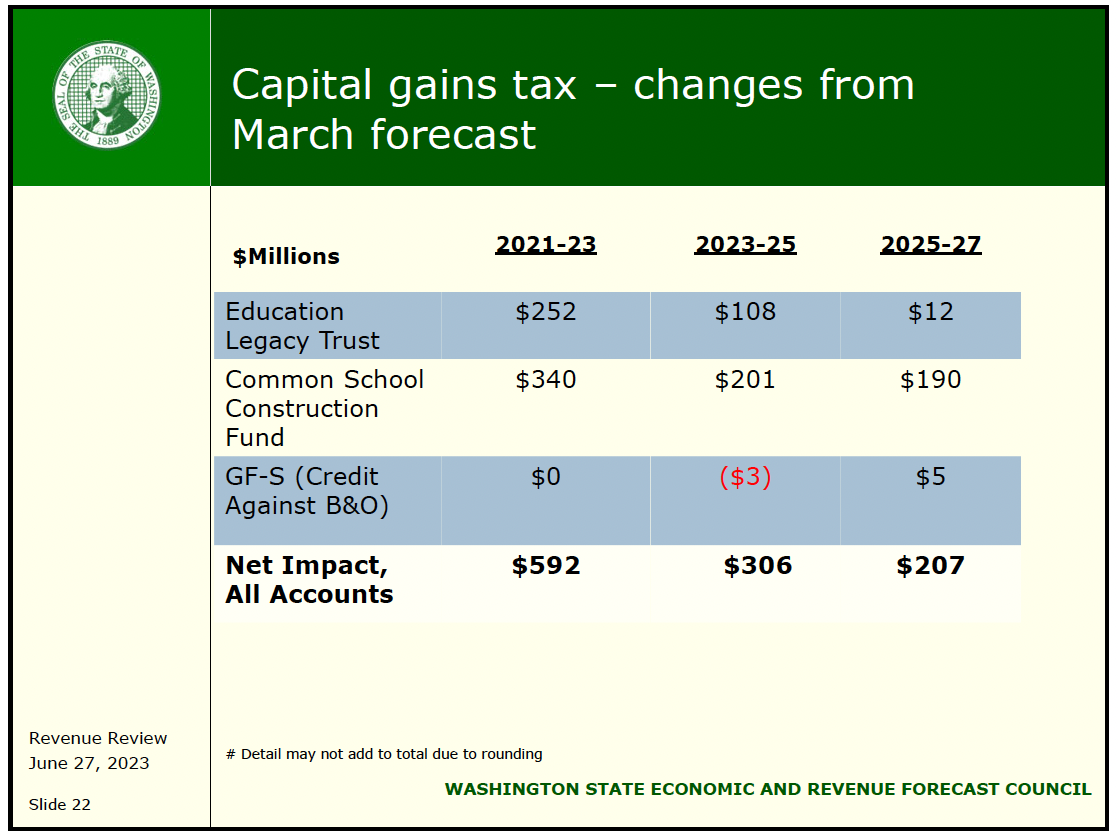
The report and commentary did signal caution amid “quite a bit of uncertainty around those collections,” 60% of the returns so far have been estimated. They note that when returns are finalized by Oct, they may see some refunds. Additionally, capital gains taxes are historically very volatile and can be tough to predict.
Other items of note in the Q2 forecast.
The report notes that tax collections have slowed, and inflation remains high even though it is slowing. There is concern about slower growth leading to recession. Employment growth is trending down over the past two years. Real estate excise taxes have slowed dramatically compared with 2022.
The next revenue forecast for the state will be on Sept. 26.
Chris Corry is the director of the Center for Government Reform at the Washington Policy Center. He also represents the 14th Legislative District in the Washington state House of Representatives.

Also read:
- Opinion: Sheriffs fight back
 Four county sheriffs are suing to block a new law giving a governor-appointed board power to decertify and remove sheriffs, bypassing voter oversight in Washington.
 - Opinion: The growing gap between public voice and political power
 Todd Myers describes how large-scale protest and sign-ins often fail to sway state leaders, and argues authentic influence is most likely found through local action.
 - Opinion: Who is winning the race for affordable power?
 Hydroelectric power keeps Washington competitive, but new laws and carbon pricing are driving up electricity costs for residents each year.
 - Opinion: Half the road, full stop – Understanding pedestrian right-of-way
 Doug Dahl explains how Washington’s law requires drivers to stop when a pedestrian is within one lane of their half of the road, not just when directly in front.
 - Opinion: The state’s RFK-proofing bill comes with a cost
 Mandates like HB 2242 can lead to higher premiums as insurance companies absorb costs for new preventive services, affecting affordability statewide.
