



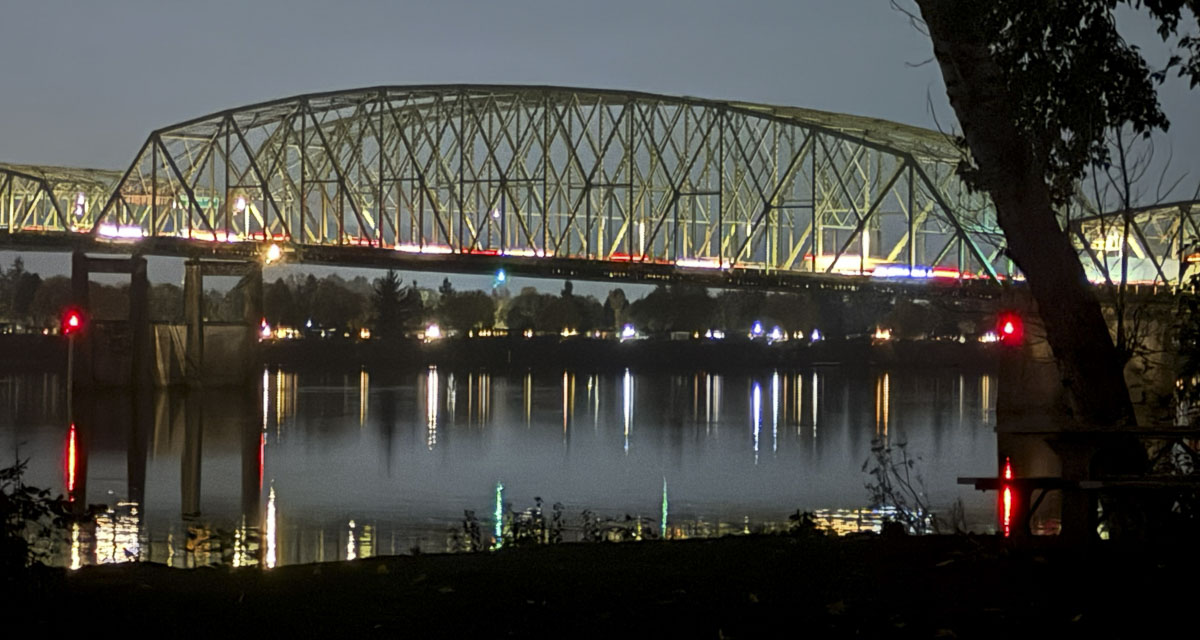
Transportation Architect Kevin Peterson offers what is needed and what can be done to salvage the scrutinized project
Kevin Peterson
for Clark County Today
The long-delayed replacement of the Interstate 5 bridges spanning the Columbia River is falling dramatically with respect to the very transportation goals it was meant to achieve, according to a detailed transportation analysis circulating among regional leaders and planners. I’ve spent my career designing transit and transportation systems around the globe and I offer this insight and perspective.
The critique argues that the current Interstate Bridge replacement project fails on three fundamental fronts — mobility capacity, urban integration, and effective transit investment. I believe there is a clear alternative blueprint that would better serve both Portland and Vancouver for decades to come.
Mobility capacity: Three interstate lanes needed — plus local lanes
Early origin-and-destination studies from the 2000s concluded that the I-5 crossing will eventually carry three to five interstate lanes in each direction serving regional needs. Portland’s long-standing desire to limit interstate traffic through its core suggests three lanes is the political reality.
Yet the current proposal gives token recognition for the two or three lanes needed to interconnect the dense localized urban fabric that is Vancouver and North Portland. This token recognition is a single lane merging local movements into the interstate freeway. This will not work.
Transportation 101 tells planners to consider interstate and local needs, creating a solution that serves both. In the urban context where five interchanges exist in three miles transportation 101 tells planners and engineers a collector distributor is the best solution.
In the failing Columbia River Crossing debate, we are plagued with Origination & Destination (O&D) studies now decades old. This is a huge flaw that should be addressed. Relying on outdated O&D data for this huge public investment suggests a misguided process.
Based on analysis of historic CRC data (2005-2008), traffic projections for the I-5 corridor indicate:
- 2030 Projections: The I-5 Bridge will need 5 to 6 lanes in each direction to handle approximately 180,000–184,000 daily vehicle movements.
- 2045–2060 Projections: By 2045, old O&D studies suggest a need for 7 to 8 lanes in each direction. By 2060, the corridor will require 9 lanes in each direction, totaling 18 lanes across the Columbia River to accommodate a projected 550,000 daily vehicle movements.
We now have a situation where old O&D studies may not make sense. Specifically, old O&D studies consider new corridors across the river. Updating O&D studies reflecting more recent population mobility trends are needed as the Portland metropolitan area is likely experiencing diminished growth expectations. Updating O&D understanding is a solid foundation in understanding how I-5 will serve the region for the remainder of this century, what new corridors should be planned, and provide insight on how mobility technology influences physical infrastructure needs.
Urban integration: A 1960s-style freeway is no longer acceptable
With five interchanges crammed into just three miles, the project corridor is textbook urban freeway territory. Nationwide, engineering standards call for a collector-distributor (C-D) system whenever interchanges are spaced less than a mile apart. The IBR proposal has no C-D.
A properly designed C-D roadway could function as an urban arterial, dramatically reducing the freeway’s footprint and reclaiming eight to ten city blocks of land compared with the current proposal. Repurposing existing I-5 Bridge structures to function as a C-D is a logical alternative that can mitigate negative urban impacts of a freeway. A 40mph arterial serving mobility needs in the North Portland, Hayden Island, and downtown Vancouver is much more respectful than forcing these local movements onto an undersized freeway. Why is a progressive urban region willing to accept an intrusive 1960s-era freeway when modern design can make it far less damaging to neighborhoods? This question should be addressed by planners and civic leaders. The sheer scale of this project should be an incentive to improve livability, not degrade it.
With a straight express freeway and adaptive reuse of the two bridges serving local mobility the footprint of I-5 can be less than I-5 now occupies.
Transit: $2 billion LRT plan delivers less than four buses
The project’s centerpiece — a $2 billion light-rail extension into Clark County — is often described as “an expensive solution offering little betterment.”
Operating in mixed traffic with two-car trains, the Yellow Line is an urban tram. With six trains an hour the Yellow Line might serve 400–600 peak-hour Clark County passengers providing that all existing Yellow Line riders stand for up to an hour at speeds of just 12–15 mph. This is an undesirable human experience suggesting 200–300 Clark County passengers per hour is a more likely outcome for the two-billion-dollar investment. This is a two billion investment that serves what four ordinary buses can accomplish, an alternative where all passengers are seated for a much faster journey.
Transit needs to increase viability. A 10 percent transit mode share across the Columbia (up from today’s roughly 3 percent) is a reasonable goal that results in 3,500–4,000 transit users per hour across the river. That goal is easily met by four-car trains running every 6–10 minutes. The problem is 200’ city blocks in downtown Portland, the Steel Bridge bottleneck, and mixed traffic operations preclude use of appropriate rail transit technology. To correct these impediments will require many decades and many tens of billions of dollars.
Now is the time to attract transit users so the ten percent mode share is possible. Bus Rapid Transit (BRT), building on the existing VINE express-bus foundation, is sensible. Ironically, regional transit planners have already quietly begun shifting towards express-bus operations for the I-5 corridor, signaling that they recognize LRT limitations.
My conclusion is LRT will (1) strip away transit funds that should be redirected to BRT in the I-5 corridor and (2) will not increase transit use to meet more than ½ to 1% of cross river mobility. For a comparable investment, BRT can grow transit to serve 6% to 10% of cross river trips. This investment can be made incrementally and integrated into an even more effective transit program for Clark County.
A smarter path forward
A practical four-step alternative is:
1. Take full advantage of the 116-foot navigation clearance to consider a new straight I-5 express bridge or tunnel upriver of the two existing freeway bridges. This would move freeway noise farther from urban centers and slash construction costs.
2. Immediately launch a comprehensive Type, Size & Location (TS&L) study comparing immersed-tunnel and bridge options, six-lane configurations (three interstate + three local C-D lanes), and a side-by-side cost-benefit analysis of BRT versus LRT — comparisons prioritizing urban integration and maximum transit utilization.
3. Fully evaluate TS&L alternatives with meaningful public understanding and involvement. Transparency, not propaganda or status quo perpetuation, is very important for informed public understanding.
4. Make an informed decision based on facts rather than sunk-cost status quo momentum.
Ironically, a solution is straightforward: keep the existing bridges as local connectors, limit the new I-5 crossing to a three-lane express bridge or tunnel, redirect transit dollars into proven high-capacity BRT, and design the entire corridor to enhance — rather than damage — the urban fabric on both sides of the river. These are not radical ideas!
Kevin Peterson has 40 years of experience as a transportation architect and planner. He is a specialist in conceptual and preliminary design of urban, transportation, and infrastructure improvements. He is continuously involved in planning and design workshops, urban studies and design efforts where his expertise, technical skill and graphic talents translate ideas into viable action. Kevin’s experience ranges from planning new cities to small, unusual transit improvements. He has contributed to hundreds of urban planning efforts, hundreds of built environment designs and over a thousand transportation/transit efforts ranging from mass transit systems to aesthetic treatment of highway improvements. Kevin has worked in Asia, Europe and North and South America.
Also read:
- Opinion: Half the road, full stop – Understanding pedestrian right-of-way
 Doug Dahl explains how Washington’s law requires drivers to stop when a pedestrian is within one lane of their half of the road, not just when directly in front.
 - Opinion: What is the cost of a bridge?
 John Ley argues the I-5 Bridge replacement’s soaring cost stems from costly extras like light rail, noting other states deliver larger, toll-free bridges for much less.
 - Letter: Vancouver Mayor Anne McEnerny-Ogle makes several serious and incorrect engineering statements
 Bob Ortblad critiques engineering claims by Vancouver Mayor Anne McEnerny-Ogle, highlighting cost and safety advantages of an immersed tunnel for the I-5 crossing.
 - Washington’s studded tire deadline is March 31
 Drivers must remove studded tires by March 31 or face a $137 fine, with WSDOT urging early action due to busy service centers and no planned deadline extension.
 - VIDEO: WA diesel hits record $6.53, crushing truckers and school budgets
 With diesel nearing $6.53 per gallon in Washington, trucking businesses and school districts now confront sharply higher fuel expenses affecting budgets and workers.
 wpDiscuz
