



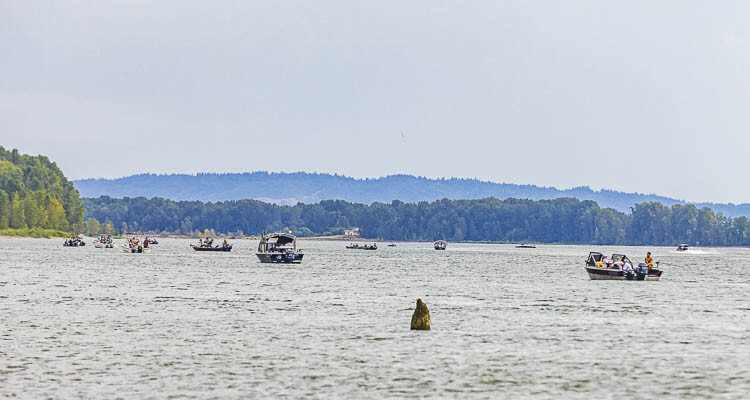
Todd Myers offers an assessment on the governor’s record on decisions and actions impacting salmon populations across Washington state
Todd Myers
Washington Policy Center

Over the last decade, salmon populations across Washington state have stagnated, making virtually no progress toward recovery. That news has not reached Governor Inslee’s spokesman Mike Faulk, who recently pointed to salmon recovery as an area of success.
Responding to questions about Governor Inslee’s record from KING 5 TV reporter Susannah Frame, the governor’s spokesman Mike Faulk offered several excuses. He complained that Frame’s “focus is on a small piece of the policy pie, not the governor’s whole strategy.” Instead, one of the things Faulk said people should look at is the governor’s record on “salmon restoration,” which he insinuated is going well.
This is completely inaccurate. Let’s look at the record.
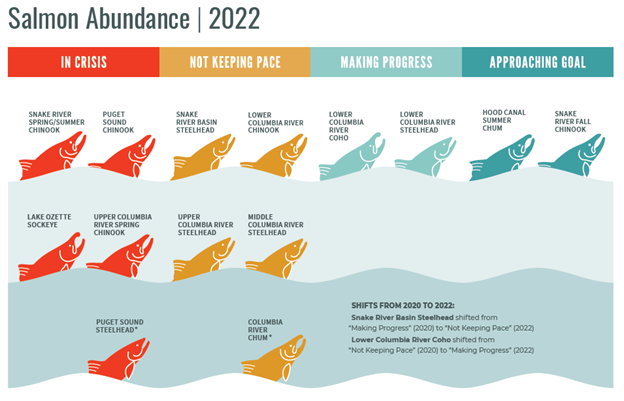
Start with the assessment of the Governor’s Salmon Recovery Office (GSRO). The GSRO tracks progress on salmon recovery with the “State of Salmon in Watersheds” report. the executive summary from the 2022 report notes, “Salmon continue to struggle in Washington. No salmon species have been removed from the federal Endangered Species Act list in Washington and most of the species on the list are in crisis or not keeping pace with recovery goals.” This assessment is notably worse than in 2012 when the GSRO report noted, “In most areas of the state, fish are increasing or staying the same while in a few areas, fish are slightly decreasing.”
NOAA Fisheries, which monitors the status of threatened species, notes that over the past decade, most salmon populations in Puget Sound are getting worse. The most recent assessment, covering the 15-year period between 2004-19 found that “trends were negative” for 16 of the 22 Puget Sound salmon populations. NOAA scientists wrote, “there is a general decline in natural-origin spawner abundance across all [major population groups] in the most-recent fifteen years.”
The Puget Sound Partnership also missed its 2020 targets for recovering Chinook salmon. The goal to “start seeing improvements in wild Chinook abundance in 2-4 populations in each biogeographic region” was missed. The Partnership’s assessment found that, “Improvements, measured in terms of population abundance increases, were very small and the 25-75th CIs overlapped zero, suggesting no change in any populations’ abundance.” No change.
Salmon populations simply aren’t recovering in Washington state. Claiming that salmon restoration is a success is baseless and contrary to the data from the governor’s own agencies.
Earlier this year we identified four actions that will help get salmon recovery back on track in the state. But step one in every recovery process is “admit you have a problem.” Governor Inslee and his spokesman continue to be in denial about their failures and the price is being paid by salmon and the orca, tribes, and the sport and commercial fishers who rely on abundant salmon populations.
Todd Myers is the director of the Center for the Environment at the Washington Policy Center.

Also read:
- Opinion: Stalin would be proud – Clark County Socialists gathered for ‘No Kings’
 Reform Clark County’s Rob Anderson criticizes local and national groups for organizing protests that featured Auditor Greg Kimsey as a keynote, raising concerns about public trust and political partisanship.
 - Letter: Vancouver Mayor Anne McEnerny-Ogle makes several serious and incorrect engineering statements
 Bob Ortblad critiques engineering claims by Vancouver Mayor Anne McEnerny-Ogle, highlighting cost and safety advantages of an immersed tunnel for the I-5 crossing.
 - Opinion: The beginning of the end of anchor babies
 Lars Larson argues the Constitution excludes children born to non-legal residents, as the Supreme Court debates birthright citizenship and public opinion data shows limited support.
 - Opinion: Defend bail now or face more chaos on our streets
 A proposed Washington court rule would cap bail for most misdemeanors and allow defendants to bypass bondsmen, raising concerns about accountability and public safety.
 - Opinion: Some worker rights get a poster, others get fine print
 Elizabeth New questions why Washington state highlights some workplace protections while Janus First Amendment rights for public employees remain hidden in official materials.
